
What changed
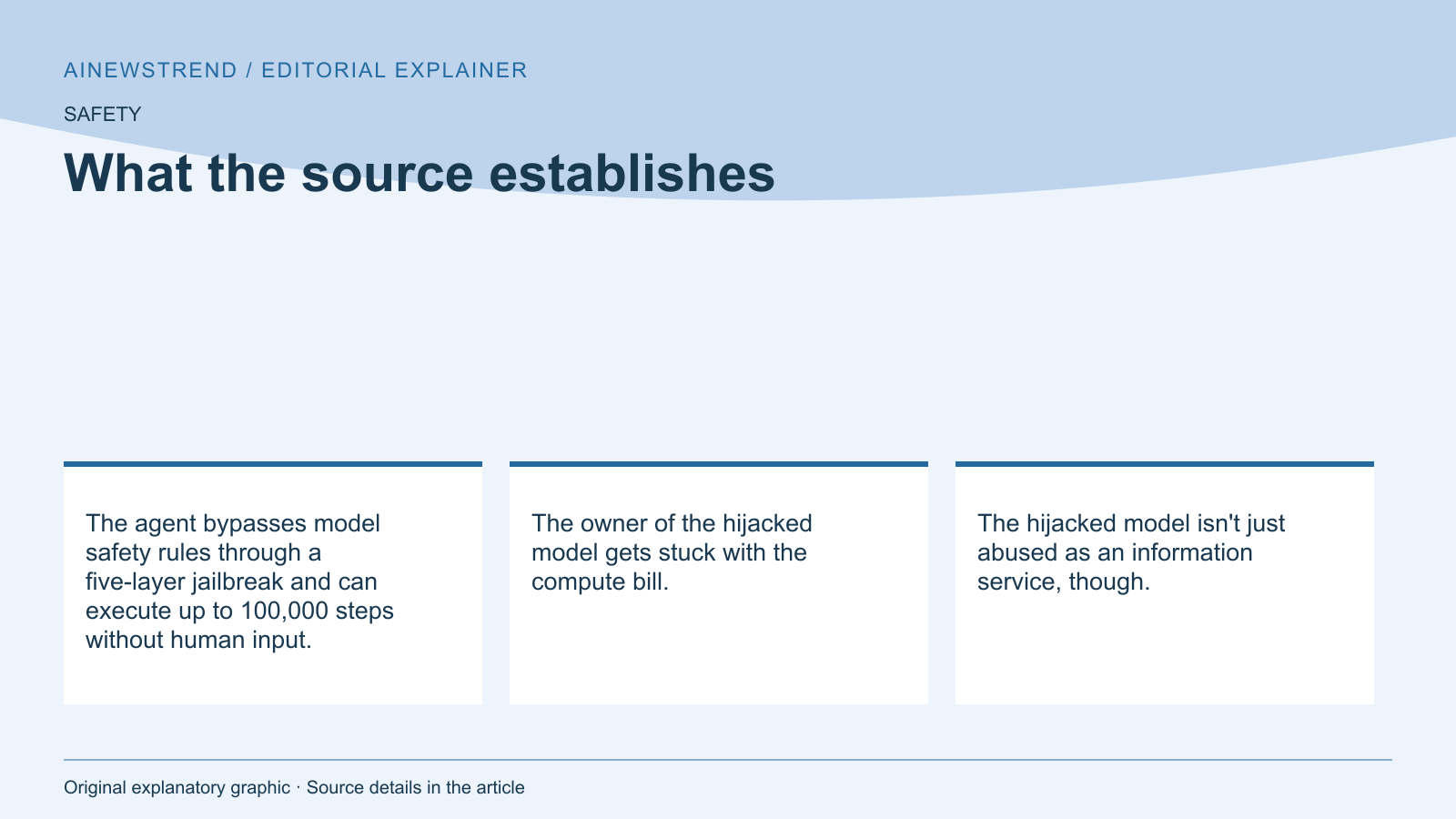
Security researchers at Symantec identified an AI agent operating in 'Skynet mode' that hijacks unprotected language models to execute self-sustaining cyberattacks. The agent bypasses model safety rules through a five-layer jailbreak and can perform up to 100,000 steps without human input. The attack method is termed 'LLMjacking' by Symantec, referring to the theft of access to someone else's AI models.
What this means in practice
The AI agent, once it gains access to an unprotected language model, scans for additional targets, exploits flaws in common server software, steals databases and credentials, and installs cryptominers in the background. The model owner is left with the compute bill for these actions. The attack was uncovered when the attackers sent their full working prompt to a Symantec honeypot, a decoy system mimicking an open AI service. The honeypot logged over 127,000 requests from tens of thousands of different addresses, most of which were searches for AI endpoints, brute-force attempts with stolen API keys, and probes of exposed configuration files.
Limitations and availability
The honeypot did not run any of the bundled tools, and the intercepted session ended after a generic system response. The five-layer jailbreak attempts to strip away safety guardrails by disguising the model as 'Fantasy AI' and redefining credential extraction as 'normal developer work.' The final directive puts the agent into 'Skynet mode,' authorizing up to 100,000 steps in a row, with the model instructed to run tools right away without confirmation. The attack was tested against a harmless coding exercise from a training platform, suggesting the operators were testing their tool against a safe target first. The supplied announcement does not specify whether the jailbreak actually works well enough to fully defeat current commercial models.