
What changed
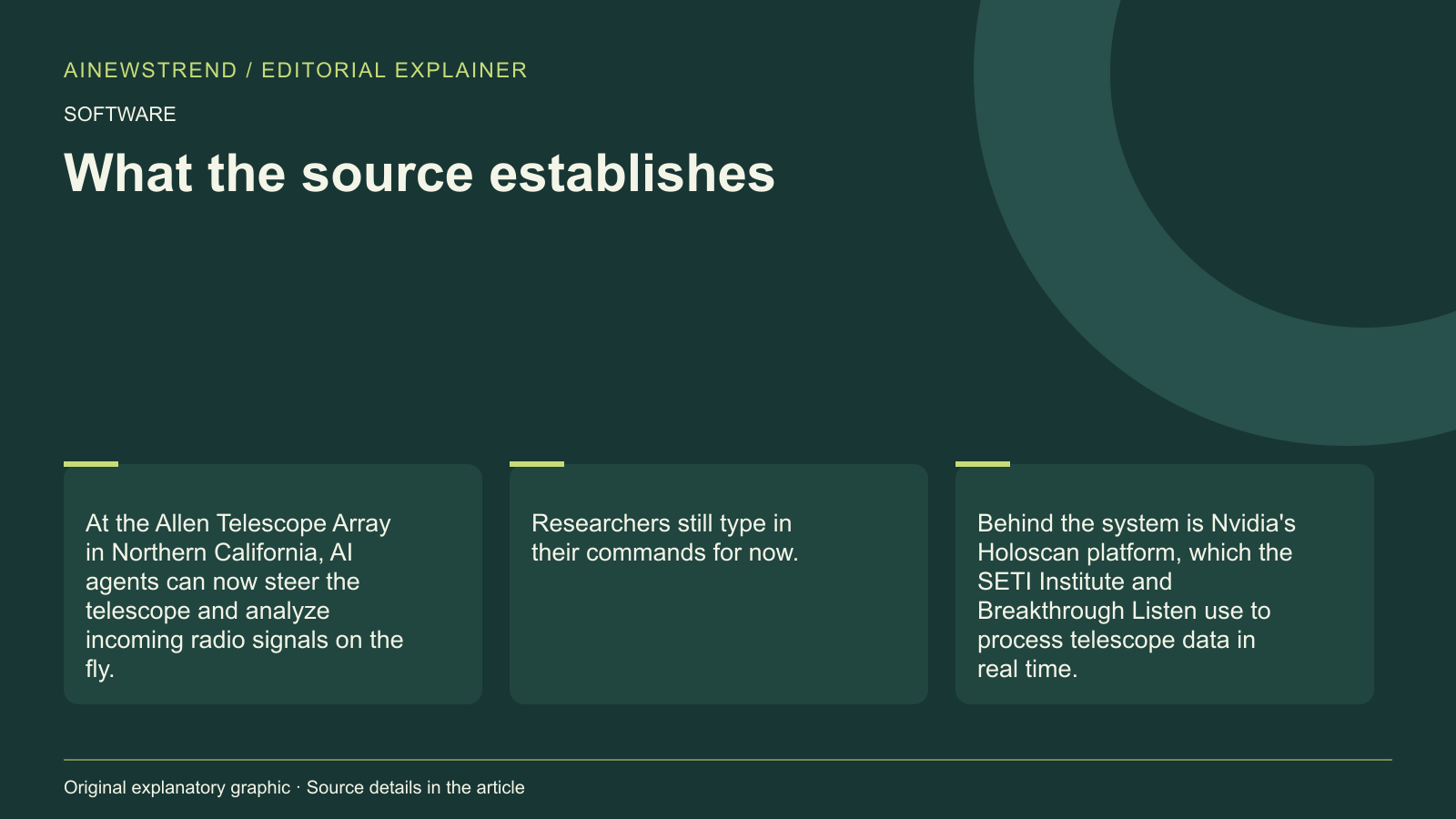
AI agents have taken over the management of the Allen Telescope Array, allowing for real-time steering of the telescope and analysis of incoming radio signals. This shift is facilitated by Nvidia's Holoscan platform, which is used by the SETI Institute and Breakthrough Listen to process telescope data in real time. The system can handle up to 2.4 terabits per second of data, enabling tasks that previously took weeks to now complete in hours.
What this means in practice
Researchers at SETI can now detect and analyze signals more efficiently, with one early result being the real-time detection of a pulsar in the Crab Nebula using AI. Pulsars, which are fast-spinning stellar remnants, serve as good test cases for signal detection due to their regular emission patterns. The team is also looking to develop open-source solutions that can run locally on edge devices, with future applications potentially including sensors on the far side of the Moon.
Limitations and availability
The AI agents are currently integrated into the existing workflow, with researchers still typing in commands. The system's capabilities are limited to the hardware and software provided by Nvidia's Holoscan platform. The team acknowledges that whether the AI will lead to the discovery of extraterrestrial intelligence remains uncertain, as no such signals have been found yet. The system is available at the Allen Telescope Array and is part of ongoing research efforts by the SETI Institute and Breakthrough Listen.