
What changed
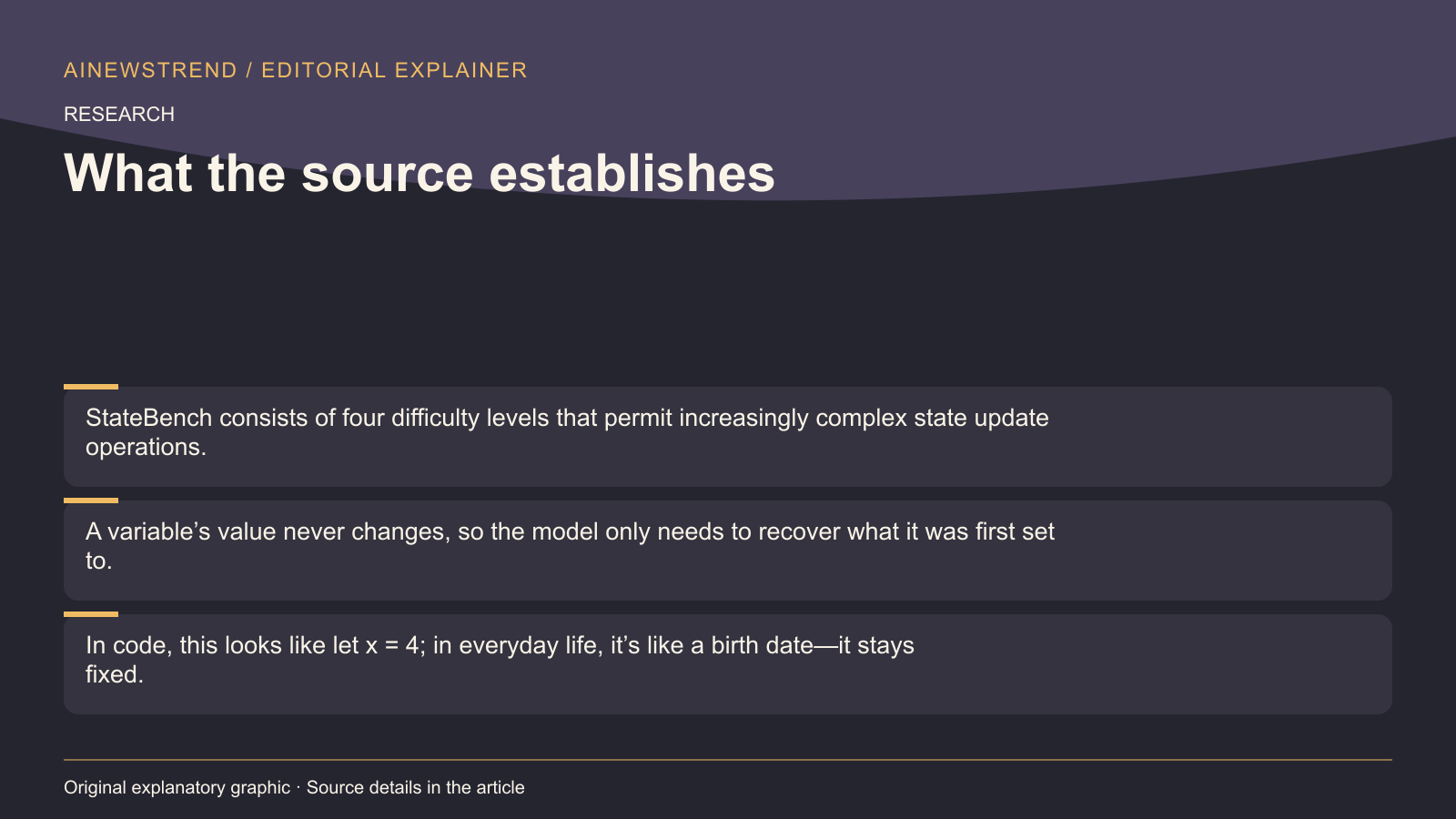
AllenAI introduced StateBench, a benchmark designed to evaluate how well language models track information about entities in long documents as they evolve. The benchmark includes four difficulty levels representing increasing complexity in state-tracking tasks, from immutable assignments to reference-based updates.
What this means in practice
StateBench was used to evaluate differences between language models with varying architectures. The benchmark revealed that recurrent and hybrid models, such as Gated DeltaNet, can generalize much farther than transformers when trained directly on these tasks. Frontier models like Gemini 3.8 Flash, Claude Opus 5.5, and GPT-6 Sol and Luna still struggle with harder forms of state tracking as inputs grow longer. The benchmark tests the same underlying problem in multiple formats to assess how different architectures perform under varying conditions.
Limitations and availability
The supplied announcement does not specify the exact release date or availability of StateBench for public use. It also does not mention any licensing conditions or download requirements. The benchmark focuses on evaluating state-tracking capabilities rather than providing a tool for developers. The results highlight theoretical distinctions in state tracking rooted in Krohn–Rhodes theory, which describes how state-tracking problems can be decomposed into atomic primitives. The benchmark is intended for researchers to understand the differences between architectures on various levels of state tracking complexity.