
What changed
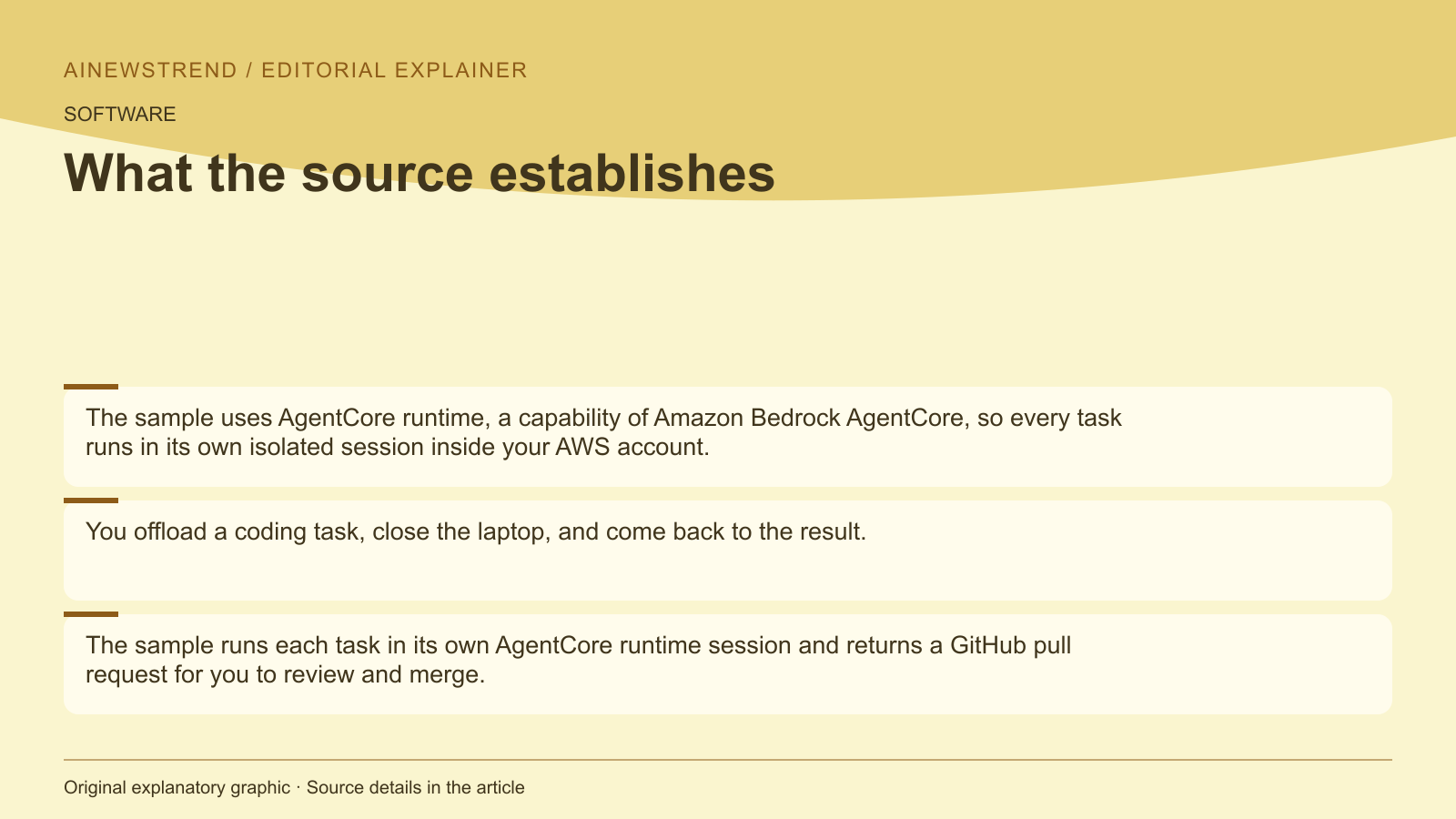
AWS has introduced a new capability that allows users to run Claude Code as a remote agent on Amazon Bedrock AgentCore. This extension enables tasks to be executed in isolated sessions within an AWS account, with the results returned as a GitHub pull request for review and merging. The solution leverages Amazon Bedrock's security controls and integrates with existing AWS infrastructure to maintain data protection and compliance.
What this means in practice
The remote agent architecture allows teams to offload coding tasks, close their laptops, and return to results without needing to keep their local environment active. Each task runs in its own AgentCore runtime session, which is a dedicated microVM with isolated CPU, memory, and filesystem. The session runs within a VPC with private endpoints to Amazon Bedrock and other AWS services, ensuring secure communication.
The workflow involves submitting a task through a local Model Context Protocol (MCP) server or a web console, which then queues the task for processing.
An AWS Lambda function screens the task prompt with Amazon Bedrock Guardrails, and the task is executed in an isolated environment. The agent clones the repository, plans the change with Claude Opus, codes with Claude Sonnet, and verifies the results.
The final output is a GitHub pull request that can be reviewed and merged by a teammate.
Limitations and availability
The solution is designed for tasks that are scoped, such as bug fixes and tests on trusted repositories. It is not suitable for untrusted code or open-ended work, as the agent can only make up to three attempts. The sample implementation, sample-remote-coding-agent, is available for use, and the workflow is supported by Amazon Bedrock's security characteristics, including data protection, access controls, and zero data retention options. The supplied announcement does not specify exact performance benchmarks or cost details for the remote agent solution.