What changed
AWS has announced the launch of a serverless Model Context Protocol (MCP) server on Amazon Elastic Container Service (Amazon ECS) with AWS Fargate. This server acts as a centralized gateway for AI agents to access enterprise data lakes, eliminating the need for custom integration code for each dataset.
What this means in practice
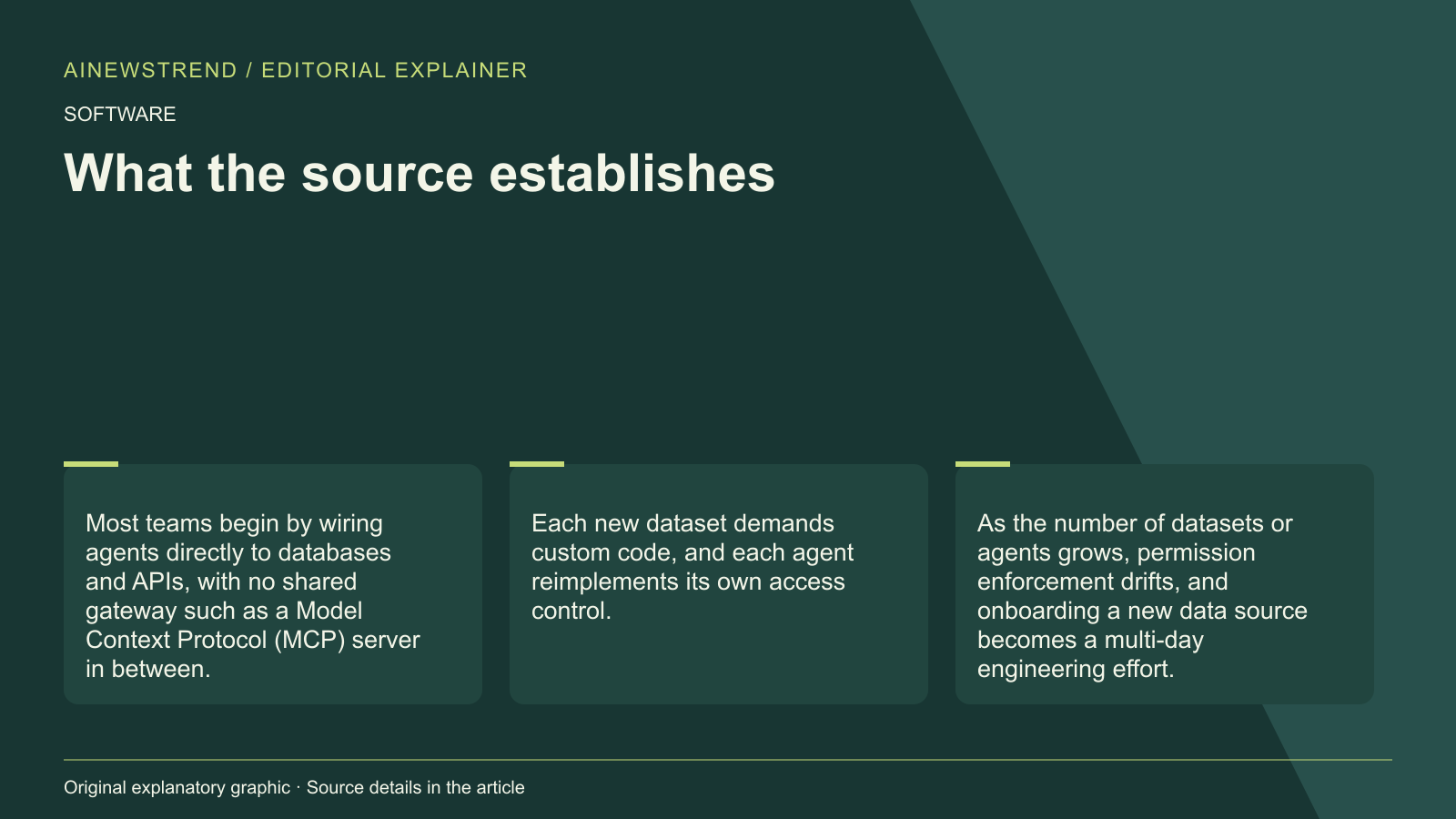
The MCP server enables organizations to grant AI agents access to data lakes without duplicating integration logic across multiple agents and applications. By using a metadata-driven approach, adding a new dataset requires only a JSON metadata file, which the server automatically discovers during the next pipeline sync. This reduces the onboarding time for new datasets and simplifies permission enforcement across multiple agents and applications in a multi-tenant environment.
Limitations and availability
The server is currently being used by AWS's North America Sort Center (NASC) network to support planning teams that rely on operational data for capacity, labor, and package flow management. The solution is built on Amazon ECS Fargate and leverages Amazon Bedrock for AI agent orchestration. The architecture includes four layers—client, MCP server, tools, and knowledge-base refresh—each independently scalable and deployable. The MCP server layer runs on its own ECS Fargate cluster, isolated from the client layer, with conversation state persisted in Amazon DynamoDB. The system is designed to scale with bursty AI workload patterns, and the metadata catalog is kept current through the knowledge-base refresh layer, indexing new dataset metadata as it arrives.