
What changed
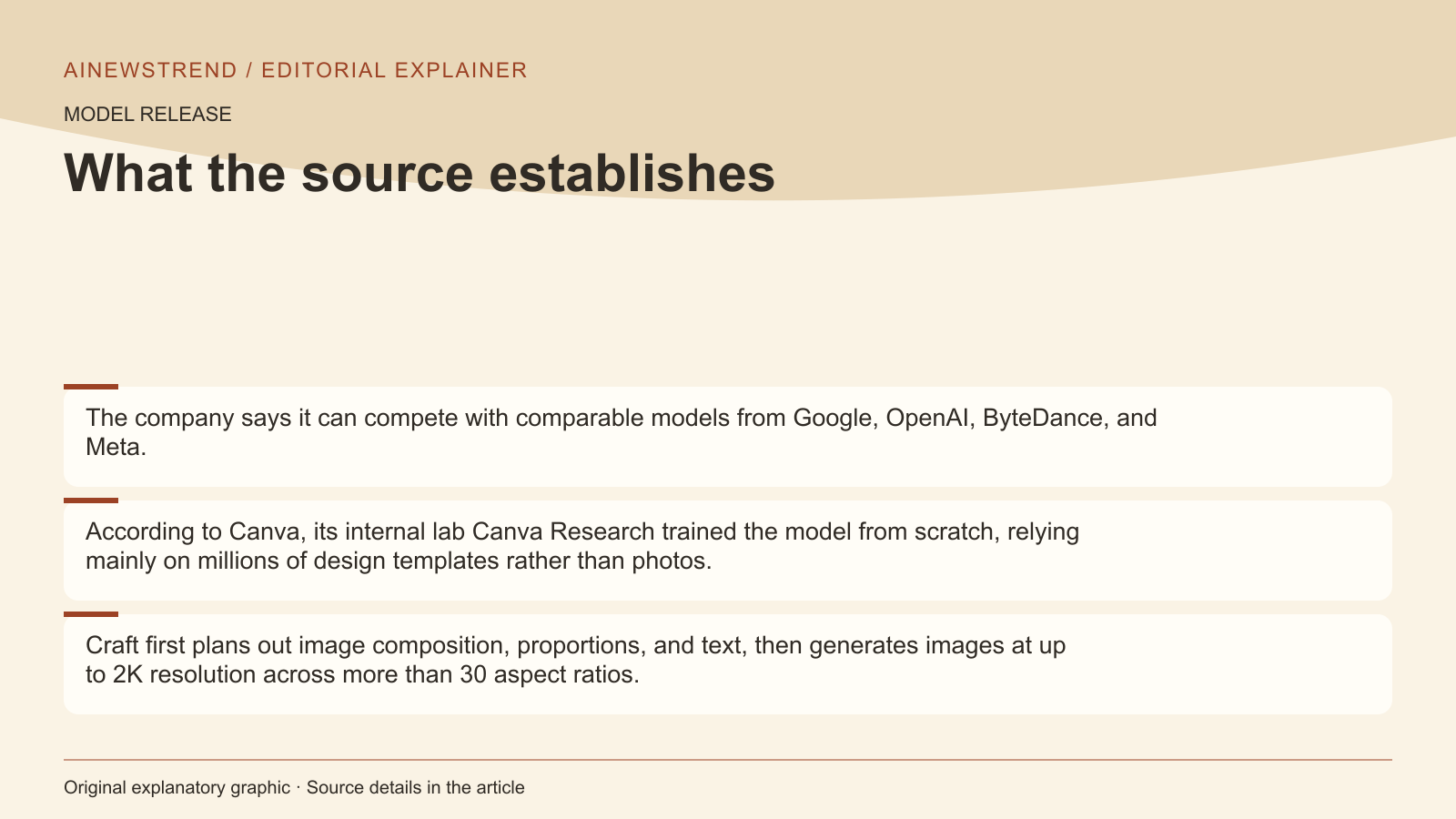
Canva has released Canva Craft, its first in-house image generation model. The company claims it can compete with comparable models from Google, OpenAI, ByteDance, and Meta. According to Canva, its internal lab Canva Research trained the model from scratch, relying mainly on millions of design templates rather than photos. Craft first plans out image composition, proportions, and text, then generates images at up to 2K resolution across more than 30 aspect ratios. The model can render text in 55 languages, Canva says. Users can break results into editable layers using Magic Layers. On the DesignArena platform's ranking, Craft placed fourth overall and first in portraits and landscapes, according to Canva. Craft is available to all users through Dream Lab and the public API, with MCP integration for chatbots like ChatGPT and Gemini planned for later.
What this means in practice
The in-house model gives Canva more control over quality and speed, according to the company. Researchers from Leonardo.ai, which Canva acquired in 2024, also contributed to the project. Two cheaper variants called Craft-fast and Craft-ultrafast are expected soon. The model's ability to render text in 55 languages and support over 30 aspect ratios suggests it is designed for a wide range of design tasks. Users can access Craft through Dream Lab and the public API, indicating broad availability for both individual and enterprise users.
Limitations and availability
The supplied announcement does not specify the total or active parameter counts of the model. Craft is available to all users through Dream Lab and the public API, with MCP integration for chatbots like ChatGPT and Gemini planned for later. The model's performance on the DesignArena platform's ranking is reported by Canva, but independent testing is not mentioned. The release of cheaper variants, Craft-fast and Craft-ultrafast, is expected soon but not yet available.