
What changed
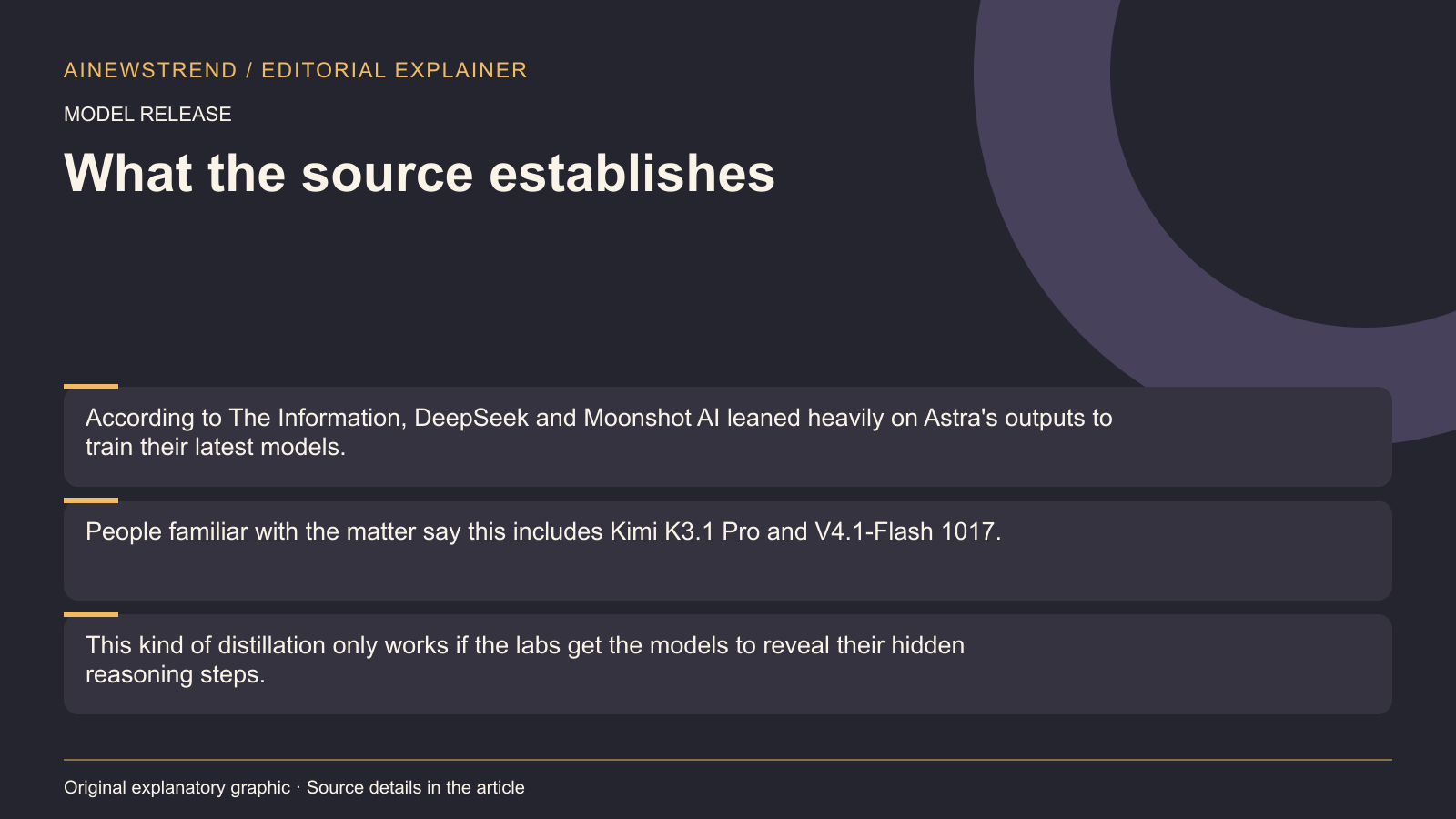
Chinese AI labs are now mainly tapping OpenAI's most powerful model, GPT-6 Astra, instead of Anthropic's Claude. According to The Information, DeepSeek and Moonshot AI leaned heavily on Astra's outputs to train their latest models, including Kimi K3.1 Pro and V4.1-Flash 1017. This kind of distillation only works if the labs get the models to reveal their hidden reasoning steps. OpenAI and Anthropic both ban that. Moonshot declined to comment, and Deep,Seek didn't respond to a request for comment.
What this means in practice
The shift indicates that Chinese AI labs are finding OpenAI's Astra more accessible for training purposes, despite the restrictions on revealing reasoning steps. Anthropic has tightened its defenses, claiming its new methods cut the amount of data attackers can pull by 90 to 99 percent. OpenAI reported a coordinated distillation campaign involving people linked to Moonshot, but attackers have adjusted their tactics each time new defenses were introduced.
Limitations and availability
The supplied announcement does not specify the exact methods Anthropic used to strengthen its defenses. It also does not detail the specific technical barriers preventing access to Claude's reasoning steps. The focus on Astra suggests that Chinese labs may have found ways to circumvent OpenAI's restrictions, though the exact mechanisms remain unclear. The availability of Astra for training purposes is not explicitly stated, but its use by DeepSeek and Moonshot implies it is accessible for such purposes.