
What changed
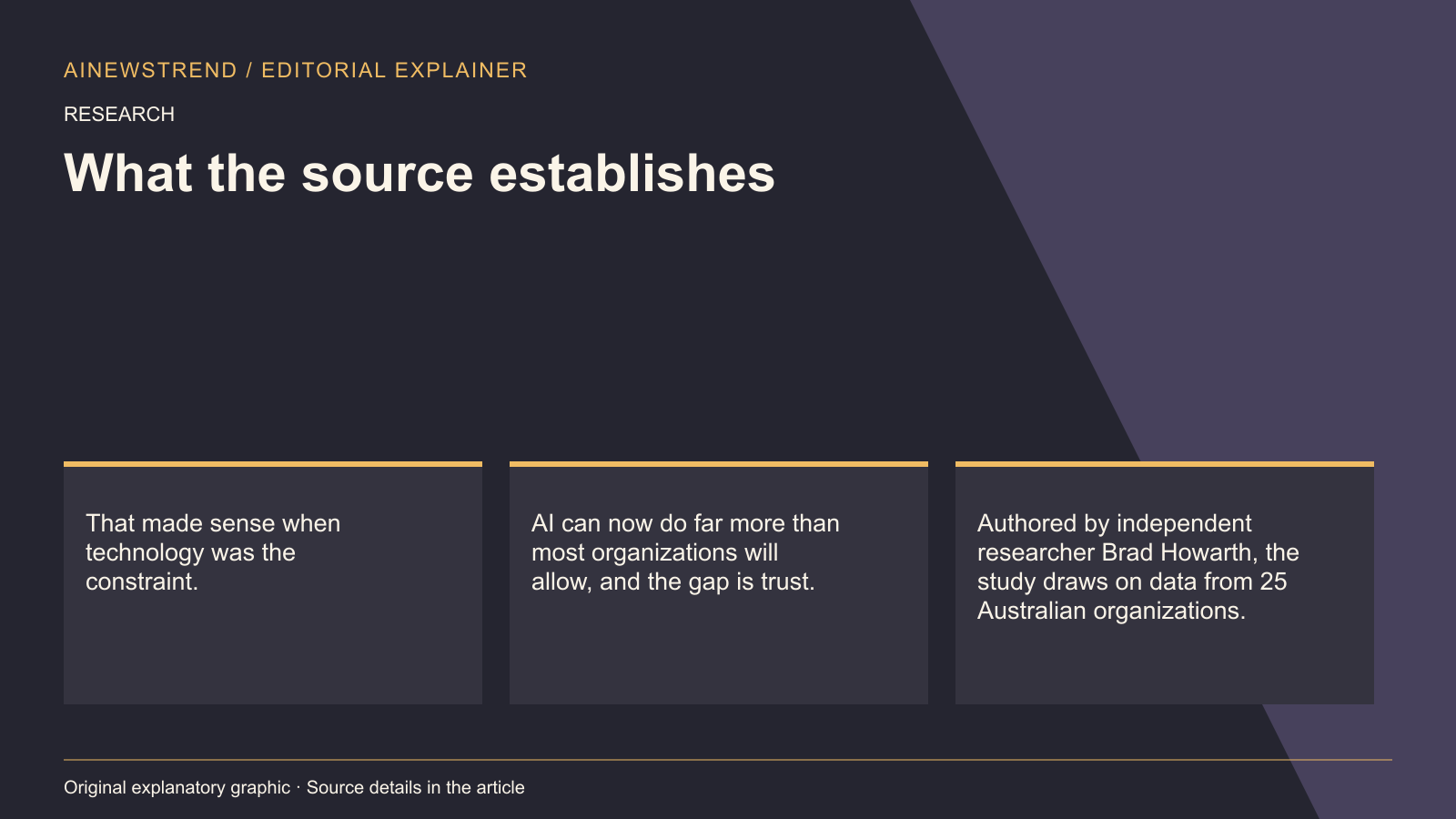
At Cisco Live APJC, Cisco Systems Inc. released new research titled "Permission to Scale: The Critical Role of Trust in Successful AI Adoption," authored by independent researcher Brad Howarth. The study, based on data from 25 Australian organizations, argues that trust—not technology—is now the primary constraint on enterprise AI adoption.
What this means in practice
The research highlights that while AI capabilities have advanced significantly, many organizations are hesitant to scale due to a lack of trust. Australia is presented as a unique test case, with only 30% of Australians believing AI’s benefits outweigh its risks, the lowest among 47 countries surveyed. Cisco’s report emphasizes the need for calibrated trust, where users understand when to rely on AI, when to verify its outputs, and when human judgment is essential.
The study also outlines a "flywheel" of adoption, where successful use builds evidence, which in turn builds trust, enabling broader AI deployment. However, trust must be measurable and realistic.
For example, many people reject AI after a single mistake, even though error rates are often lower than those of humans.
The report draws parallels to the automotive industry’s experience with Tesla’s Autopilot system, which has a crash rate of about one in 7 million miles, compared to human drivers’ average of one in 1 million miles.
Limitations and availability
The research is qualitative and based on a small sample size of 25 Australian organizations. While the findings align with conversations with corporate leaders, the report does not provide specific metrics or benchmarks for AI performance. Cisco’s report suggests that trust must be enforced at the network and security layers, with the company positioning its networking, security, and Splunk portfolio as potential trust layers for agentic AI. However, the report does not specify how or when these capabilities will be made available to customers.
The study also notes that many organizations lack consistent controls for AI agents and nonhuman identities, with only 36% of Australian organizations applying such controls.
Cisco’s 2026 Relentless Defense report highlights the need for "bounded autonomy," where AI agents can act on behalf of users but cannot exceed predefined boundaries.
The report provides a business rationale for Cisco’s strategy but does not detail implementation timelines or specific product releases.