
What changed
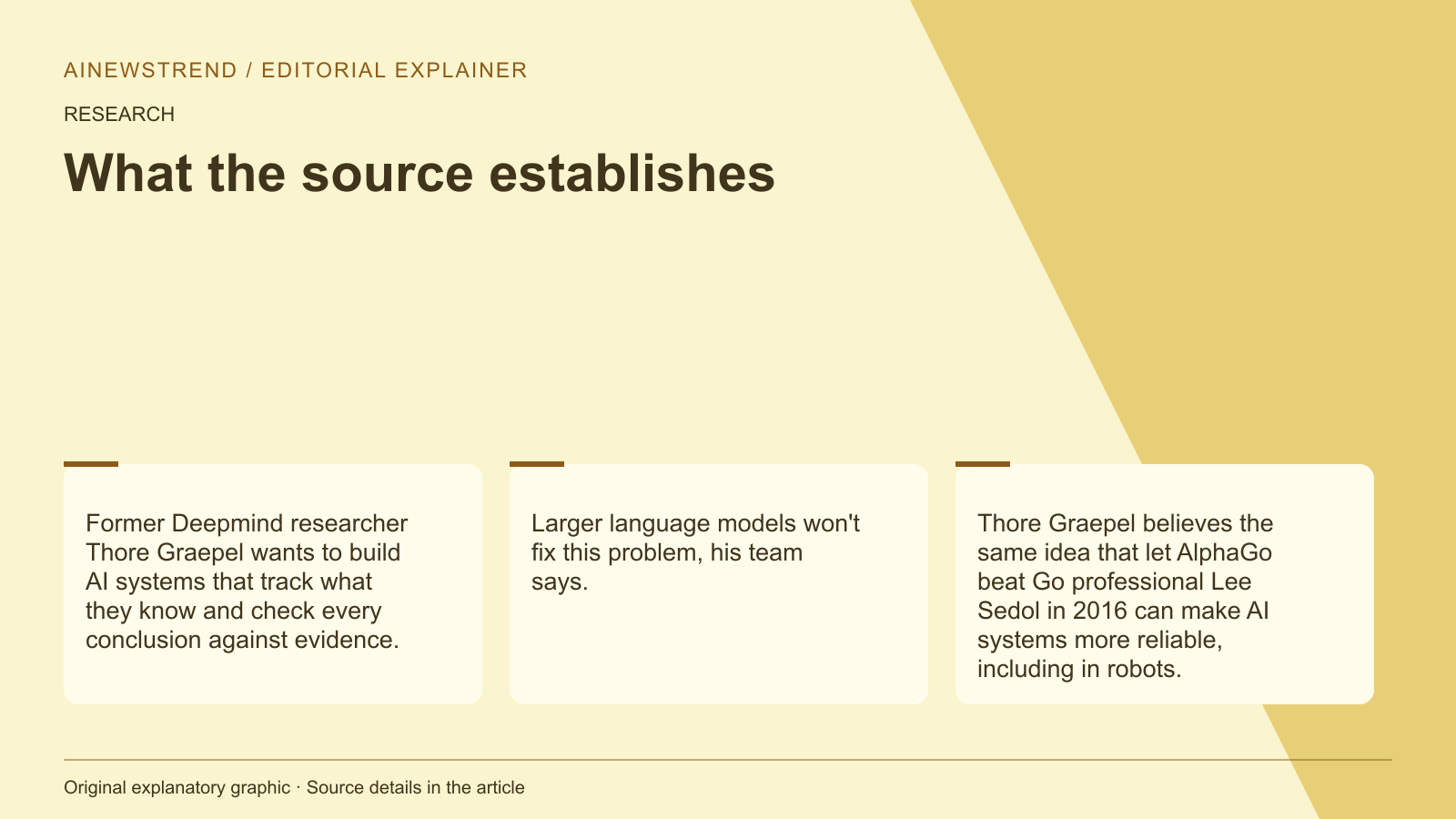
Former DeepMind researcher Thore Graepel, now leading Metis Reasoning, has proposed a method inspired by AlphaGo's approach to reduce AI hallucinations. The method separates knowledge from model weights and stores it in an external ledger, where an independent module checks every assumption against evidence. This approach aims to cut hallucinations and provide source-backed explanations, though it currently exists only as a theoretical framework with no working system.
What this means in practice
Metis Reasoning applies AlphaGo's building blocks to general reasoning, with an explicit knowledge state taking the role of the game board. The knowledge ledger records what is known, how confident the system is, and which questions remain open. A separate module checks new entries against calculations, formal proofs, or empirical evidence, and when an assumption falls away, every conclusion that depended on it gets re-evaluated. The system picks whichever 'move' reduces uncertainty about the original question the most, delivering either an answer or a justified abstention. The approach could also favor smaller models running on edge devices and in robots.
Limitations and availability
The white paper describes only a research program, with no working system, no benchmarks, and no comparisons with current reasoning models. The team acknowledges that the real world provides only partial information, evidence can be expensive to obtain, and some questions have no answer. The biggest open question is how a verified knowledge ledger would take shape in messy domains beyond textbook examples, given that symbolic AI systems once failed because all their knowledge had to be entered by hand. The supplied announcement does not specify the exact timeline for a working system or benchmarks.