
What changed
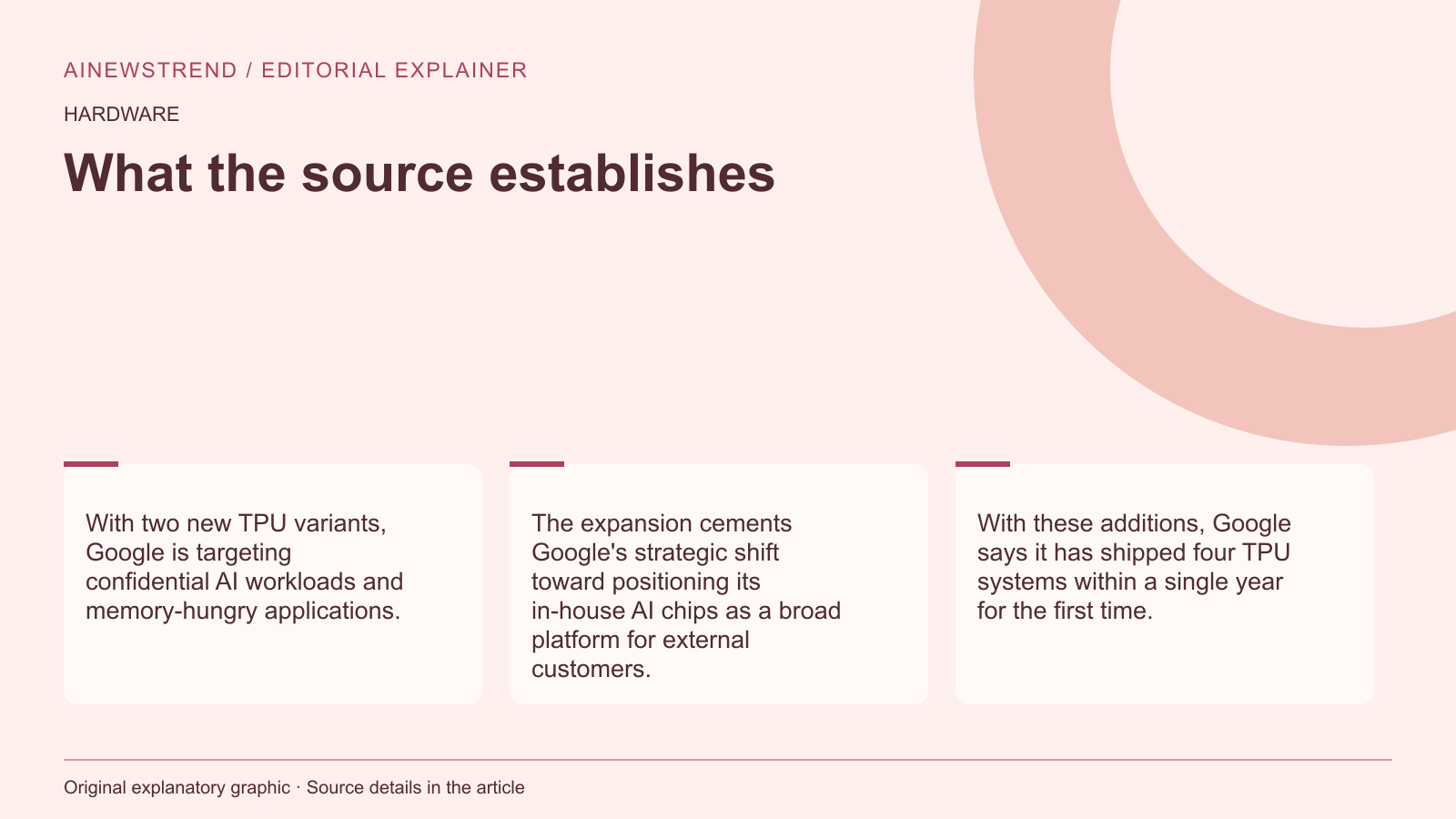
Google has added two new systems to its eighth-generation AI accelerator lineup: the TPU 8tx for confidential computing and the TPU 8i Max for memory-intensive workloads. With these additions, Google says it has shipped four TPU systems within a single year for the first time. Both new variants are built on existing silicon, with different packaging, networking, and memory setups around the same processor.
What this means in practice
The TPU 8tx keeps sensitive data encrypted during processing, targeting enterprises and government agencies working with confidential data. It uses the same low-latency Boardfly network as the TPU 8t and is designed to deliver up to twice the latency reduction. The TPU 8i Max doubles compute power and memory bandwidth in the same rack format by combining two TPU 8i chips on a single package, offering significantly more performance per square meter of data center space.
Limitations and availability
Google has released TorchTPU as open source to make TPUs easier to use, supporting PyTorch, vLLM, and SGLang. The company frames its modular approach as a design choice to deliver new hardware variants in months rather than years. The expansion reflects Google's strategic shift toward marketing its in-house AI chips as a broad platform for external customers, with nearly 100 external TPU customers now using the technology.