
What changed
IBM announced significant technical progress toward its IBM Quantum Starling project, which aims to deliver the world’s first fault-tolerant quantum computer by 2029. Starling will be capable of running quantum circuits with 100 million operations on 200 qubits. The framework for Starling was detailed in a 2025 paper, which introduced a modular approach to implementing bivariate bicycle quantum low-density parity check (qLDPC) error correction codes.
What this means in practice
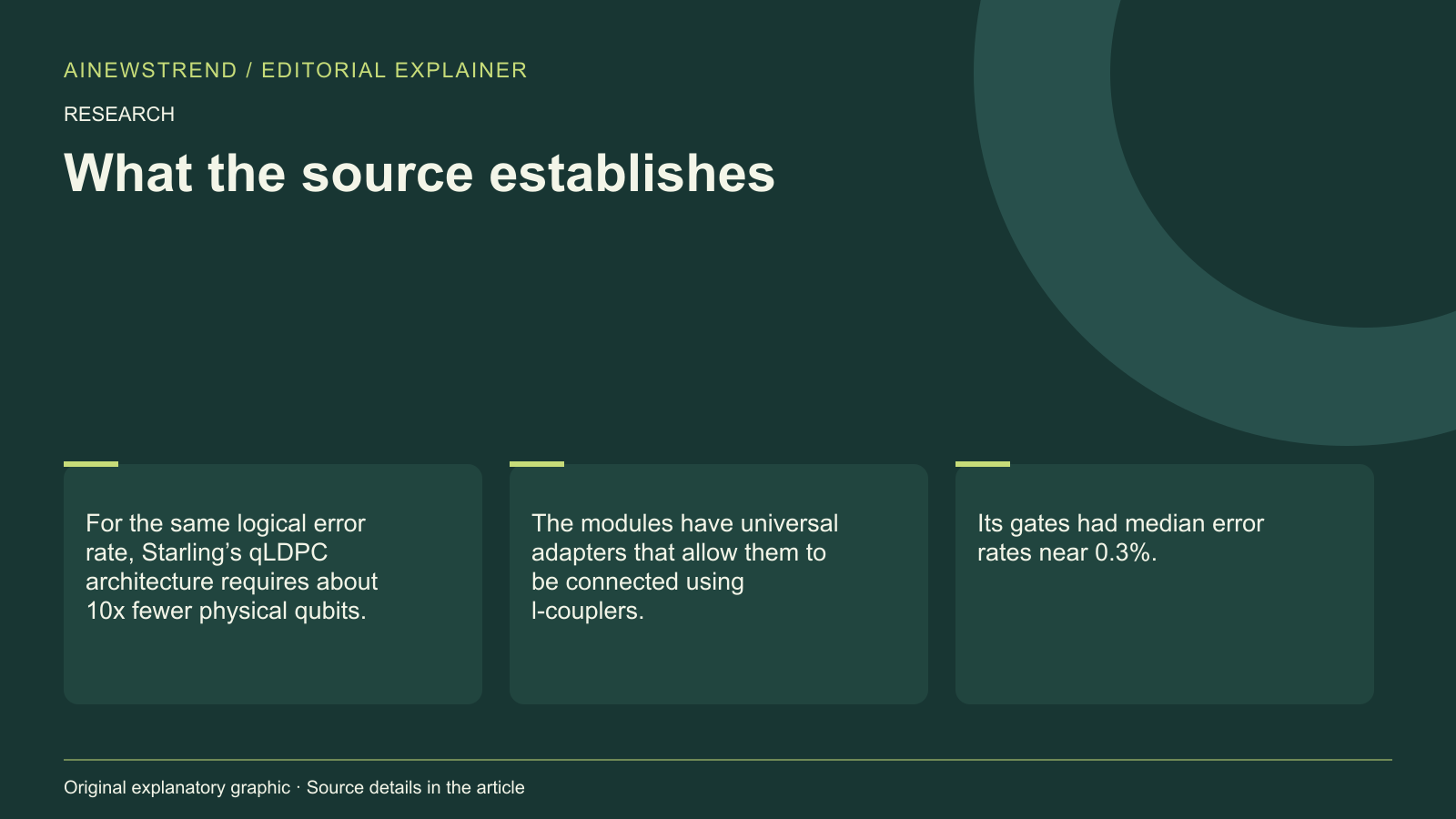
The modular architecture described in the paper reduces resource requirements by an order of magnitude compared to prior approaches. For the same logical error rate, Starling’s qLDPC architecture requires about 10x fewer physical qubits. This is achieved by assembling modules that each contain a quantum memory and logical processing unit (LPU), which allows logic operations on the memory. The modules are connected using l-couplers, and sophisticated cryogenic and control systems house and run the modules at ultra-cold temperatures.
Limitations and availability
The results from IBM Quantum Loon, a precursor to Starling, show qubit relaxation times (T1) of about 200us with reset time constants of 20ns–40ns. The ultimate aim for Starling is to achieve T1 in the millisecond range and gate errors in the low 0.01% range. The c-coupler layers have quality factors above 10 million, and the number of layers has increased from two to three, with plans to reach four or more. These advancements are part of a parallel effort to deliver Starling, with the modular designs and improved decoders contributing to the project’s progress.