
What changed
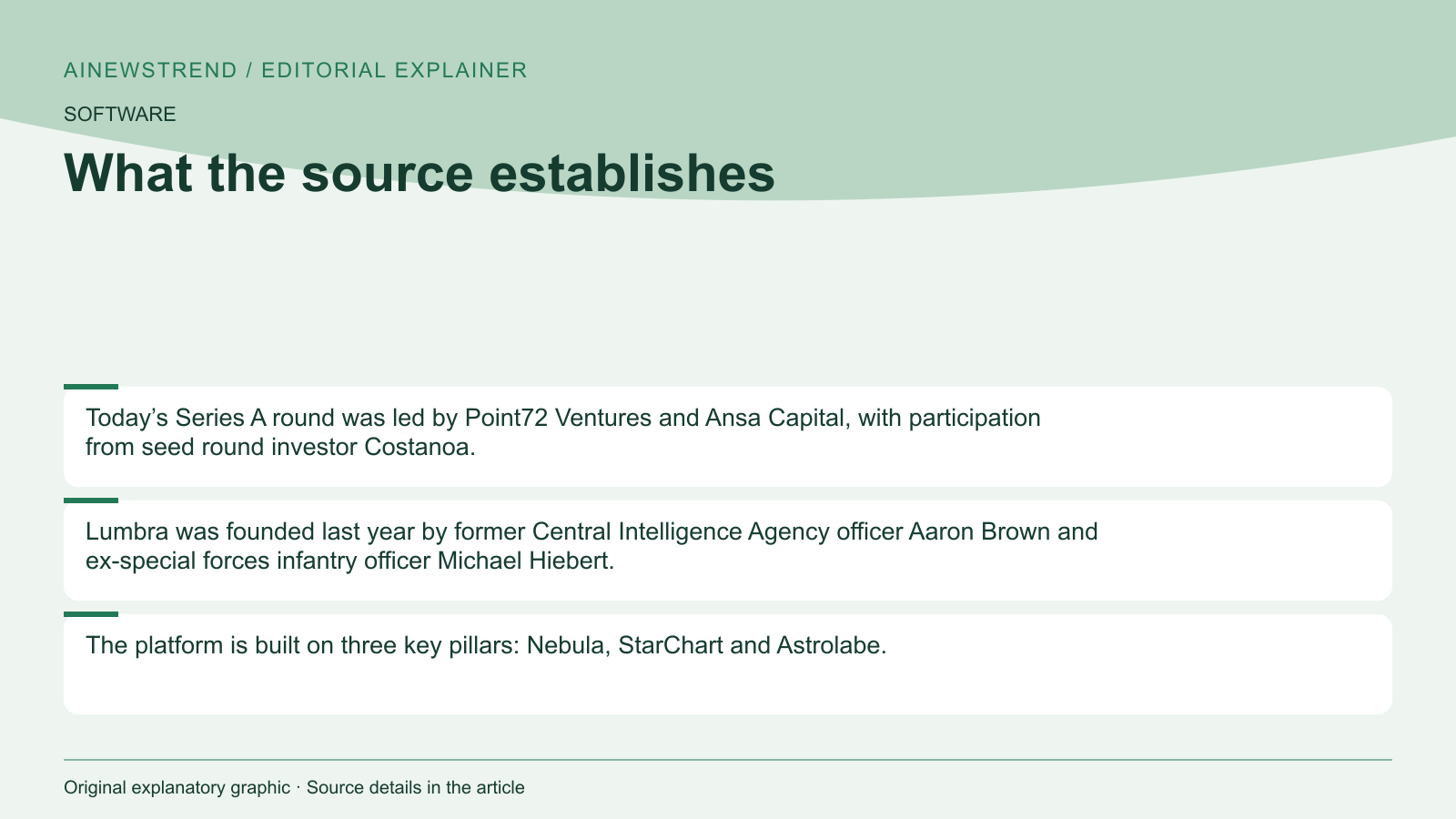
Lumbra Inc., an artificial intelligence startup, has raised $25 million in early-stage A funding to develop autonomous agents for handling sensitive data in high-consequence environments. The round was led by Point72 Ventures and Ansa Capital, with participation from seed round investor Costanoa.
What this means in practice
LumbraOS, the platform developed by Lumbra, is designed to orchestrate AI agents within ultra-secure computing environments. It allows operators to mix and match various AI models for different national security tasks. The platform is built on three key components: Nebula, StarChart, and Astrolabe. Nebula traces AI agent claims back to source data for validation, StarChart links insights across datasets with sensitivity tags, and Astrolabe enforces governance policies and monitors agent behavior.
Lumbra has already secured a multimillion-dollar contract with an unnamed U.S. intelligence agency, with AI agents operating on a top-secret defense network within six months. The Pentagon has also recognized Lumbra as one of two companies underpinning its Agent Network project.
Limitations and availability
LumbraOS is currently focused on classified computing environments, with plans to expand into high-stakes industries such as healthcare, finance, and law. The company aims to use the funds to grow its engineering and product development teams and accelerate go-to-market operations. The supplied announcement does not specify the exact number of active parameters or model sizes used in LumbraOS.
The company’s co-founders believe that LumbraOS can help organizations deploy AI agents safely across their networks to automate complex workloads. The platform’s traceable audit logs and strict governance controls are intended to make agents controllable, transparent, and reliable at scale.