
What changed
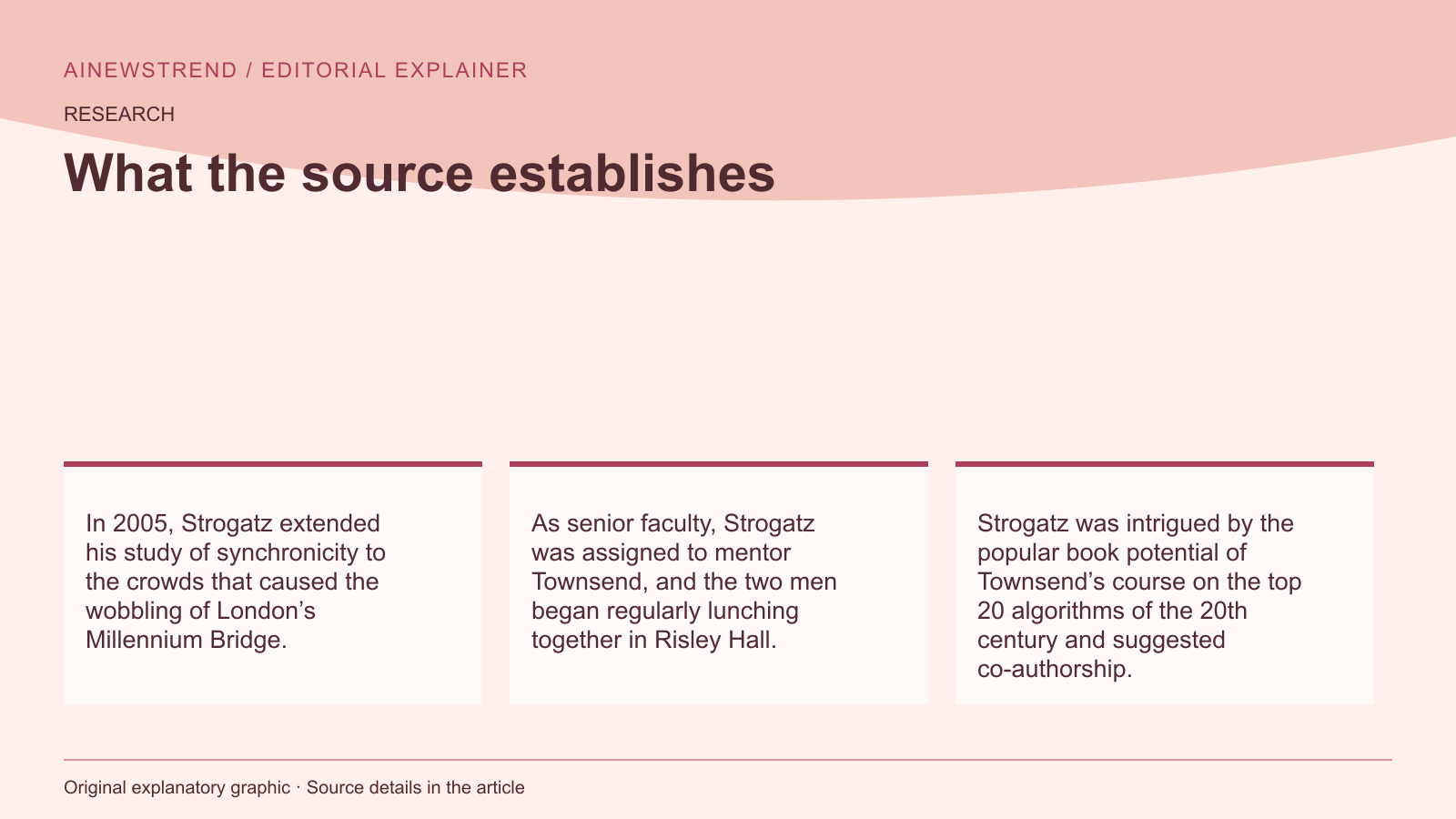
Steven Strogatz and Alex Townsend, applied mathematicians, have co-authored a new book titled Big Math: The Hidden Codes That Run Our World. The book explores the intersection of mathematics, AI, and large-scale computational problems, emphasizing how mathematical tools have evolved to handle increasingly complex tasks.
What this means in practice
The book defines 'big math' as mathematical problems that are too large or complex for human cognition alone. It highlights how computational methods, such as linear algebra and numerical analysis, have become essential in fields like AI, engineering, and social sciences. Strogatz and Townsend argue that while traditional mathematics often deals with small-scale problems, the rise of large language models and quantum computing has pushed the boundaries of what is computationally feasible. They also discuss real-world applications, such as gerrymandering, where mathematical models can help assess fairness in redistricting.
Limitations and availability
The book does not specify exact technical details about algorithms or computational methods, focusing instead on conceptual and historical perspectives. It does not mention any specific software tools or platforms that implement the discussed mathematical techniques. The authors emphasize that while mathematics can provide frameworks for understanding complex systems, it does not replace human judgment or ethical considerations in areas like political redistricting. The book is intended for a general audience interested in the role of mathematics in modern society, rather than for specialized technical readers.