
What changed
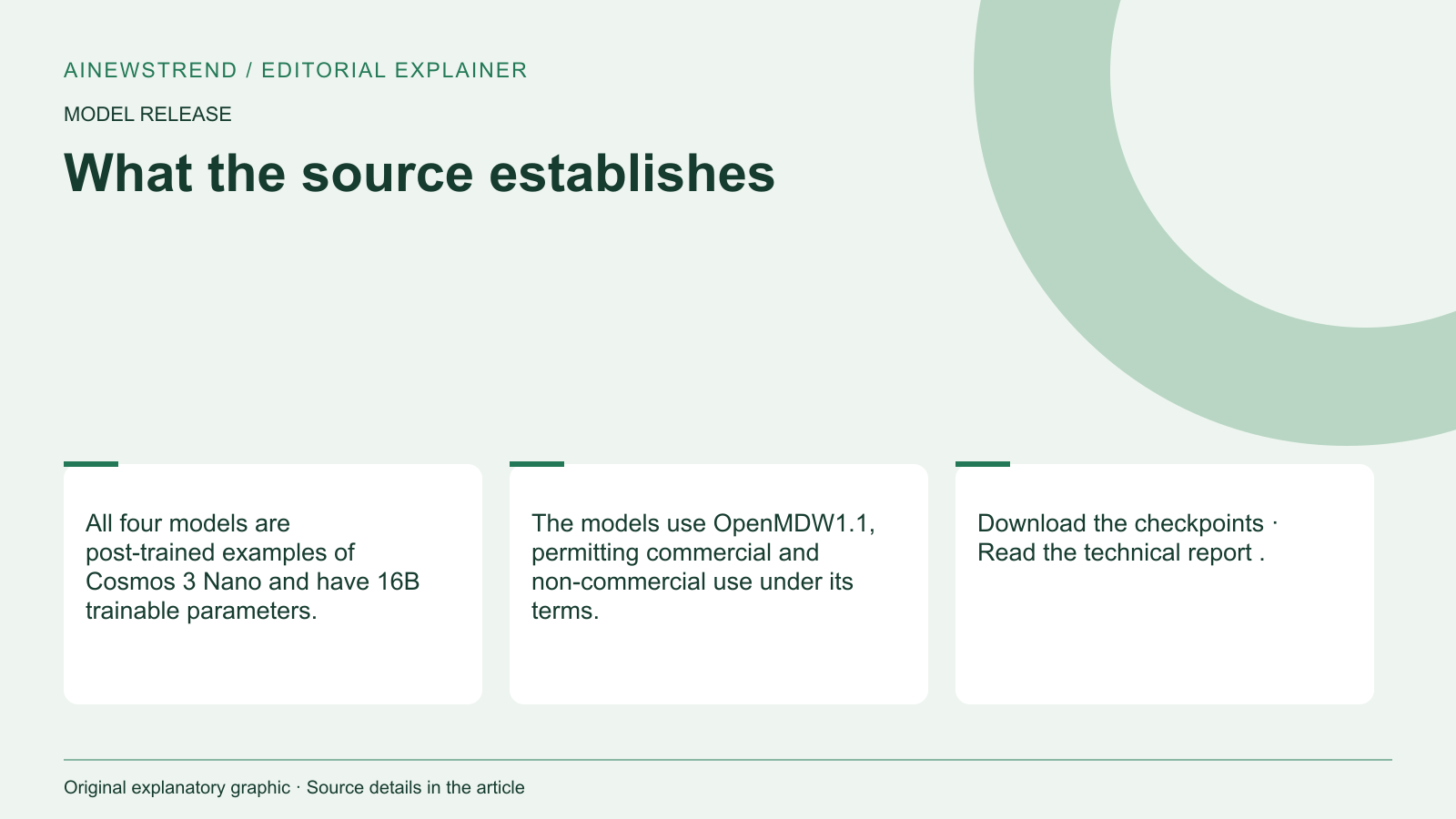
NVIDIA has announced the addition of four new open-weight checkpoints to its Cosmos 3 model family. These models are designed for generating interactive world simulations and multi-sensor multi-view driving scenes. The models include Cosmos3-Nano-Transfer-Auto, Cosmos3-Nano-Sim-Auto, Cosmos3-Nano-Sim-Transfer, and Cosmos3-Nano-Sim-Bimanual. All four models are post-trained examples of Cosmos 3 Nano and have 16B trainable parameters. They use OpenMDW1.1, which permits commercial and non-commercial use under its terms.
What this means in practice
The new models offer various capabilities for robotics and autonomous driving. For robotics, the models can generate visual consequences from actions and turn simulator controls into photorealistic video. For autonomous driving, they can generate synchronized camera and LiDAR observations, ensuring that appearance and geometry agree. Developers can vary environmental conditions to expand training and evaluation coverage, with optional initial RGB images to anchor scene appearance. The models also support interactive two-arm simulation for YAM and AgiBot embodiments, controlled by a policy or human-operated joysticks.
Limitations and availability
The models require Linux, an NVIDIA GPU, Docker, and NVIDIA Container Toolkit. The published vLLM-Omni setup was tested on one GB200; this is not a minimum-memory specification. The server downloads weights; the clients fetch sample inputs. The supplied announcement does not specify the exact release status or availability of the models beyond their inclusion in the Cosmos 3 model family.