
What changed
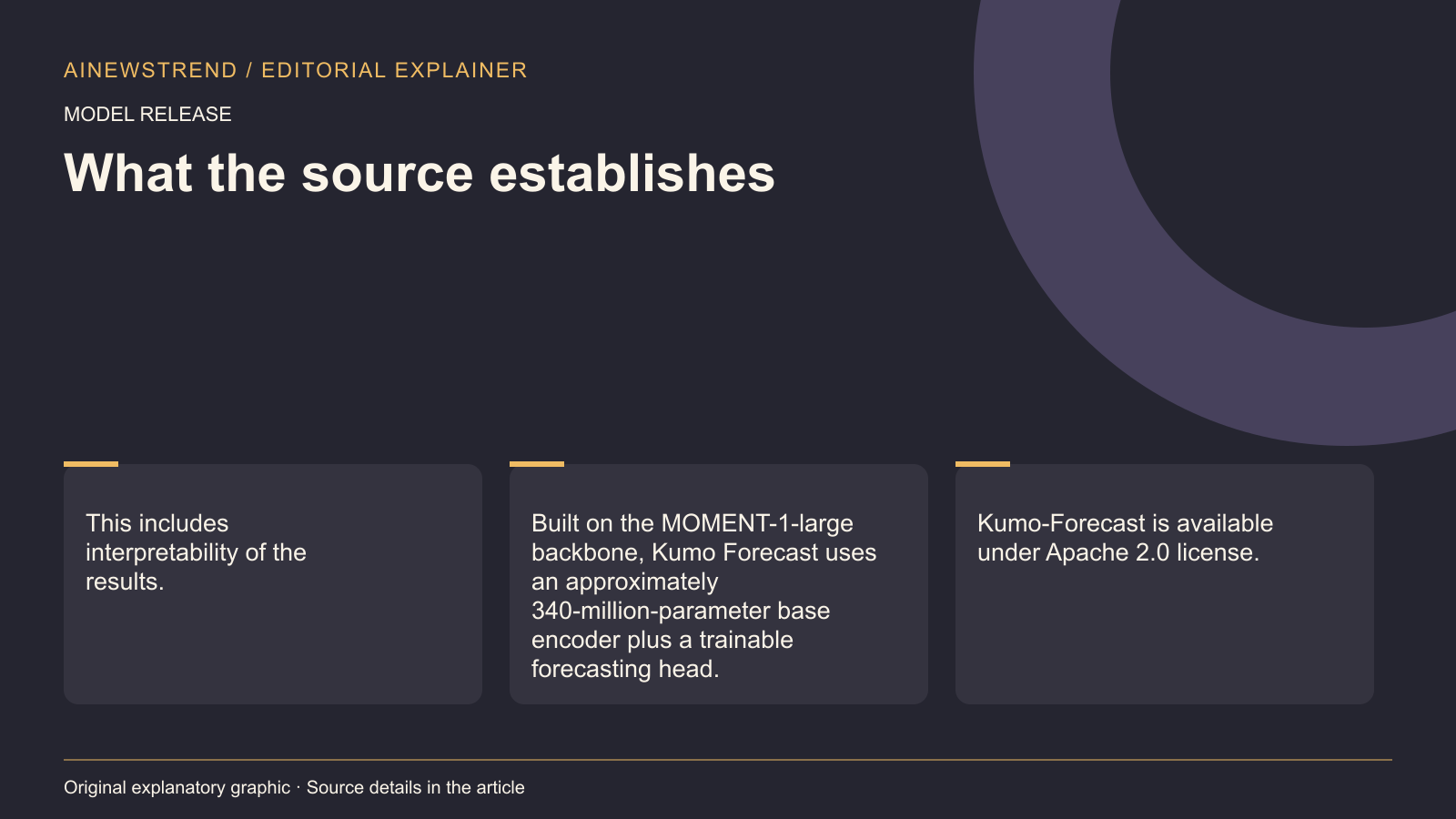
NVIDIA has announced the release of Kumo Forecast, a multi-variate time-series forecasting model that combines a pretrained Transformer backbone with Domain-Aware Representation and Retrieval (DARR). This model uses an approximately 340-million-parameter base encoder along with a trainable forecasting head. It is built on the MOMENT-1-large backbone and provides a DataFrame-first API, configurable forecast horizons, and an interpretability framework.
What this means in practice
Kumo Forecast allows developers to generate forecasts by leveraging both pretrained representations and historical data patterns. The model supports direct forecasting using a MOMENT-based Transformer and a trained forecasting head. In DARR mode, it retrieves related patterns from historical data using a nearest-neighbor approach and combines that information with direct forecasts. Developers can adjust the reliance on each pathway through configuration options. The interpretability framework produces horizon-specific explanations without modifying the underlying forecaster.
Limitations and availability
The model requires numeric, temporal data and supports input sequence lengths of 256, 512, 1024, and 2048 observations. Inputs must include a timestamp column and one or more numeric value columns, represented as a pandas DataFrame or CSV/JSON input. When using DARR mode, the context dimensions must match the input context. Kumo Forecast is available under the Apache 2.0 license, with model code at NVIDIA/Kumo-TS and model weights at nvidia/Kumo-Forecast.