
What changed
OpenAI has announced that ChatGPT will merge its Chat and Work features, changing how usage limits are applied. Starting in December, Plus, Pro, and Business plans will share a single token budget across ChatGPT and Codex. This integration folds Work's agentic features into the main interface.
What this means in practice
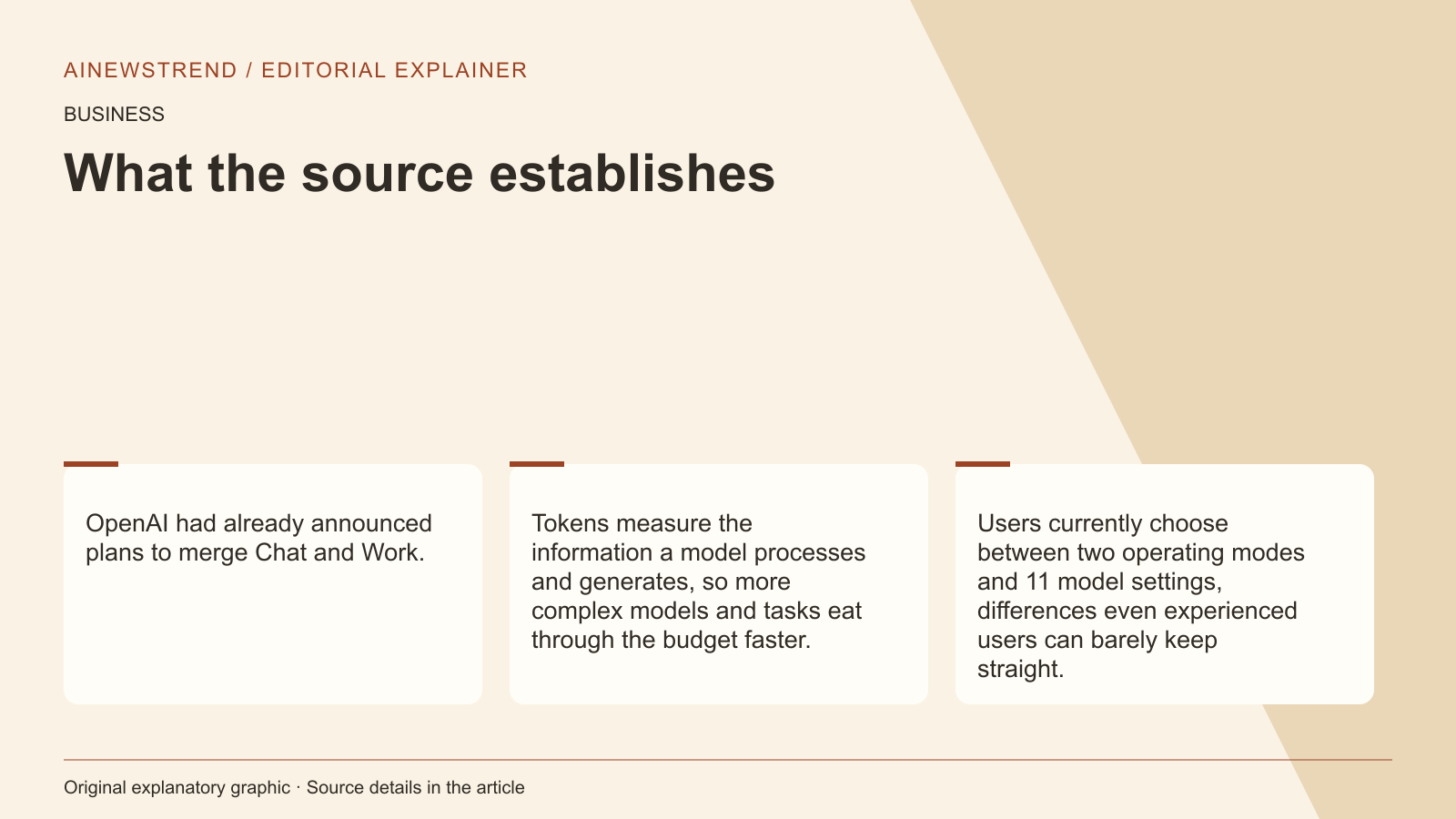
Users will now have a unified token budget for both ChatGPT and Codex, with tokens measuring the information processed and generated by the model. More complex models and tasks consume tokens faster. Users can check their remaining balance and reset times in Settings. Once the limit is reached, they can wait for a reset, upgrade, or purchase extra credits. Chats with Instant models will not count toward the budget, keeping ChatGPT as a flat-rate service on paper. However, heavy usage on cheaper plans may lead to lower-quality results.
Limitations and availability
OpenAI recently doubled usage limits for higher-priced plans, likely to prepare for the merger. The merger is a response to criticism of ChatGPT's growing complexity. Users currently choose between two operating modes and 11 model settings, which can be confusing even for experienced users. Anthropic has already combined Chat and 'Cowork' in Claude. The supplied announcement does not specify exact token limits or budget reset schedules.