What changed
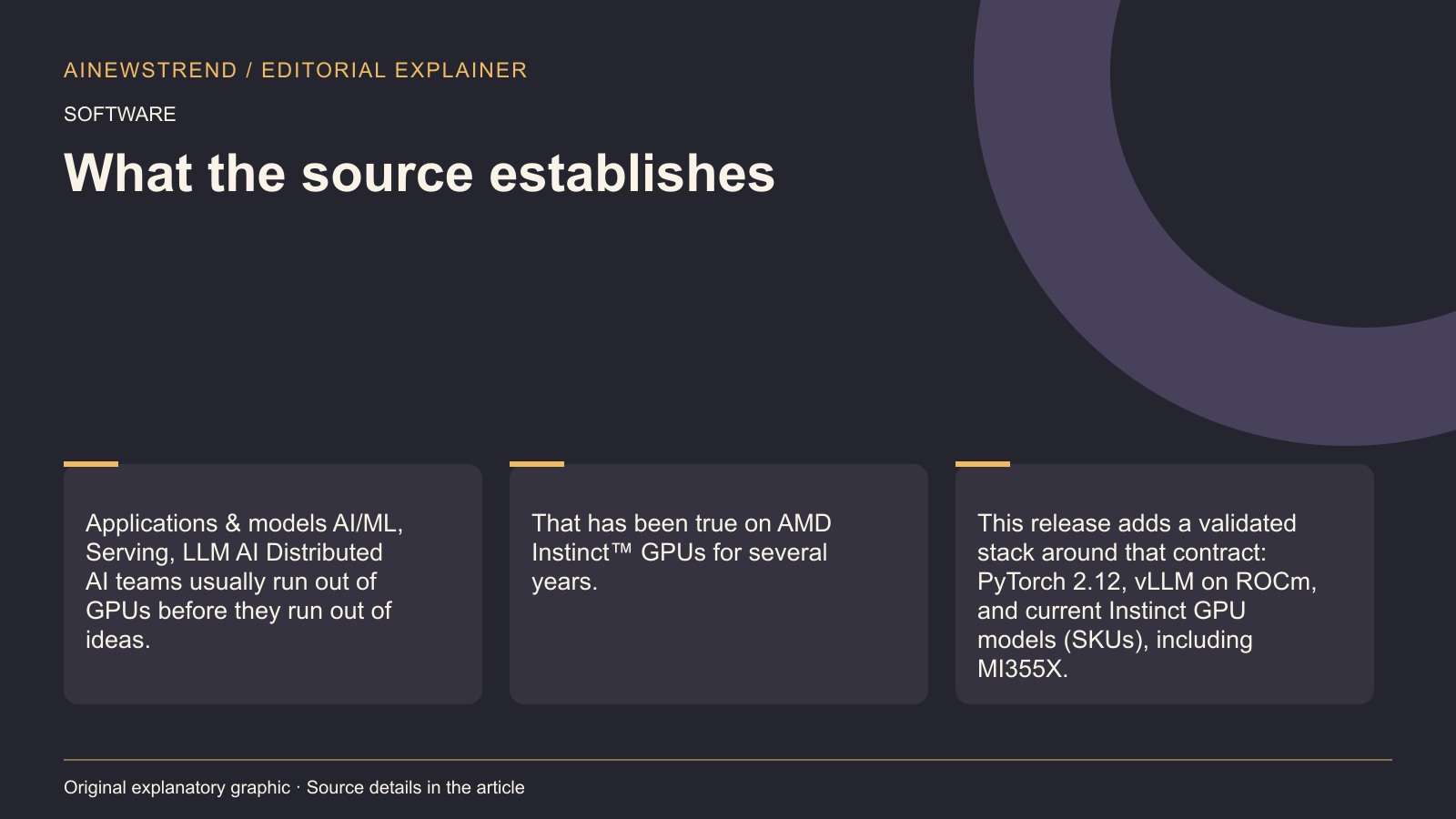
AMD has released ROCm 10.0.0, which now supports Ray 2.58.0. This integration allows developers to run existing Ray code on AMD Instinct GPUs without needing to modify the code for vendor-specific hardware. The release includes a validated stack with PyTorch 2.12, vLLM on ROCm, and current Instinct GPU models such as the MI355X. The combination enables scalable AI workflows, including large language model (LLM) serving, with minimal changes to the codebase.
What this means in practice
The integration means that developers can deploy distributed AI applications on AMD Instinct GPUs using Ray without rewriting their code. Ray automatically discovers Instinct GPUs and maps them to ROCm and HIP, so standard Ray APIs function as they do on other accelerators. This allows for seamless scaling of workloads, including distributed training and model serving, without vendor-specific glue code. The release also supports specific Instinct SKUs like MI300X, MI325X, and MI355X, which can be requested directly in deployments.
Limitations and availability
The supported Instinct GPU models include MI300X, MI325X, and MI355X. Developers must ensure their host systems meet the ROCm system requirements for these GPUs and use a supported Linux operating system. To install Ray with ROCm support, users should follow the official ROCm Ray install guide. The release does not specify any additional limitations or availability details beyond the supported hardware and software stack.