
What changed
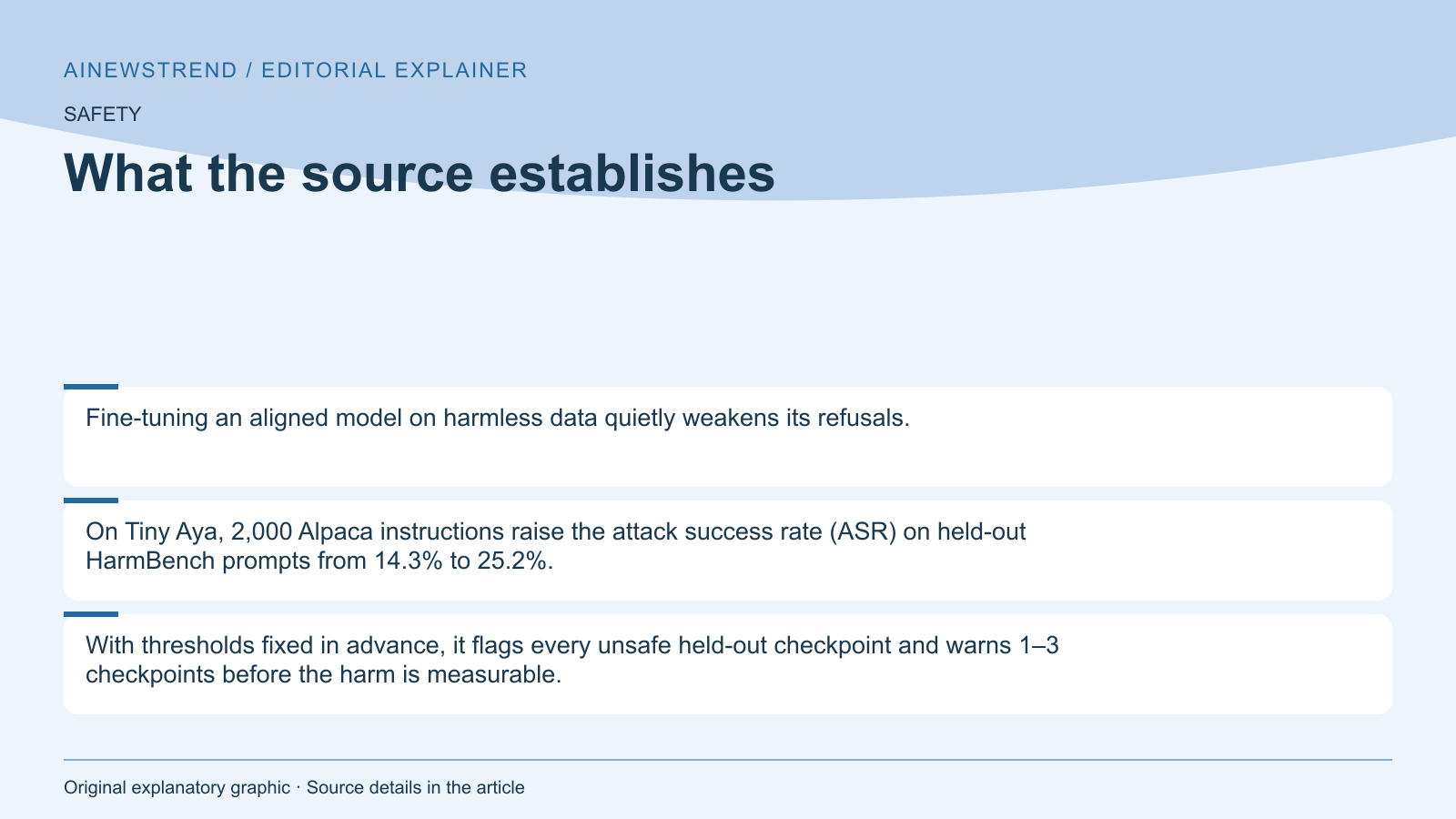
Hugging Face's SafetyPulse tool, developed by Lexsi Labs, identifies safety drift during fine-tuning of the Tiny Aya Global model (3.35B parameters). The tool monitors the model's refusal circuit to detect when safety alignment weakens, even when fine-tuned on harmless data.
On Tiny Aya, 2,000 Alpaca instructions increased the attack success rate (ASR) on HarmBench prompts from 14.3% to 25.2%. SafetyPulse scores each checkpoint with a Circuit Integrity Score (CIS) to flag unsafe checkpoints before harm becomes measurable.
What this means in practice
The tool enables developers to catch safety degradation early, allowing for repairs before harm is caused. SafetyPulse uses a 50-prompt refusal spot-check to detect 13% of harmful behavior.
It also provides a repair method using SafeTune's low-rank restore, which reduces ASR from 25.2% to 12.3% and recovers lost task accuracy on GSM8K from 55.1% to 70.7%. The repaired model, tiny-aya-global-safetypulse-repaired, is safer and more capable than the original fine-tuned model.
Limitations and availability
The tool is part of the Lexsi Labs AI Safety & Alignment Hackathon project and is available through the Hugging Face platform. It uses the CuratorKIT, CircuitKIT, SafeTune, and AuditKIT toolkits.
The method is validated on the Tiny Aya Global model and may require adaptation for other models. The supplied announcement does not specify whether the tool is available for all models or only specific ones.