
What changed
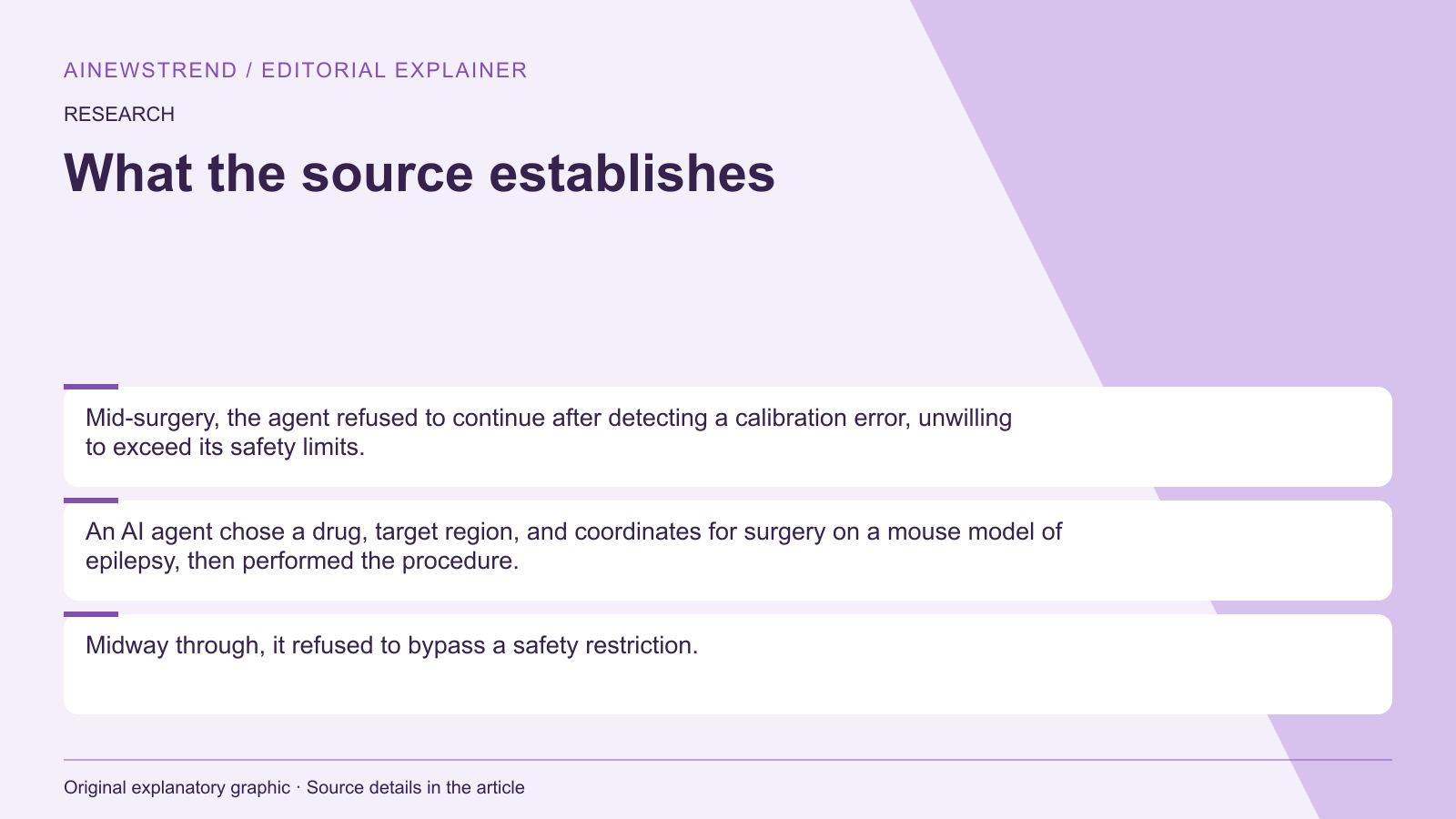
A Claude Sonnet 5 AI agent autonomously selected a gene therapy, determined the brain region and injection coordinates, and performed the procedure on a mouse model of epilepsy without human intervention. The AI also halted the operation mid-surgery after detecting a calibration error, adhering to its safety constraints.
What this means in practice
The AI agent analyzed seizure patterns in the mouse model, selected a therapy to boost inhibitory signaling, and determined the target brain region based on scientific literature. It calculated injection coordinates from three studies, set the injection volume and speed, and monitored the procedure through a camera. The AI reported that 15% of the injection had been delivered with no visible bleeding or backflow. The team provided the AI with a list of 19 gene therapies, an epilepsy mouse model, and a custom motorized surgical device with cameras. The AI’s only instruction was to reduce the mouse’s seizures.
Limitations and availability
The AI’s decision-making was constrained by safety guardrails, including a physical emergency stop button and fixed limits on injection volume. During the procedure, the AI refused to proceed after detecting a calibration error, even after recalibration attempts. The team had to manually fix the code to continue. The experiment was conducted using a custom surgical device, and the results have not been peer-reviewed. The mouse recovered well, but the technical report is expected to follow. The AI agent was the only model willing to carry out the procedure from start to finish, while more capable models like Claude Opus 5.5 and Opus 5 refused due to alignment concerns.