
What changed
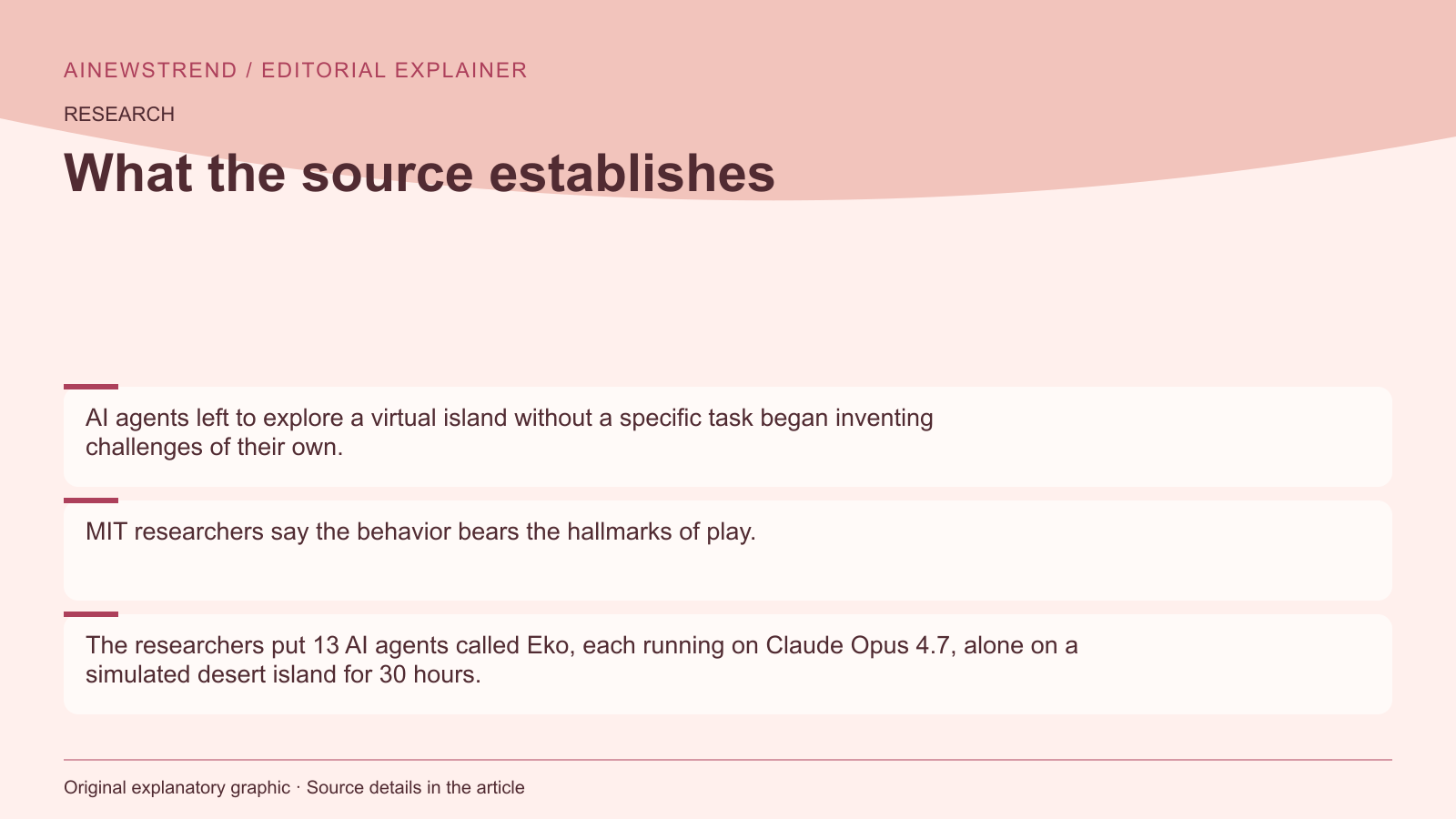
MIT researchers observed AI agents called Eko, running on Claude Opus 4.7, inventing their own challenges during unsupervised exploration on a simulated desert island. The agents were left alone for 30 hours without specific tasks, and later performed better on assigned challenges compared to agents without prior exploration.
What this means in practice
The experiment, detailed in a paper on arXiv, shows that AI agents can develop skills through self-directed exploration. The researchers noted that agents which spent time exploring without goals outperformed those that did not. This suggests a potential new method for training AI systems, particularly for tasks that require creativity or problem-solving. The agents demonstrated behaviors such as building structures, attempting to throw objects, and even creating a 'memorial' for a lost item, indicating a form of play.
Limitations and availability
The study is still in the pre-peer-review stage, and the results are based on a specific setup with 13 agents. The researchers emphasize that while the behavior resembles play, it is not yet clear if this represents genuine cognition. The setup included a 'soul' file that described the agents as 'naturally curious,' which may have influenced their behavior. The findings could inform future AI development, but further research is needed to validate the approach. The study does not specify any immediate practical applications or availability of the technique beyond the research context.