
What changed
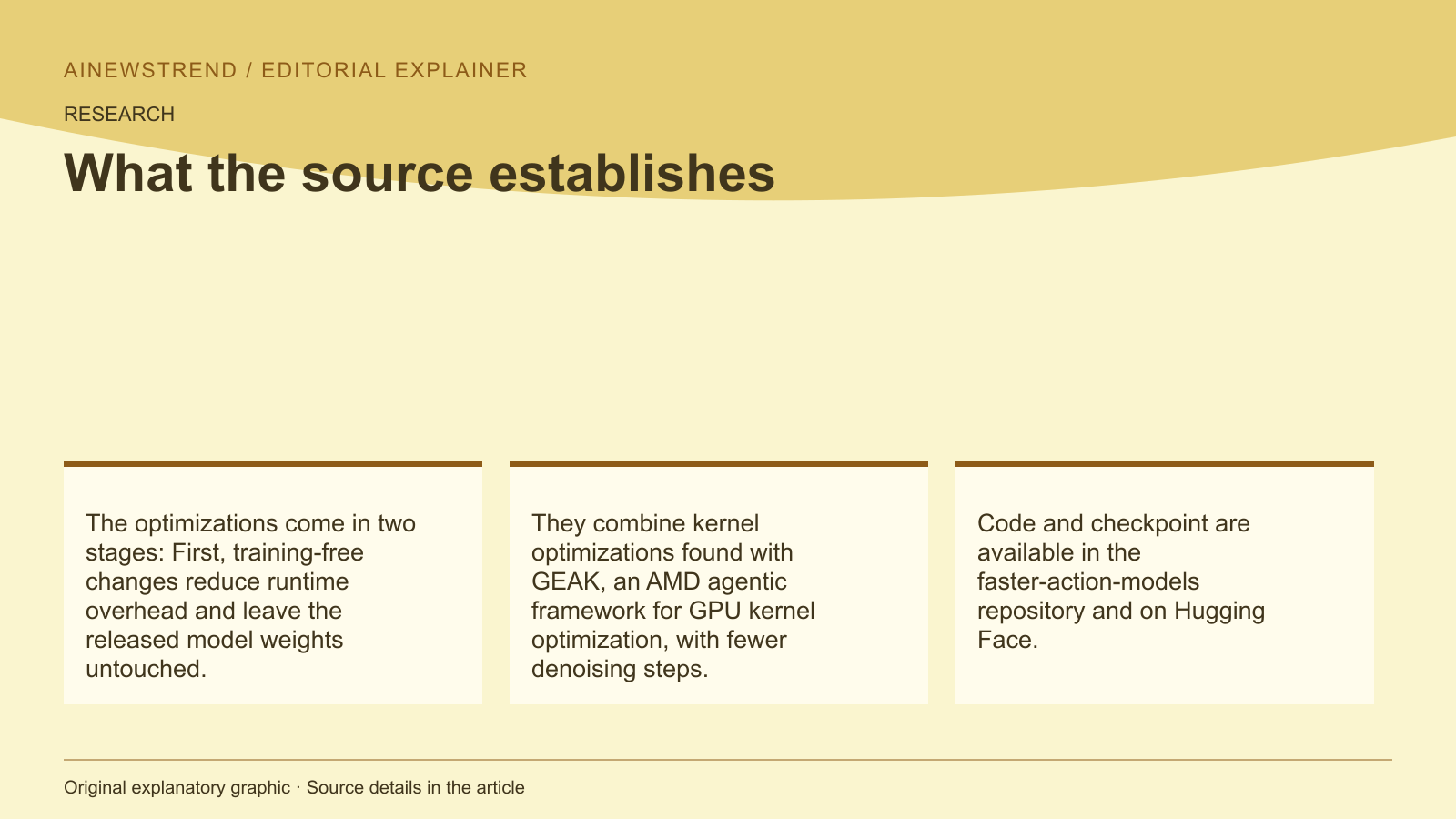
AMD announced optimizations for World Action Models (WAMs) to reduce inference latency on its GPUs. These optimizations are applied to two representative WAMs, FastWAM and DiT4DiT, using training-free changes and architectural adjustments. The optimizations include kernel-level improvements via the GEAK framework and reducing the number of denoising steps in the inference process. These changes aim to lower closed-loop inference latency while preserving task performance.
What this means in practice
The optimizations allow for faster inference on AMD GPUs, which is crucial for real-time robotic control applications. By reducing the runtime overhead of the Action DiT’s denoising loop, which previously accounted for about 87% of end-to-end inference time, AMD has significantly improved the efficiency of WAMs. The training-free techniques, such as GEAK-based kernel improvements and fewer denoising steps, have led to substantial latency reductions. For example, GEAK alone reduces FastWAM latency from 222.55 ms to 24.17 ms, a 9.2× speedup, and DiT4DiT/LIBERO latency from 81.47 ms to 6.49 ms, a 12.6× speedup. Combining these techniques further enhances performance, with GEAK and two denoising steps achieving a 23× speedup for FastWAM on LIBERO and a 14× speedup for DiT4DiT on LIBERO.
Limitations and availability
The optimizations are available through the faster-action-models repository and on Hugging Face. The code and checkpoints are compatible with AMD Instinct™ MI355X and Radeon™ PRO W7900 GPUs. The results were reproduced across the LIBERO and RoboCasa benchmarks, showing close alignment with reported evaluations. The supplied announcement does not specify the exact hardware requirements beyond the mentioned GPUs. The optimizations are currently in preview and are intended to make WAMs more practical for robotic control on AMD GPUs.