
What changed
On October 21, 2026, OpenAI, PerturbAI, and Scripps Research announced the use of thousands of AI agents to analyze biological data from millions of mouse brain cells. The agents, powered by GPT-Rosalind, were used to identify promising research leads in complex data, uncovering unexpected biological connections that could aid in understanding diseases such as Alzheimer’s and Parkinson’s.
What this means in practice
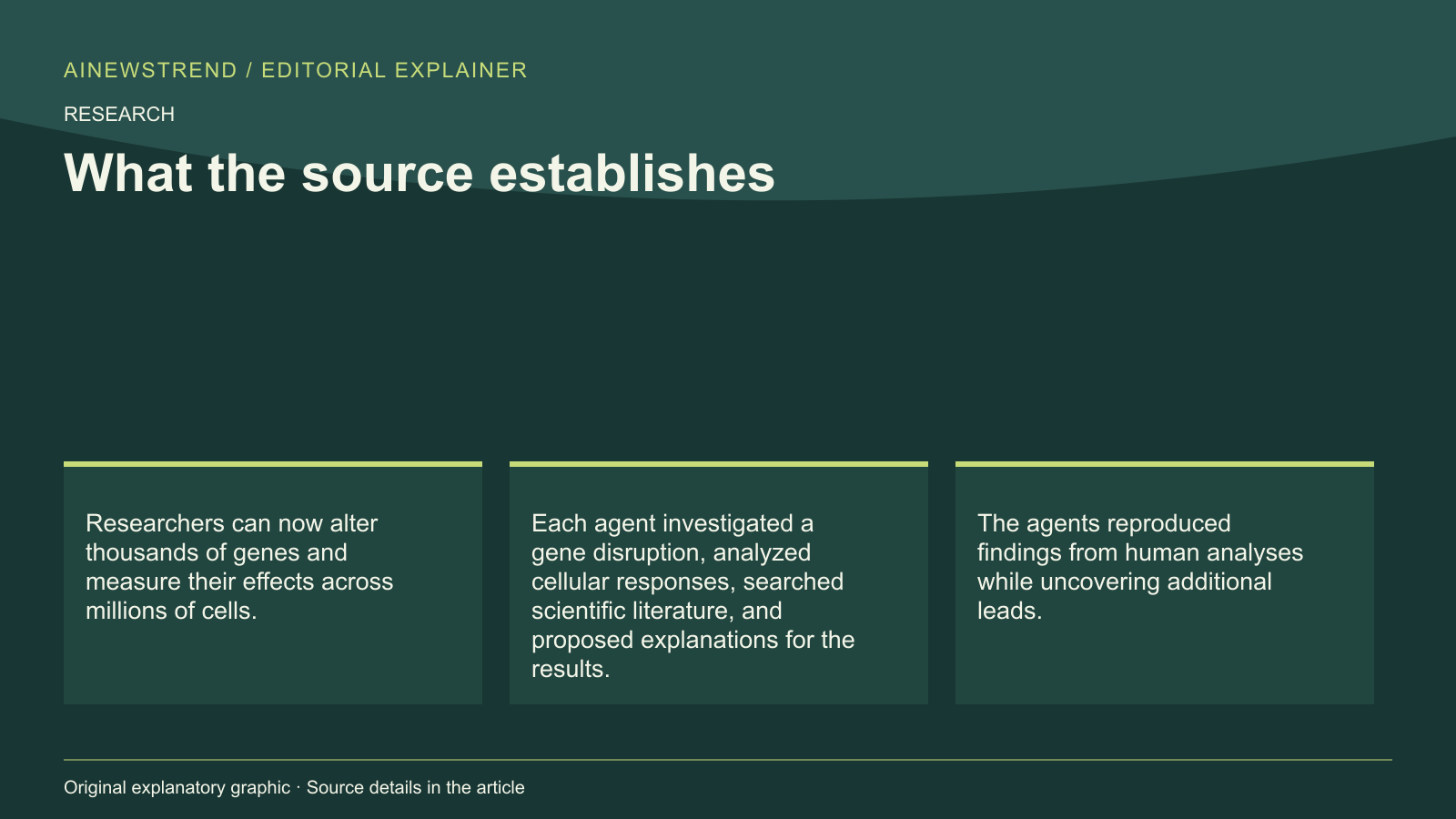
The collaboration deployed thousands of AI agents in parallel to analyze a whole-brain CRISPR atlas, which shows how gene disruptions affect different types of cells across the mouse brain. Each agent investigated a gene disruption, analyzed cellular responses, searched scientific literature, and proposed explanations for the results. The agents’ reports were combined into a reasoning atlas linking genes, cellular effects, relevant publications, and possible biological mechanisms.
The research team estimated that comparable human analysis and literature review, conducted one perturbation at a time, would take months to a year. The agents reproduced findings from human analyses while uncovering additional leads.
Their assessments of novelty and scientific value also aligned with judgments from blinded human experts. These findings help prioritize further experiments needed to test the proposed biological mechanisms.
Limitations and availability
The reasoning atlas is available for researchers to explore, allowing scientists to compare related genes, investigate unexpected responses, and identify promising leads to pursue. The study highlights how AI can help researchers explore more of what large biological experiments reveal by linking new data with knowledge scattered across disciplines. The agents identified unexpected differences in how two disease-linked genes affect brain cells differently, as well as a potential connection between cholesterol regulation and neurodegeneration. These findings could help scientists investigate how disease develops and where future treatments might intervene.
The supplied announcement does not specify the exact number of AI agents used or the specific hardware requirements for running the analysis.
The agents identified an unexpected difference between Tsc1 and Tsc2, two genes that work together to control mTOR, a major regulator of cell growth, metabolism, and aging. Disrupting either gene had similar effects in several groups of neurons.
But in the cerebellum, which helps coordinate movement, Tsc2 disruption altered the activity of dozens of genes involved in neuronal communication, while Tsc, disruption produced little change.
The agents also identified a potential connection between cholesterol regulation and neurodegeneration, which could help scientists investigate how disease develops and where future treatments might intervene.
The research team tested whether a single agent could perform as well as thousands of agents working in parallel, and found that distributed agents cited more than 700 references, compared with 11 for a single agent.