
What changed
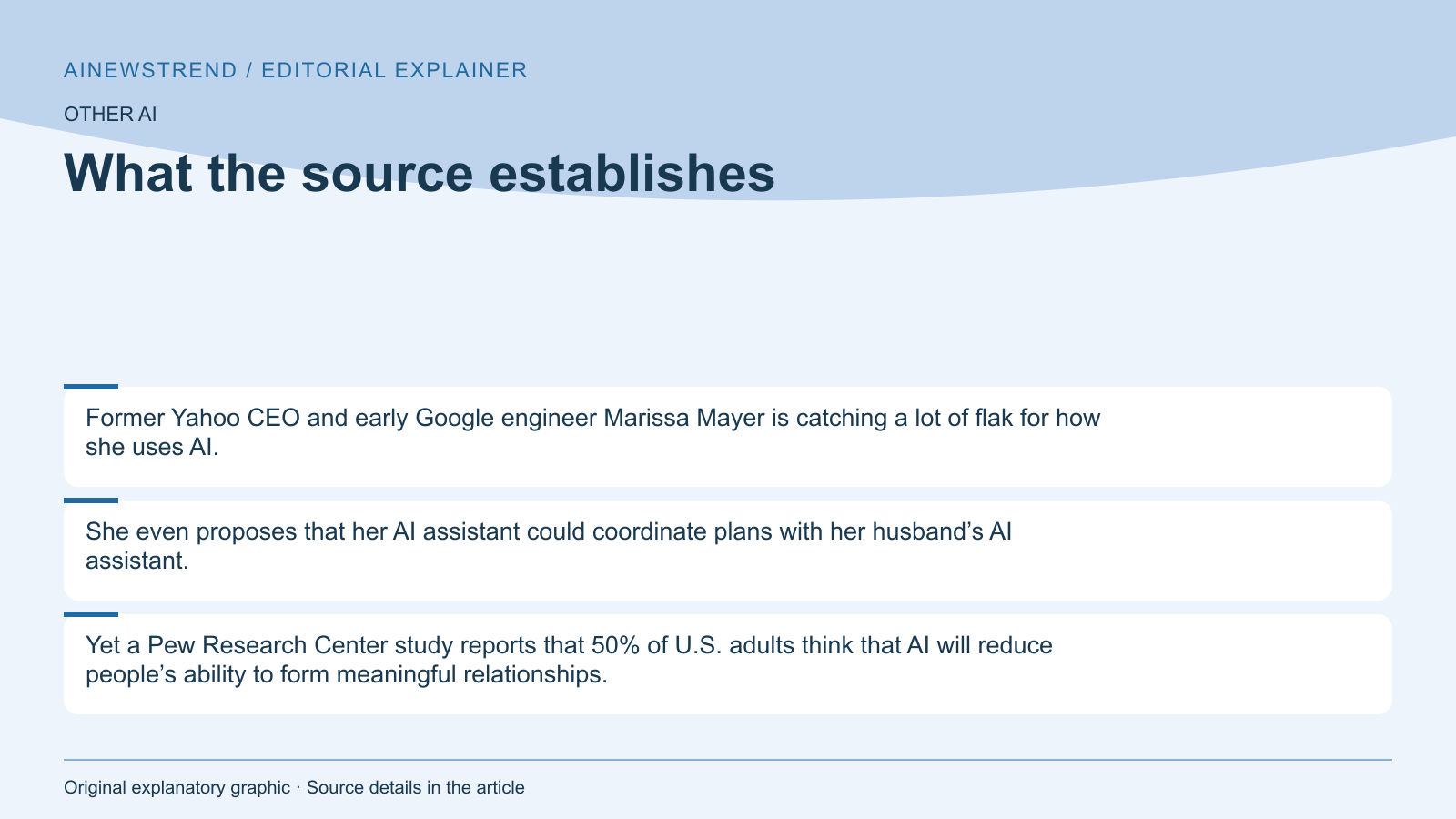
In an interview about her new AI assistant app Dazzle, former Yahoo CEO Marissa Mayer faced backlash for using AI to describe her 10-year-old daughter for a school presentation. The description, which included traits like 'empathetic' and 'creative,' was seen as vague and unremarkable. Mayer also suggested using the app to outsource tasks like planning a child's birthday party and coordinating with her husband's AI assistant. Similar critiques have been directed at other tech leaders, including Meta CEO Mark Zuckerberg, who has argued that AI could help people form more meaningful connections by addressing the perceived gap between the average person's social needs and their current relationships.
What this means in practice
Mayer's use of AI to describe her child has sparked criticism, with some arguing that it reflects a broader trend in Silicon Valley of prioritizing technological solutions over human connection. The public has expressed skepticism about the ability of AI to understand or replicate human emotions, with a Pew Research Center study showing that 50% of U.S. adults believe AI will reduce people's ability to form meaningful relationships. Zuckerberg, meanwhile, has proposed that AI could help fulfill social needs by offering virtual companionship through AI avatars, which he claims are becoming increasingly realistic. These proposals have been met with resistance, as critics argue that human relationships are inherently complex and cannot be easily replaced by technology.
Limitations and availability
The supplied announcement does not specify the exact features or capabilities of Dazzle beyond its use in describing children and planning social events. Mayer's comments suggest that the app is still in a prototype stage, and its full functionality remains unclear. Similarly, Zuckerberg's vision for AI-driven social connections is speculative, with no concrete details on how these technologies will be implemented or made available to the public. The debate highlights a growing divide between the expectations of tech leaders and the concerns of the general public regarding the role of AI in personal and social life.