
What changed
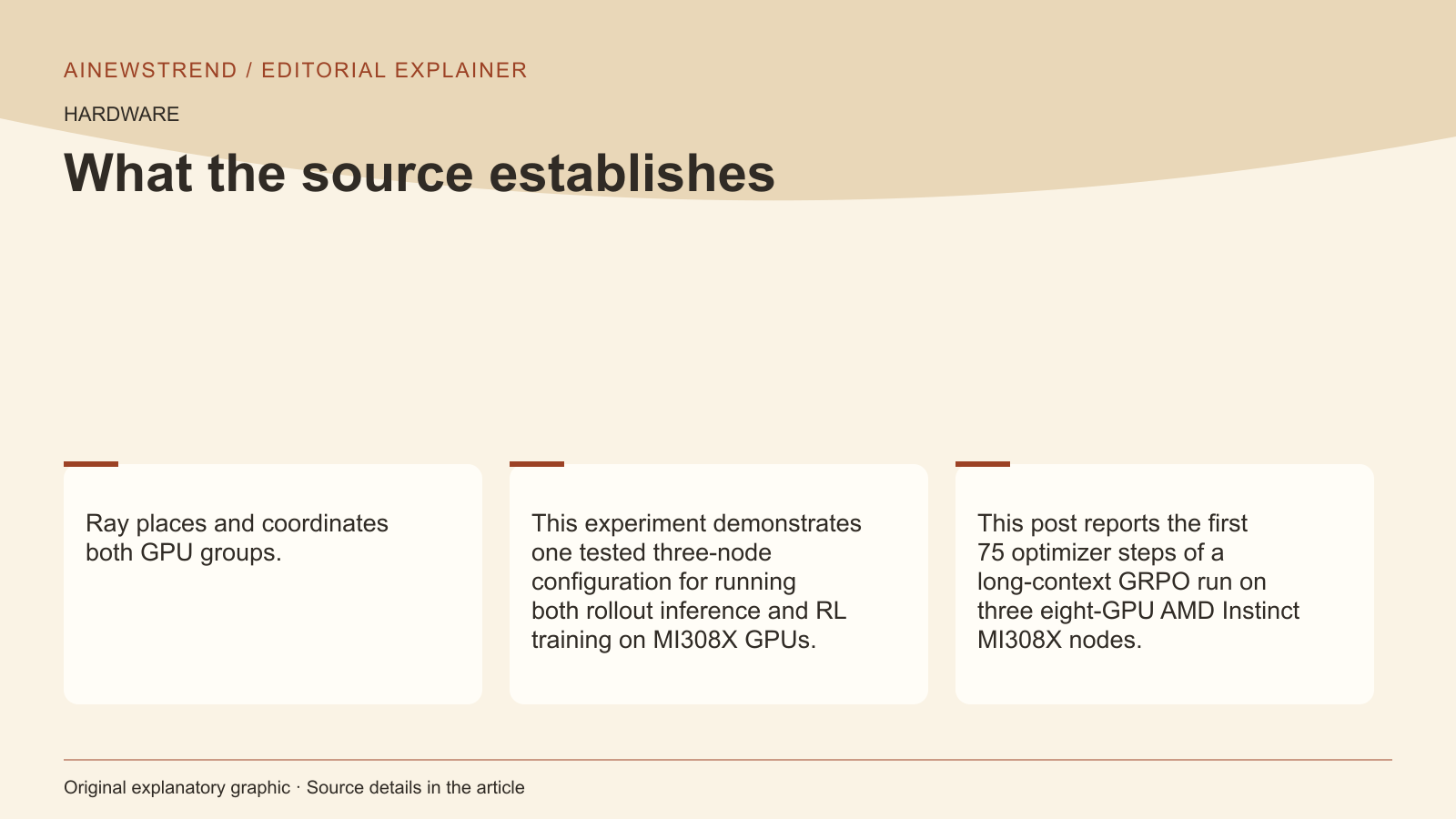
AMD and DeepSeek researchers demonstrated end-to-end DeepSeek-V4 Flash reinforcement learning using an AITER-backed stack on 24 AMD Instinct MI308X GPUs. The test covered a complete workflow across three MI308X OAM nodes, including long-context FP8 rollout, BF16 MoE actor training, online RDMA weight updates, evaluation, and checkpoint recovery. Training and inference ran as disaggregated services, with two nodes hosting a BF16 actor and a third node running an FP8 rollout engine.
What this means in practice
The MI308X deployment supports disaggregated training and inference, with two nodes running a 16-worker Megatron actor through an AMD-native training backend and a third node hosting an eight-way tensor-parallel vLLM rollout server. The first 75 optimizer steps maintained stable generation throughput, with a mean rollout throughput of 311 generated tokens/s. Online reward improved over the run, increasing from 45.3% in steps 1–25 to 59.2% in steps 51–75. Held-out AIME-2024 accuracy also improved, rising from 30.0% at step 1 to 49.2% at step 75.
Limitations and availability
The tested configuration uses three MI308X nodes and specific software versions reported in the test setup. The MI308X actor uses TP4/PP4/EP4, while rollout uses TP8 on a dedicated node. The AMD-native training backend provides DeepSeek-V4 Megatron layer specifications, ROCm compatibility paths, and AITER-backed operators. The experiment highlights the MI308X's ability to handle large-capacity HBM, high-throughput FP8 execution, multi-node collectives for TP/PP/EP actor training, and RDMA for repeated online policy updates. The results are specific to the three-node configuration and software versions used in the test.