
What changed
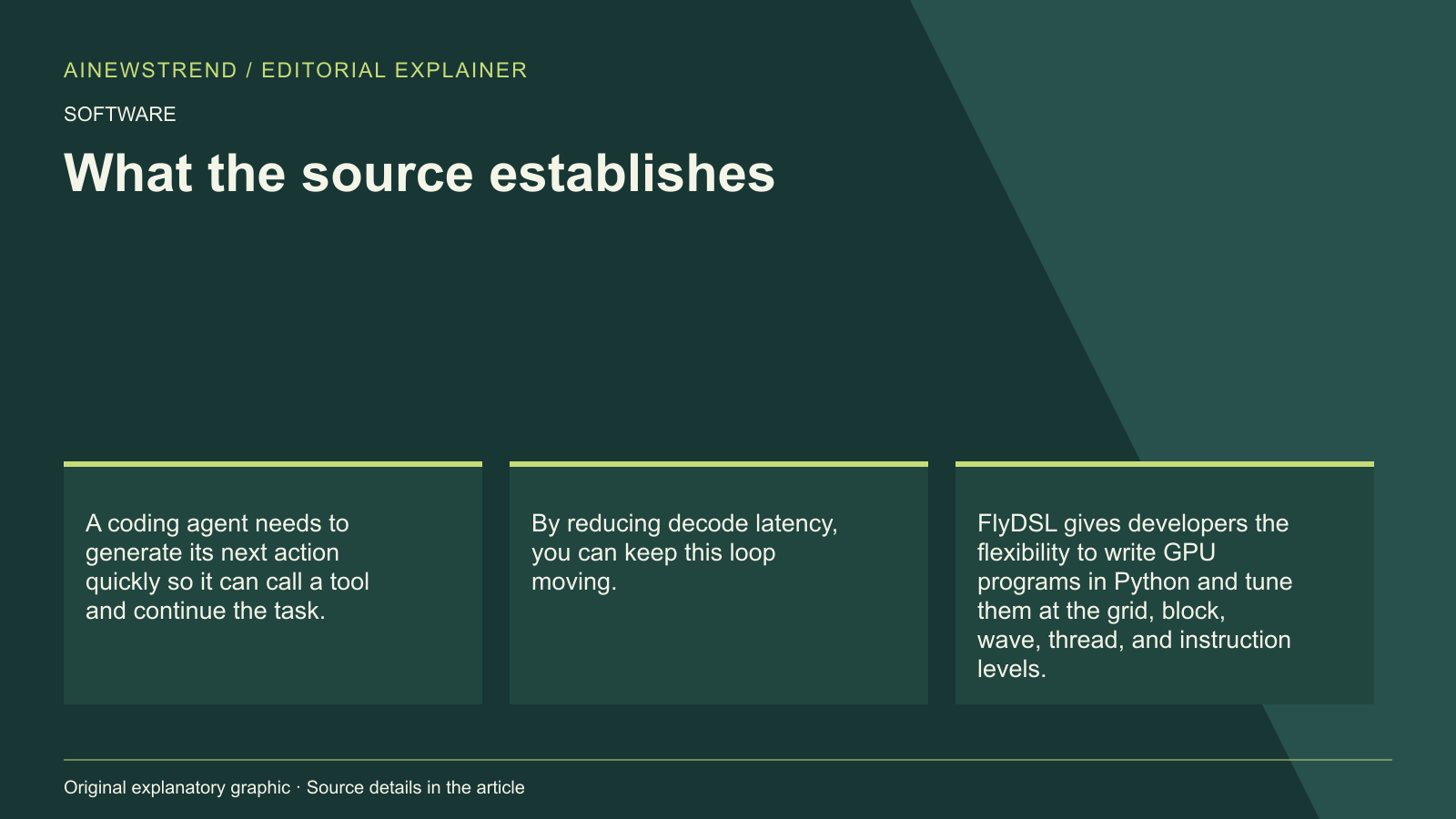
AMD has introduced FlyDSL Mono Kernels, a new set of tools designed to enhance the performance of large language model (LLM) serving by reducing decode latency. These kernels allow developers to write GPU programs in Python and tune them at various levels, including grid, block, wave, thread, and instruction levels. The just-in-time (JIT) compilation builds specialized kernels on demand, avoiding the need to precompile all variants. This approach enables developers to combine stages of a model layer into mono kernels, overlapping independent work and reducing waits.
What this means in practice
The FlyDSL Mono Kernels are integrated into the ATOM framework, which supports several model families, including GLM-5.2, Kimi-K3, DeepSeek-V4.1, and MiniMax-M3. These kernels help in overlapping computation with reductions across GPUs and allow thread blocks to stay active as the layer advances. Developers can load weights alongside earlier computation and let the next stage process portions of the output as they become ready. This reduces idle time and helps the decode step finish sooner. The approach also extends to vLLM and SGLang, showing potential for broader application in LLM serving.
Limitations and availability
The supplied announcement does not specify the exact release date or availability of FlyDSL Mono Kernels beyond their integration into ATOM. The performance improvements are demonstrated through specific measurements, such as decode latency reductions for MiniMax-M3 using MI355X, TP4, and other hardware configurations. However, the measurements cover GPU decode steps and do not measure per-user token rate or isolate the contribution of each scheduling choice. The availability of these kernels depends on the integration with ATOM and the support for specific model families mentioned.