
What changed
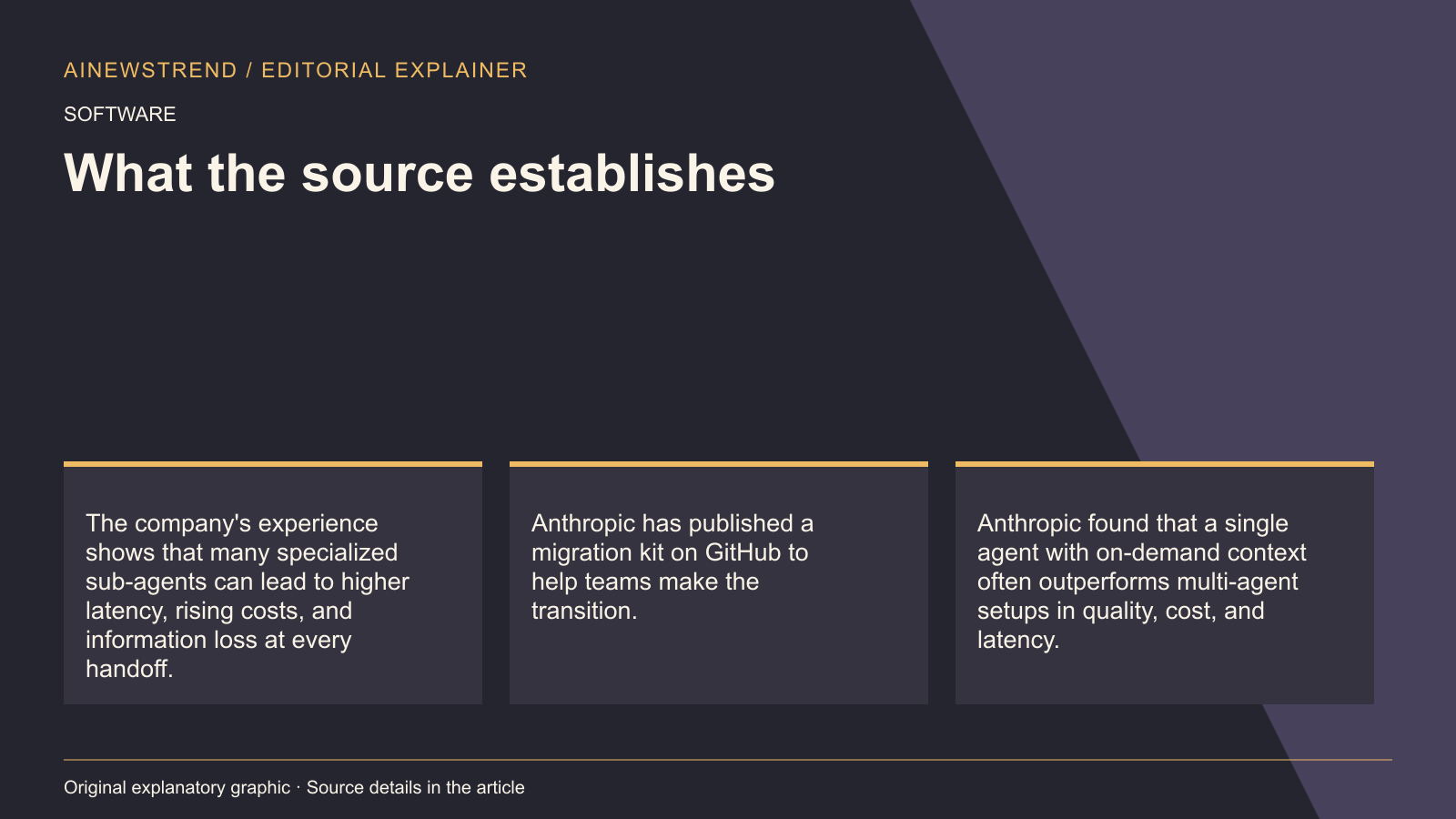
Anthropic recommends that companies evaluate whether they can consolidate sub-agents into a single agent that loads context on demand. The company's experience shows that many specialized sub-agents can lead to higher latency, rising costs, and information loss at every handoff. Anthropic has published a migration kit on GitHub to help teams make the transition. Anthropic found that a single agent with on-demand context often outperforms multi-agent setups in quality, cost, and latency. Newer models starting with Opus 4.5, along with Opus 5.5 and Fable 5.1, can manage complex plans directly in a single loop, which can also reduce costs and wait times. In one comparison, Anthropic says the single-agent architecture ran about twice as fast as the multi-agent setup.
What this means in practice
The recommendation comes from hands-on experience across multiple enterprise deployments, where Anthropic's Applied AI team found that a single agent using so-called skills frequently beat both monolithic prompt designs and sub-agent setups on quality. One company, for example, had a dozen specialized sub-agents inside its customer-facing agent, which made it hard to keep a consistent brand experience and hurt usability with high latency. In the multi-agent workflow, context gets lost at every handoff between feature writing, test writing, and code review. In the single-agent workflow, one agent writes both the feature and the tests because it already has the context, while a separate verifier only runs the tests and reports results. Anthropic also warns against merging blindly, since in one test with a support agent, folding in a sub-agent did reduce latency but broke a previously working process. The primary agent started answering on its own instead of consulting the right specialist.
Limitations and availability
Anthropic says sub-agents still make sense when a single agent's context window shows measurable performance degradation, when multiple tasks need to run in parallel with separate context windows, or when a single agent struggles with tool selection. For a step-by-step migration, Anthropic has published a migration kit on GitHub that walks teams through a workflow to identify existing patterns, evaluate alternatives, and verify the best approach. Teams should keep skill libraries from sprawling instead of giving every team its own agent, and Anthropic recommends packaging workflows into skills and loading tools on demand through a tool search. A small central team should own the system prompt and overall quality. Anthropic also advises against fetching context through code and injecting it directly into prompts.