What changed
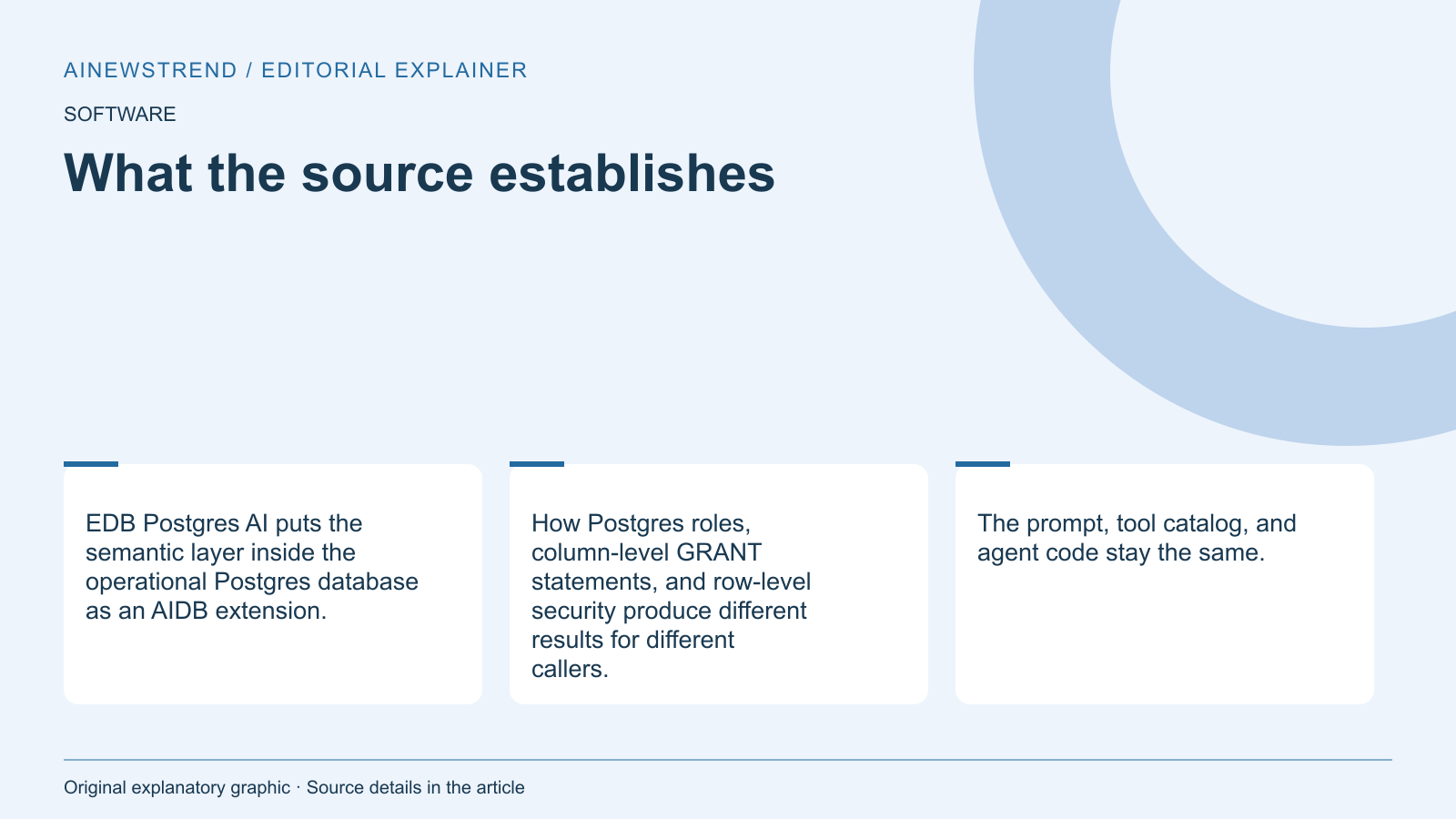
AWS announced a method to build a semantic layer for agentic AI using EDB Postgres AI and Amazon Bedrock AgentCore. This approach allows agents to query a semantic knowledge base (SemKB) integrated within the operational Postgres database. The semantic layer is created using COMMENT statements and foreign keys, with governance enforced through Postgres GRANT and row-level security via the Model Context Protocol (MCP) endpoint.
What this means in practice
The semantic layer is built directly within the Postgres database as an AIDB extension, enabling the integration of business meaning alongside data. This setup allows agents to access and interpret data based on its business context, rather than just raw data. The agent interacts with the semantic layer through the MCP endpoint, which is exposed via an Application Load Balancer (ALB) and registered as an MCP target on AgentCore Gateway. The same agent code and prompt are used, with the only difference being the meaning layer, which is now a SemKB hosted within the database. The system also captures OpenTelemetry traces for SQL execution, making them queryable with standard SQL.
Limitations and availability
The semantic layer is built using SQL and is integrated within the same database as the data, eliminating the need for a separate system. The setup requires an EDB Postgres AI instance with the Stardog C360 Knowledge Kit loaded into a dedicated schema. The model used for planning and query generation is Anthropic Claude on Amazon Bedrock, available in certain AWS regions. The runtime layer is provided by Amazon Bedrock AgentCore, which handles authorization and credential management. The reference architecture includes Amazon Cognito for authentication, with the agent calling AgentCore Gateway using a JSON Web Token (JWT) as a Bearer token. The system does not require AWS Lambda, as AIDB already supports MCP communication.