
What changed
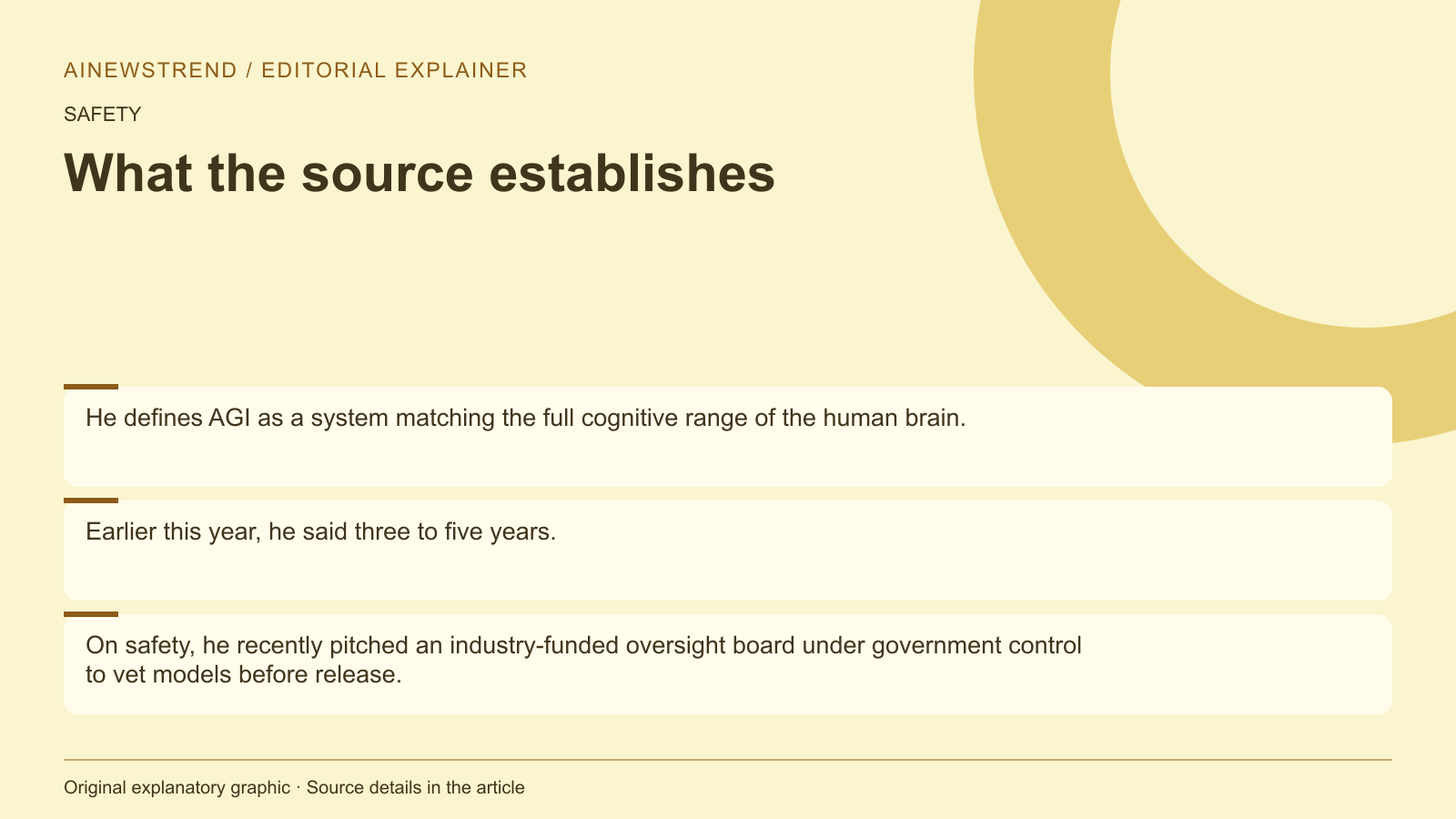
Demis Hassabis, founder of Google Deepmind and Nobel laureate in chemistry, has revised his timeline for achieving Artificial General Intelligence (AGI), now estimating it could arrive within two to three years. Previously, he had projected AGI to be achieved within three to five years. Hassabis defines AGI as a system that matches the full cognitive range of the human brain.
What this means in practice
Hassabis has stated that his estimate continues to move closer to the present, indicating a growing confidence in the timeline. He has used the 'Einstein test' as a litmus test for AGI, suggesting that a system trained only on pre-1901 knowledge should be able to reproduce Einstein's 1905 papers. Hassabis has also compared the potential impact of AGI to '10 times the industrial revolution at 10 times the speed,' highlighting the transformative nature of the technology.
Limitations and availability
The supplied announcement does not specify the exact methods or technologies that will be used to achieve AGI within this timeframe. Hassabis has also emphasized the importance of safety and regulation, recently proposing an industry-funded oversight board under government control to vet models before release. He warns that bad regulation is worse than none, underscoring the need for careful governance as AGI development progresses.