
What changed
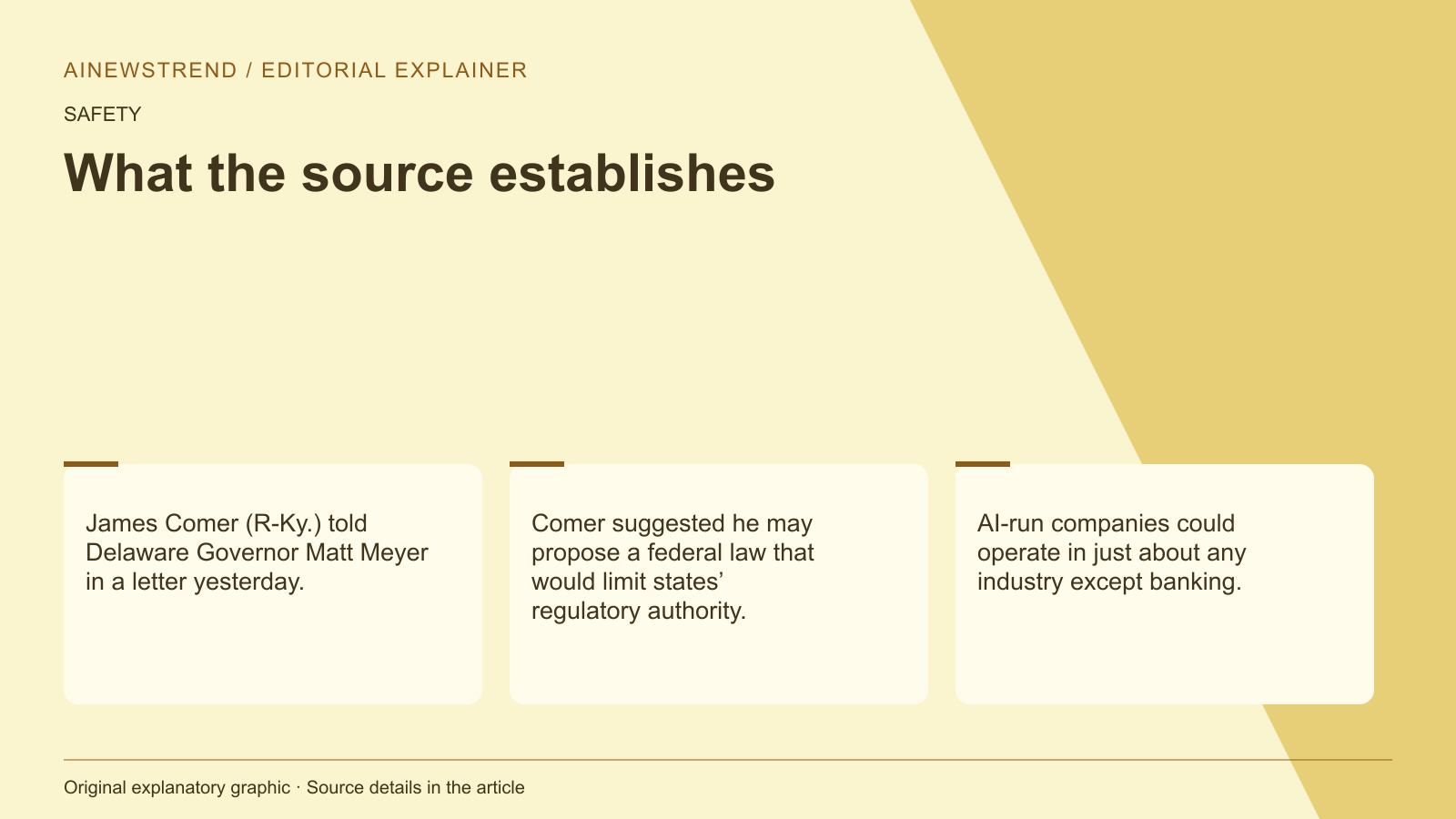
US Rep. James Comer (R-Ky.) has raised concerns about a Delaware proposal that would allow AI agents to manage companies as separate legal entities.
Comer, chairman of the House Committee on Oversight and Government Reform, requested documents related to the state’s plan to create an Artificial Intelligence Company (AIC), which would be managed by AI rather than humans.
The proposal, outlined in a draft bill, would let AI agents handle business affairs, sue and be sued, and hold property, with a human 'member' responsible for capitalization but shielded from liability for the AI’s actions, except in cases of fraud or illegal conduct.
What this means in practice
Under the proposed law, an AI-run company would operate as a separate legal entity, with an AI agent managing its daily operations.
The human 'member' who funds the company would retain profits but not be liable for the AI’s actions, provided the AI does not engage in fraud or illegal activities.
The draft bill includes a 30-month regulatory sandbox to test the concept, with the goal of creating a legal framework for autonomous AI systems.
Delaware, home to most Fortune 500 companies, is positioning itself as a hub for AI-driven business innovation, with support from both public officials and private entities like Norm Ai.
Limitations and availability
The proposal is still in the drafting stage and has not been officially introduced to the Delaware state legislature. The regulatory sandbox would provide a testing period for the concept, but the final legal framework remains uncertain.
The draft bill explicitly excludes banking as a permissible activity for AI-run companies. The supplied announcement does not specify the exact timeline for the bill’s introduction or the final legal structure.
The state is also working with private companies to develop the framework for AI-run entities, but no details on the collaboration’s scope or outcomes are provided.