
What changed
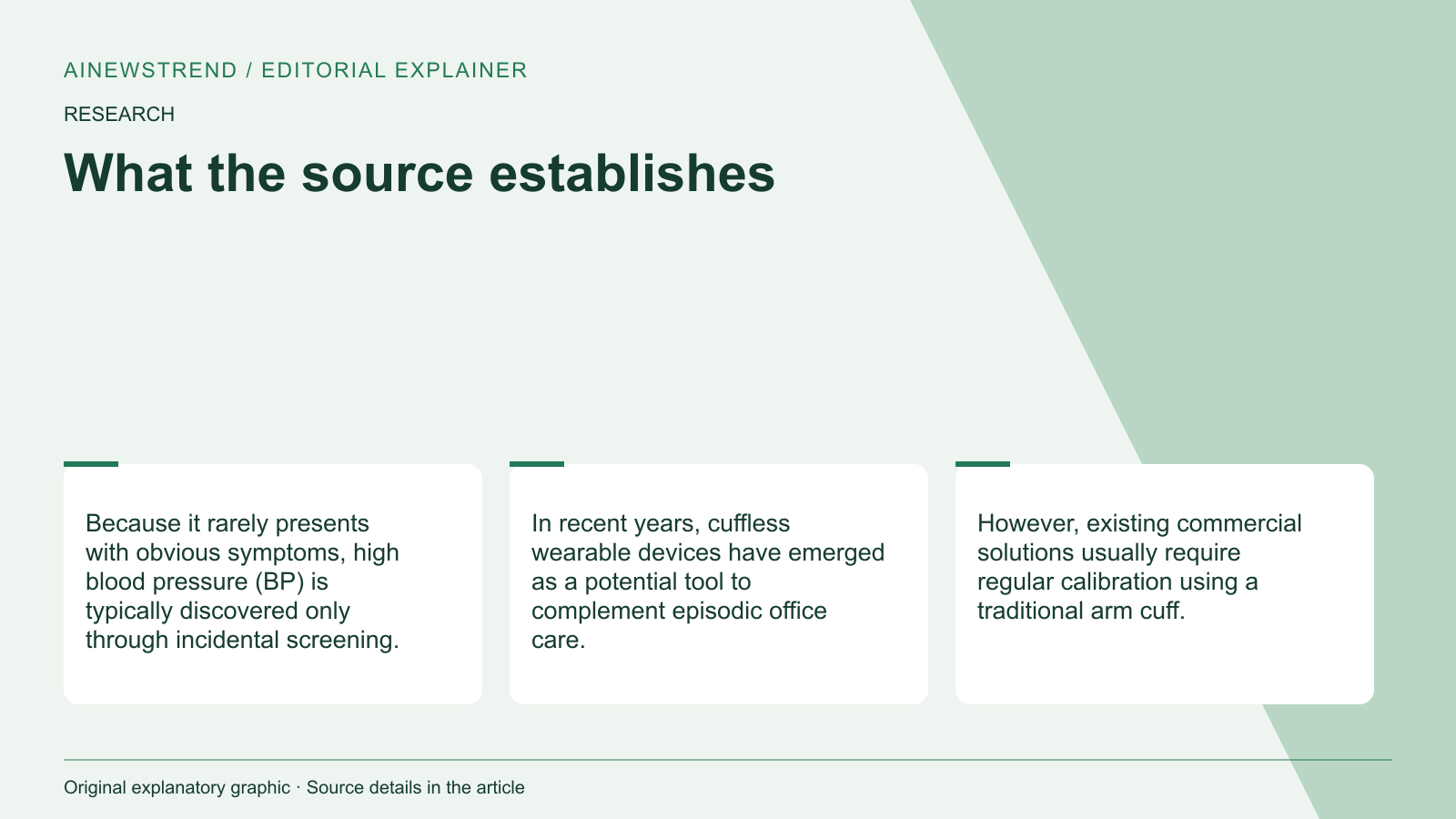
Google Research announced a new AI system that uses standard smartwatch sensors to detect signs of hypertension without requiring cuff calibration. The system, named AI-PPG-ACC-HTN, leverages photoplethysmography (PPG) and accelerometer (ACC) data to identify persistent hypertensive states.
What this means in practice
The AI system focuses on identifying an individual's underlying, persistent hypertensive state by aggregating passive physiological signatures over multiple days. It uses data from two sensors already present on modern smartwatches: PPG, which tracks changes in blood volume at the wrist, and ACC, which identifies periods of stillness and captures the ballistocardiogram (BCG). The system creates waveform embeddings from these signals and aggregates them over time to predict blood pressure status, using a user's height as a proxy for arterial path length.
Limitations and availability
The system was validated against the clinical gold standard of 24-hour ambulatory blood pressure monitoring (ABPM) and achieved accuracy levels comparable to traditional cuff-based diagnostic workflows. The research findings informed the blood pressure trends Health Guardian feature in the Google Health app. The study involved 196 participants across five US sites, and the results showed the system can detect hypertension with accuracy levels comparable to traditional cuffed BP devices. The supplied announcement does not specify the exact release date or availability of the feature beyond its inclusion in the Google Health app.