What changed
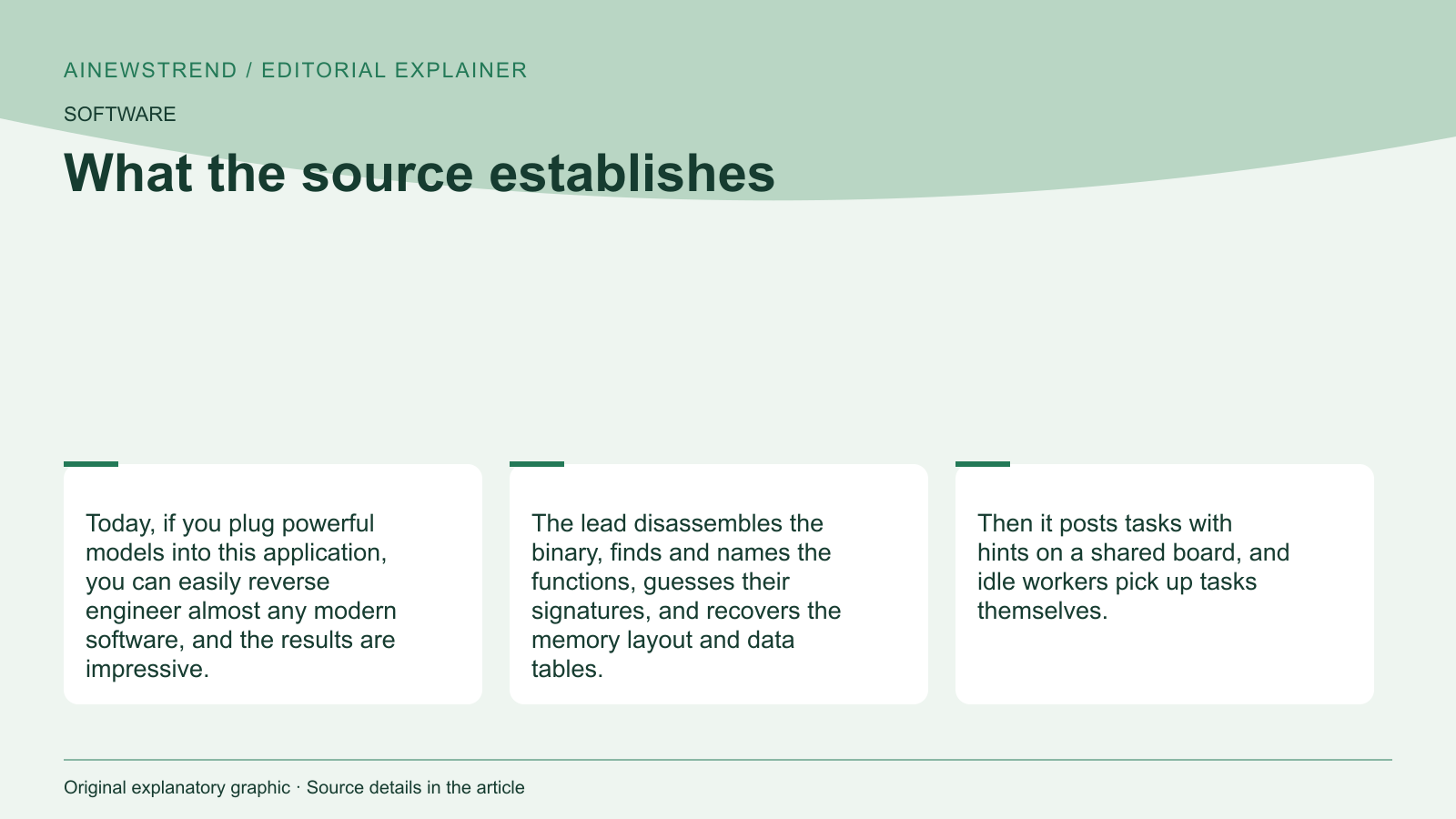
Hugging Face's blog post details experiments where local and open AI models were used to reverse engineer software. The team used a combination of models, including DeepSeek-V4.1-Flash-1017 as the lead agent and Qwen/Qwen3.5-9B as worker agents, to re-implement compiled software into Python. The experiments involved reconstructing an animated Hugging Face logo and a space shooter game.
What this means in practice
The team designed two toy problems for reverse engineering. In the first, they reconstructed an animated video of the Hugging Face logo, which required rewriting 38 functions. In the second, they reverse-engineered a space shooter game with 56 functions. The lead agent, DeepSeek-V4.1-Flash-1017, managed tasks and escalated 15 functions to the lead in the first experiment, while 20 functions were escalated in the second. The workers used a testing oracle, diff_test, to ensure their Python implementations matched the original binary's behavior. The lead agent also modified the workers' harnesses to improve performance.
Limitations and availability
The experiments highlight the challenges of using small models for complex tasks. In the space shooter game experiment, workers struggled with the draw_particles function due to a misinterpretation of ARM instructions. The lead agent corrected this by adjusting the workers' prompts. The results show that while the pipeline is slower and more expensive than solo runs, it can be effective for larger tasks. The team used an extended version of a harness based on IPython, and all agents had access to tools for reading binaries, tracing execution, and testing rewrites. The supplied announcement does not specify the exact availability of the models or tools used in the experiments.