
What changed
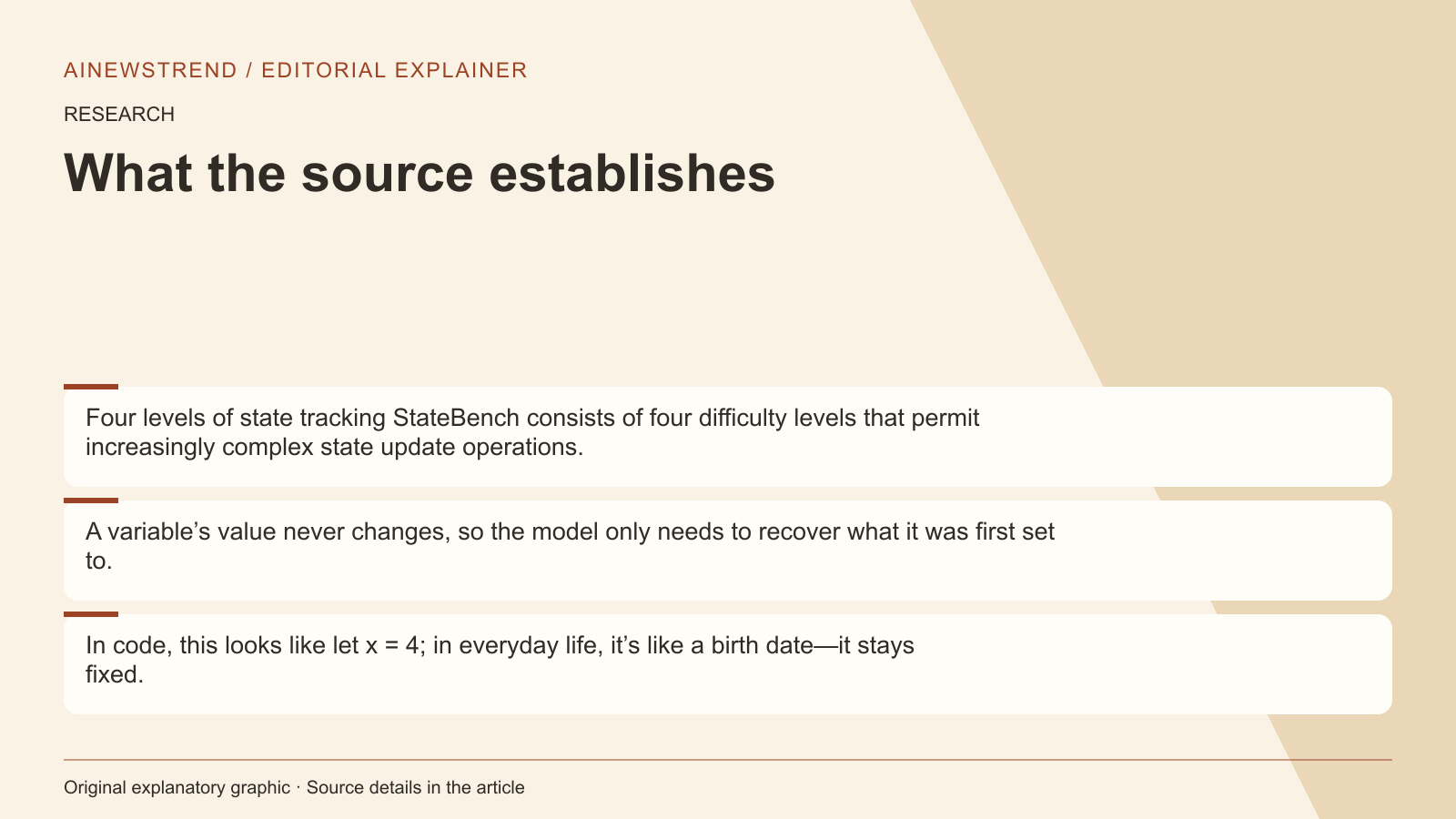
Hugging Face introduced StateBench, a benchmark designed to evaluate how well language models track state changes in long documents. The benchmark focuses on state tracking, which is crucial for tasks like reading code or following narratives where entities evolve over time. StateBench includes four difficulty levels, ranging from simple immutable assignments to complex reference-based updates.
What this means in practice
The benchmark tests models on different levels of state-tracking complexity, which can be understood through variable assignment examples. R-trivial problems involve immutable assignments, while general finite problems involve reference-based updates. Hugging Face tested a range of models, including open pretrained models and frontier models like Gemini 3.8 Flash, Claude Opus 5.5, and GPT-6 Sol and Luna. The results showed that recurrent and hybrid models, such as Olmo Hybrid, performed better on more complex state-tracking tasks compared to transformer-based models.
Limitations and availability
The benchmark is available for researchers to use and evaluate models on different state-tracking tasks. However, the supplied announcement does not specify the exact download or API availability for StateBench. The benchmark is intended for academic and research purposes, and the results highlight the theoretical limitations of transformer models in handling complex state-tracking tasks. The four difficulty levels are based on variable assignment types and are rooted in Krohn–Rhodes theory, which describes how state-tracking problems can be decomposed into atomic primitives.