
What changed
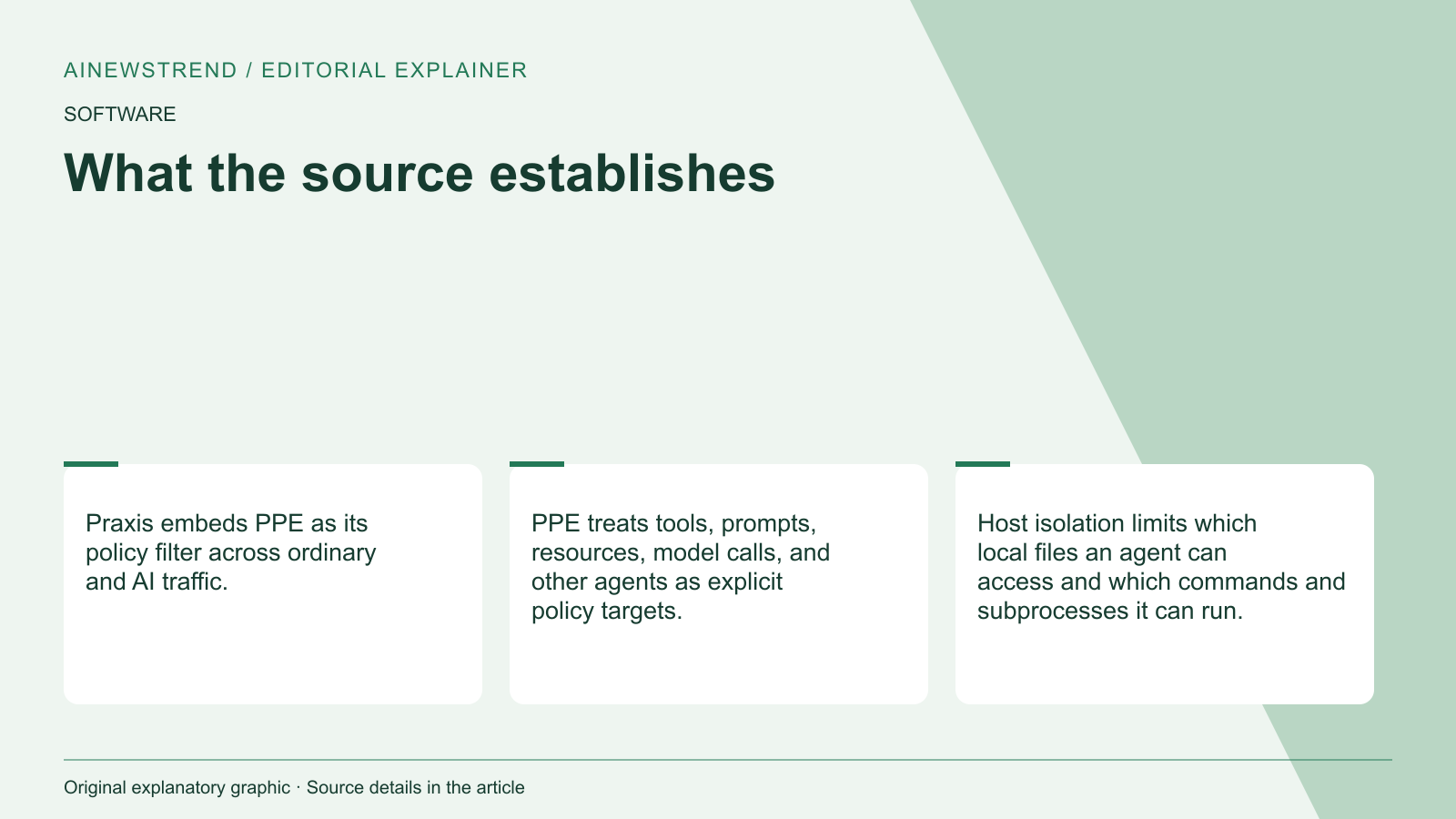
IBM, in collaboration with Red Hat, has contributed the Praxis Policy Engine (PPE) to the open-source Praxis project. This integration allows for policy enforcement across AI agents, gateways, and infrastructure, embedding security controls directly into the AI stack. The PPE is designed to treat tools, prompts, resources, and model calls as explicit policy targets, combining identity, delegation, content controls, and audit in a reference monitor.
What this means in practice
The Praxis Policy Engine enables teams to define access rules, behavior policies, and domain-specific controls through a single policy specification. These policies can be deployed at gateways, beside agents, or within frameworks, protecting operations that cross these points. IBM highlights that PPE supports application-layer policy enforcement, including in Rosso Cortex for laptop policy builds, and integrates with ContextForge and Mellea. This approach aims to provide a secure foundation for AI gateways, which sit above inference serving stacks like llm-d, offering access control, tool invocation, and token usage metering.
Limitations and availability
The supplied announcement does not specify exact deployment timelines or availability dates for the Praxis Policy Engine. IBM-affiliated contributors hold maintainer roles in the project, and Praxis has been onboarded into the Cloud Native Computing Foundation (CNCF) Sandbox. Future research directions include work with CoSAI on the Open Delegation and Identity Standard (ODIS) and contributions to the Open Cybersecurity Schema Framework (OCSF). PPE can emit OCS, and the project plans to investigate how host isolation and gateway policy enforcement can work together to prevent bypasses while maintaining usability and portability.