What changed
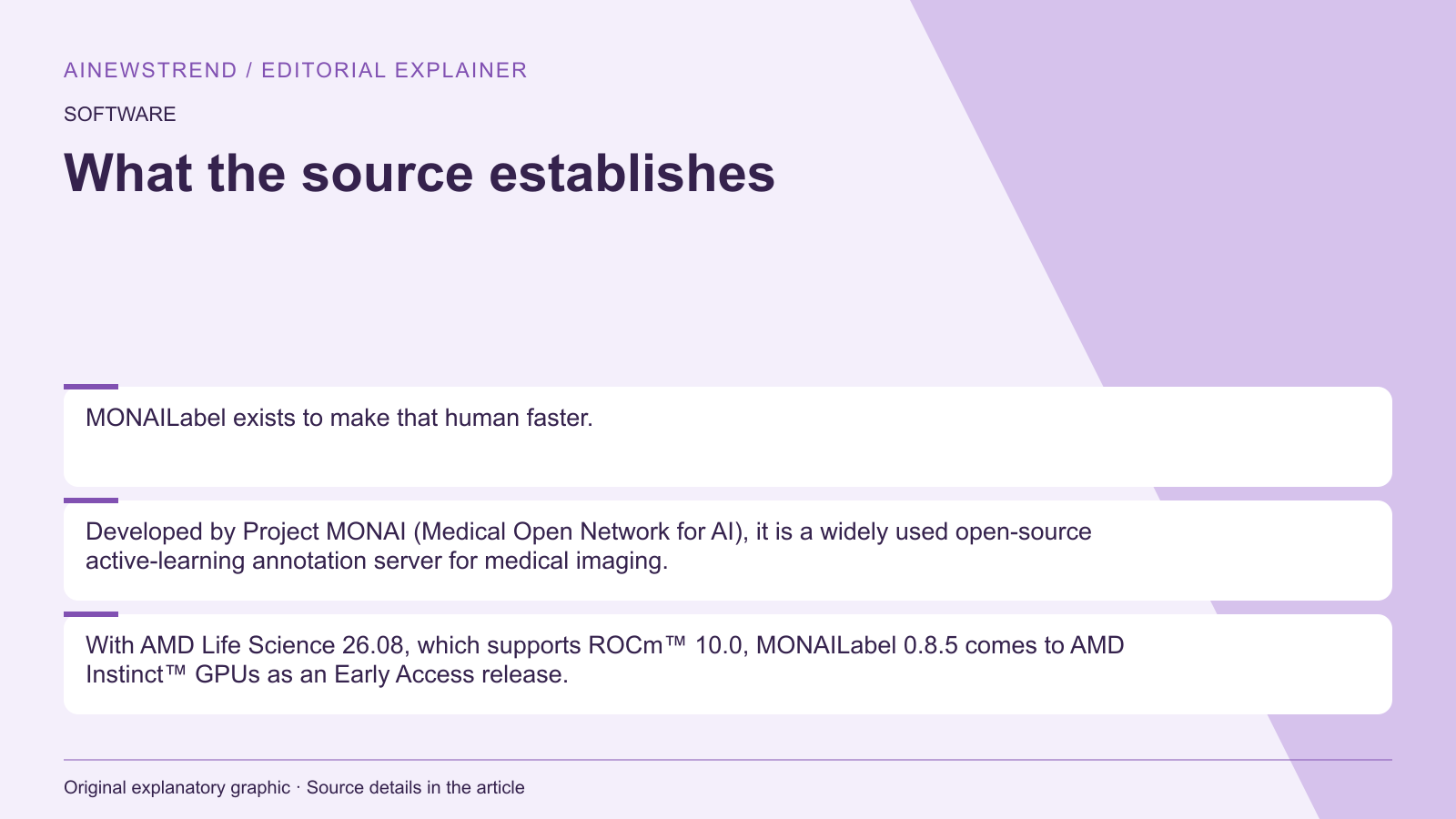
AMD has released MONAILabel 0.8.5, an open-source active-learning annotation server for medical imaging, on its AMD Instinct™ GPUs through ROCm™ 10.0. This Early Access release enables radiologists and researchers to label 3D CT and MRI volumes interactively with the model suggesting and the human refining. The port is part of AMD Life Science's medical-imaging stack and is framework-transparent, running through PyTorch-ROCm with HIP presenting itself as torch.cuda.*.
What this means in practice
The port allows existing model configs, sample apps, and MONAI bundles to run without modification. With AMD Instinct™ MI355X and ROCm 10.0, model inference is 131× faster than on a host CPU at the same fp32 precision (median across four spleen CT volumes from the Medical Segmentation Decathlon Task09; range 115–133×). Each volume’s inference completes in roughly 0.05–0.12 s with bf16 autocast, and about 0.13–0.28 s at fp32. The smallest unit of work, a single 96³-voxel sliding-window patch through the BasicUNet-3D backbone (5.7M parameters), runs in single-digit milliseconds on MI355X. The maximum absolute error between CPU and GPU outputs is ~4.6×10⁻⁶, within float32 accumulation rounding and far tighter than the 5×10⁻² tolerance.
Limitations and availability
The port is available for AMD Instinct™ GPUs with ROCm 10.0, requiring Python 3.12 and a PyTorch-ROCm wheel. The port is deliberately small, with the entire functional ROCm enablement living in three files without changes to the Python API or new GPU kernels. MONAILabel does not require hipCIM to run, but it runs faster when hipCIM is present. The port is part of a series on the AMD Life Science medical-imaging stack, with companion posts covering the hipCIM image-I/O library, MONAI data loading, and validated Model Zoo inference.