
What changed
NVIDIA has expanded the Cosmos platform with new training tools, simulation checkpoints, and Cosmos Data Factory blueprints to help developers rapidly build world models. These updates allow developers to scale training data, adapt models, test behavior, and optimize for performance before deployment. The platform now ranks top five on six different open models leaderboards.
What this means in practice
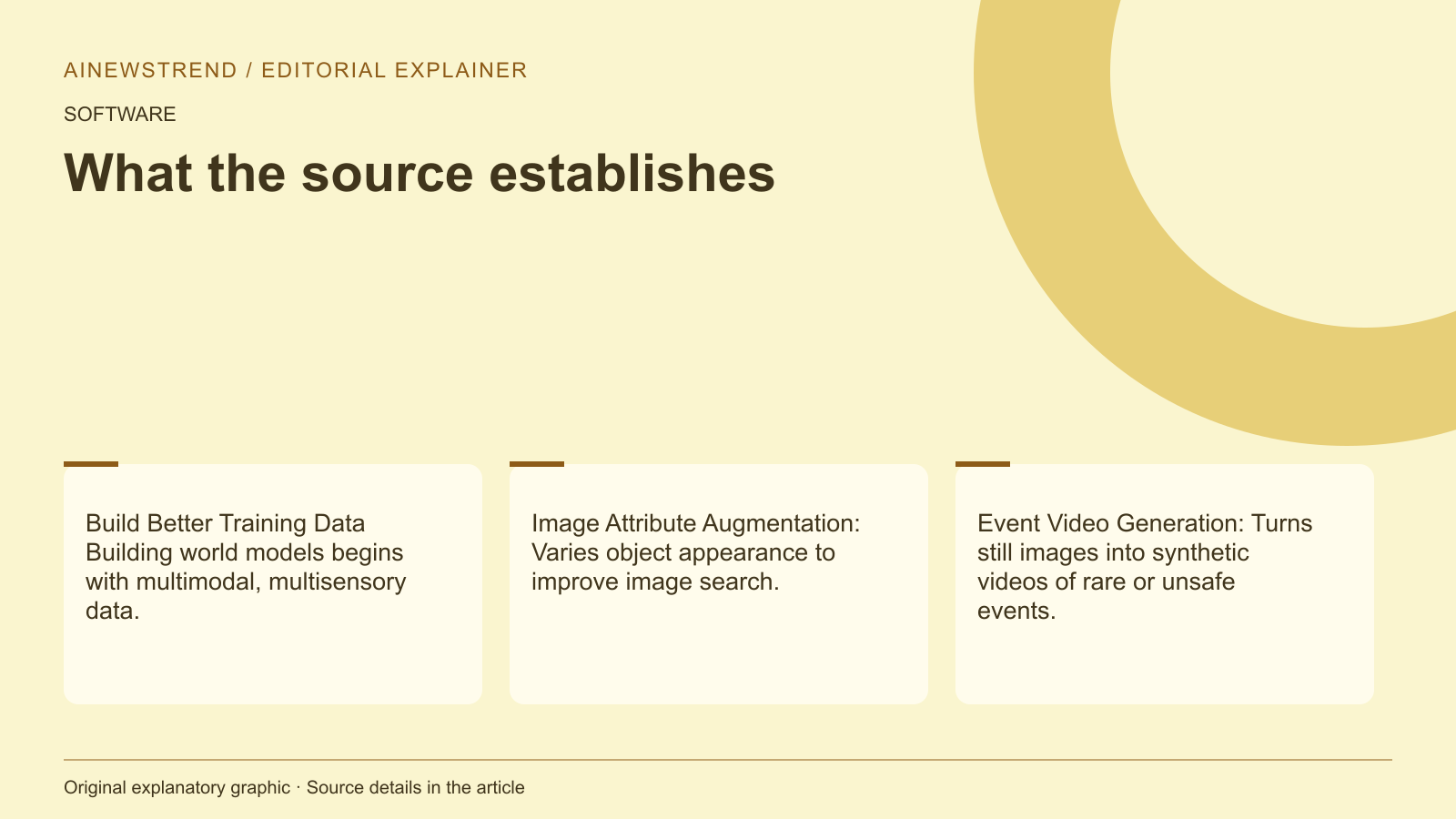
The new Cosmos Data Factory offers five cloud-native blueprints available through GitHub, Microsoft Azure, Nebius, and CoreWeave. These include tools for autonomous vehicle dataset generation, image attribute augmentation, event video generation, defect image generation, and video data augmentation. Companies like Porsche and ANYbotics are already using these blueprints to speed up their physical AI development workflows. Porsche is expected to reduce repeated physical test drives by up to 90% and shorten development cycle times by up to 85%. ANYbotics generated over 1,500 synthetic video clips to train its industrial-inspection robots. Ultralytics improved defect localization and recall by retraining its YOLO model with synthetic defects generated using Cosmos Data Factory.
Limitations and availability
The Cosmos platform is fully modular and open, allowing developers to use Cosmos Data Factory to generate training datasets, Cosmos Framework to train and adapt world models, and deploy supported models through NIM microservices. The new Cosmos 3 Nano model variants enable developers to test autonomous policies in multiview, multisensor scenarios. Developers can deploy core Cosmos models using updated NVIDIA Cosmos 3 NIM microservices, which deliver up to 2x faster inference with no quality loss in validated configurations. The NVIDIA Metropolis Blueprint for video search and summarization (VSS) 3.3, built on Cosmos NIM microservices, helps teams monitor 40% more video streams with the same GPU. ADNOC uses Fogsphere’s MistIQ agentic platform, built with Cosmos and the NVIDIA Metropolis VSS Blueprint, to detect safety hazards in real time across 65 sites.