
What changed
The open-source OpenMobile-2 project, developed by researchers from Nanjing University and AI company SenseTime, demonstrates that open-source smartphone agents can rival proprietary models.
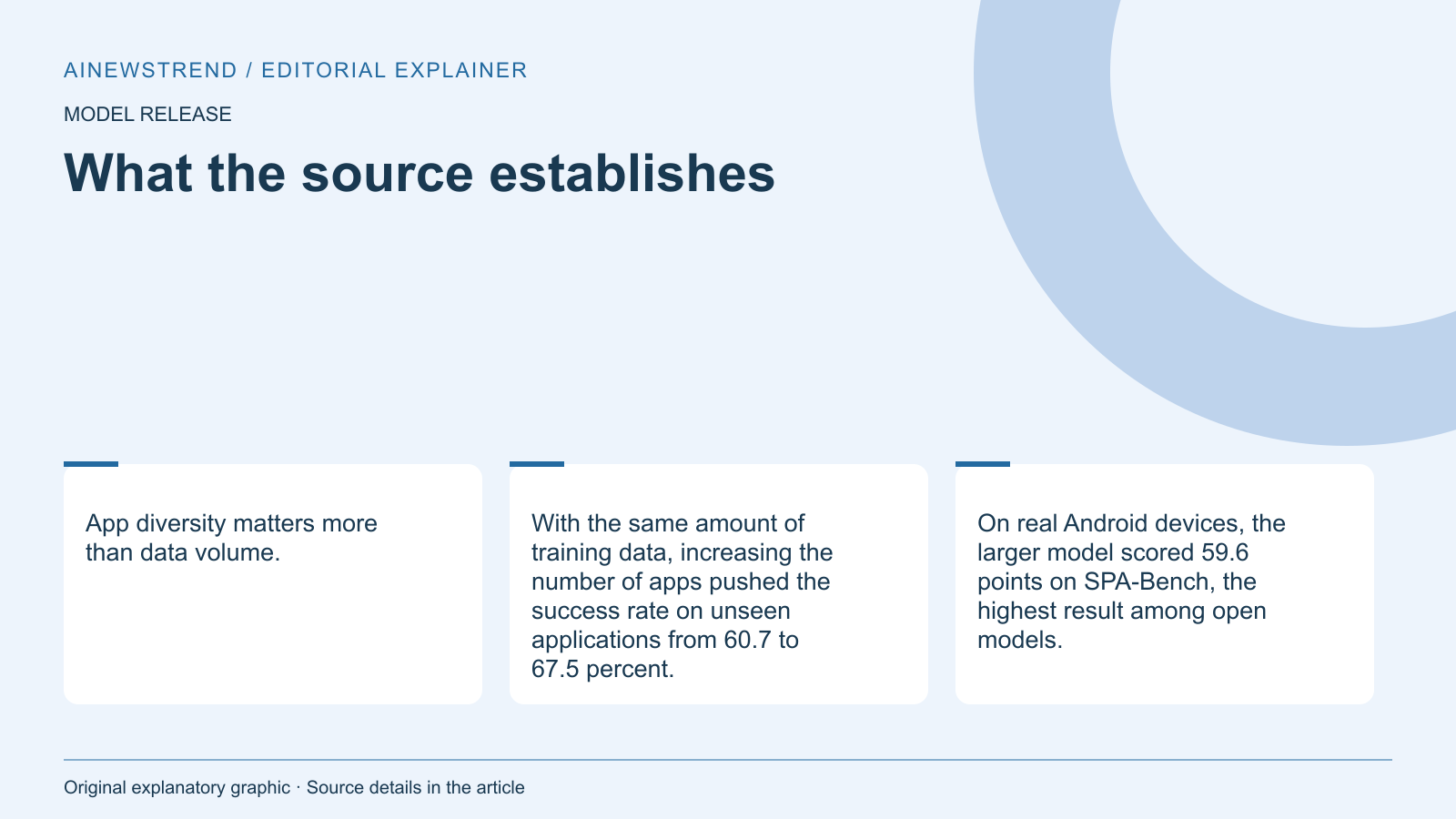
The project trains AI agents in an environment with more than 110 simulated apps, achieving a success rate on unseen applications of 67.5 percent, up from 60.7 percent with fewer apps.
The larger model, built on Qwen3.6 with 27 billion parameters, scored 59.6 points on SPA-Bench, the highest result among open models on real Android devices.
What this means in practice
The researchers emphasize that app diversity is more important than data volume for improving agent performance. By rebuilding 35 popular apps, including Taobao, JD, DiDi, Meituan, Slack, and Google Drive, they created a training environment covering over 110 applications.
This setup allows agents to learn through practice, mimicking how humans use apps by maintaining data across sessions and enabling inter-app data transfer via the clipboard.
The models also support hybrid mode, combining normal screen actions with direct app functions.
This approach enables agents to solve tasks more efficiently, with the larger model improving its score on AndroidWorld from 67.1 to 79.9 points and on MobileWorld from 35.9 to 50.4 points.
The team also generated 11,600 example workflows and over 2,000 practice tasks with automated success checks, using Google's Gemini 3.1 Pro as the teacher model.
Limitations and availability
The training environment is fully open, with the authors releasing the full training environment, data, and instructions to reproduce everything. However, the simulated apps and direct command interfaces are only available in the training setup and not on real devices.
The researchers note that the current results are experimental, and the models have not been deployed on actual Android devices yet. The study also highlights that reinforcement learning provided limited gains, mainly in environments similar to the training setup.
The authors caution that the simulated apps and direct command interfaces are experimental and only exist in the training environment. While the models show promise, they are not yet available for real-world use.
The team also mentions that the results are based on their custom benchmark with 215 tasks, and task completion is judged by a program comparing app data before and after each run, rather than a language model.