What changed
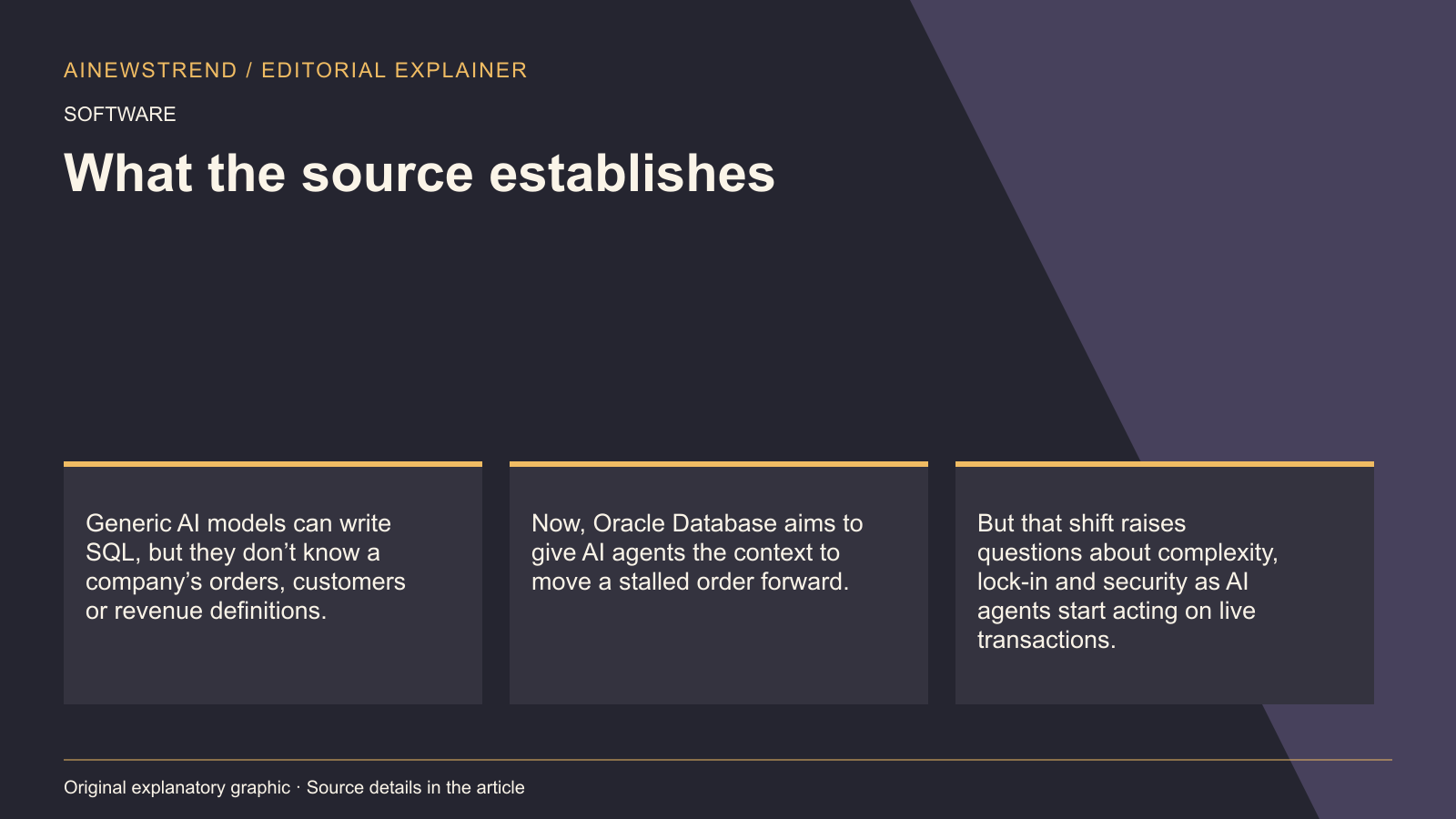
Oracle Corp. announced a new feature for its Oracle Database that allows AI agents to understand business context, such as company-specific data like orders, customers, and revenue definitions, to assist in transactional tasks. This integration is part of a broader push to combine various data types—vectors, graphs, documents, and transactions—into a single engine, according to Hasan Rizvi, executive vice president of product and research, database engineering, at Oracle.
What this means in practice
The feature enables AI agents to provide more tailored responses to queries related to business operations. For example, an AI assistant could identify the location of stock, resolve transaction issues, or expedite delivery processes by leveraging internal business data. This is a shift from generic AI assistants, which provide broad, non-specific answers. Oracle claims that this approach inherits the reliability, security, and scalability of its long-standing database engine, which has been in development for 40 years.
Limitations and availability
The database runs on-premises, through Oracle Cloud, and across multiple public clouds. Oracle expanded Iceberg support in its Autonomous AI Lakehouse during the announcement. However, the supplied announcement does not specify details about the exact release timeline or licensing conditions for the AI integration. Security remains a concern, as Oracle’s Deep Data Security defines access policies within the database, ensuring user identity travels with every request from an AI agent or application. The company acknowledges that AI may lower the barrier for potential attacks, making security a critical focus area.