
What changed
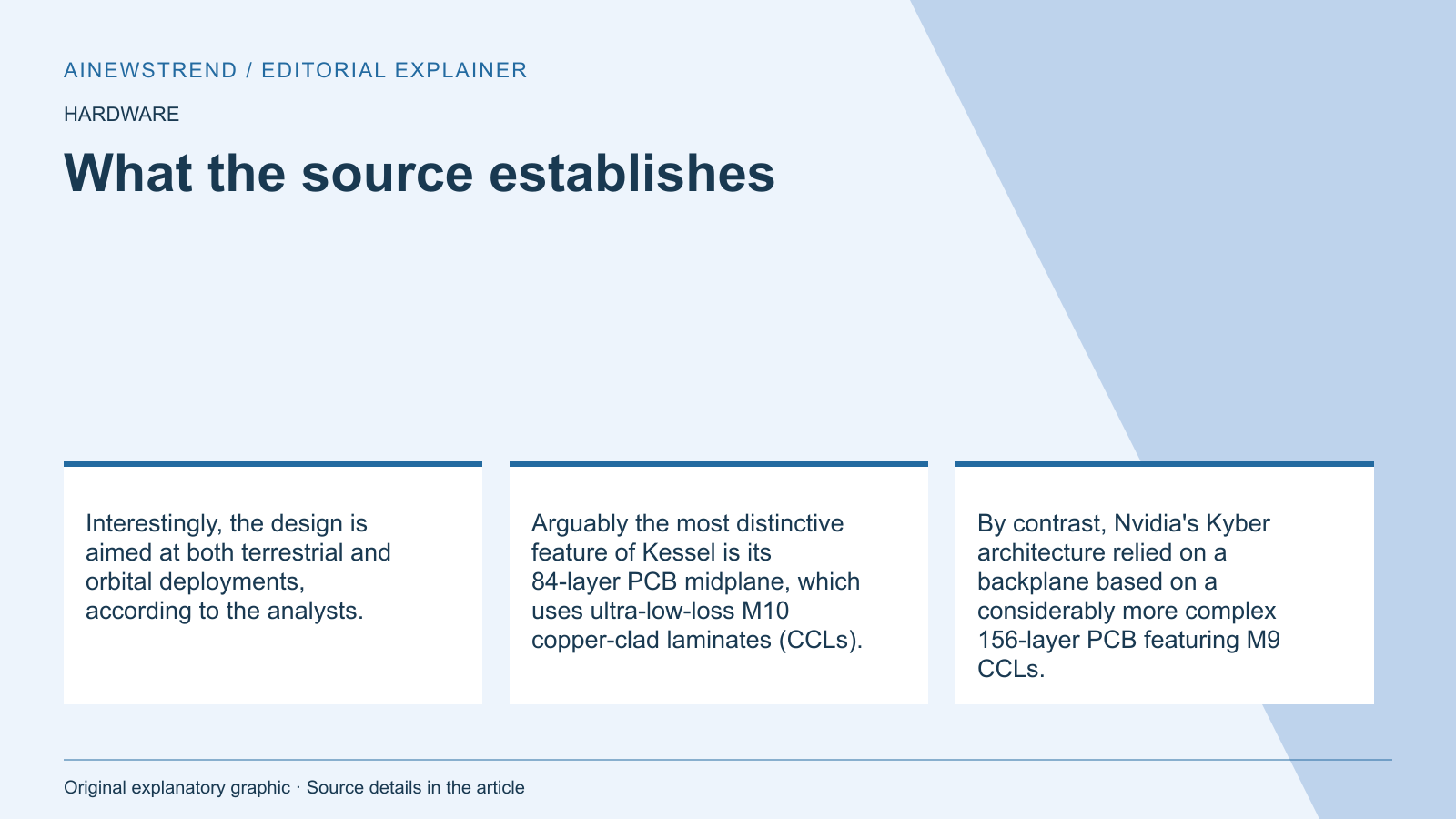
SpaceX/xAI is developing a custom version of Nvidia's Vera Rubin NVL72 rack-scale AI system, codenamed Kessel. The system replaces conventional NVLink cable assemblies with a massive 84-layer printed circuit board (PCB) midplane. The Kessel system retains 36 Vera CPUs, 7,2 Rubin GPUs, and nine NVLink switch trays but introduces a different solid-state interconnect architecture. The system is designed for use in both terrestrial and orbital data centers.
What this means in practice
The Kessel system retains the fundamental configuration of Nvidia's Vera Rubin NVL72 platform, which comprises 72 GPU packages distributed across 18 compute trays and nine NVLink switch trays. Instead of using internal NVLink cable cartridges, SpaceX plans to position compute and switch trays back-to-back around a passive PCB midplane. The architecture resembles a smaller version of Nvidia's Kyber design with 576 AI GPUs, which also relies on a PCB-based interconnect rather than conventional cable assemblies.
The most distinctive feature of Kessel is its 84-layer PCB midplane, which uses ultra-low-loss M10 copper-clad laminates (CCLs). This design could improve manufacturability and production yields, but the more advanced copper-clad laminate will likely increase material costs. An 84-layer PCB is exceptionally hard to build, with manufacturing yields potentially becoming a major obstacle due to defects in internal layers.
Limitations and availability
The move to a PCB midplane could simplify system assembly by eliminating numerous high-speed cable connections, but it may not reduce manufacturing costs. An 84-layer PCB that relies on ultra-low-loss M10 laminate is an expensive component that requires sophisticated manufacturing processes and precise quality control. The economic viability of Kessel will depend on whether savings from cable elimination and independent component procurement can offset the cost of its complex midplane.
SpaceX/xAI plans to acquire AI accelerators, CPUs, switches, and networking components directly from Nvidia and procure other components from third-party suppliers.
This approach allows SpaceX to select its own PCB manufacturers, component vendors, and manufacturing partners, optimize its hardware for its infrastructure, and potentially reduce intermediary costs. However, the company will assume greater responsibility for system design, validation, manufacturing quality, and supply-chain management.