
What changed
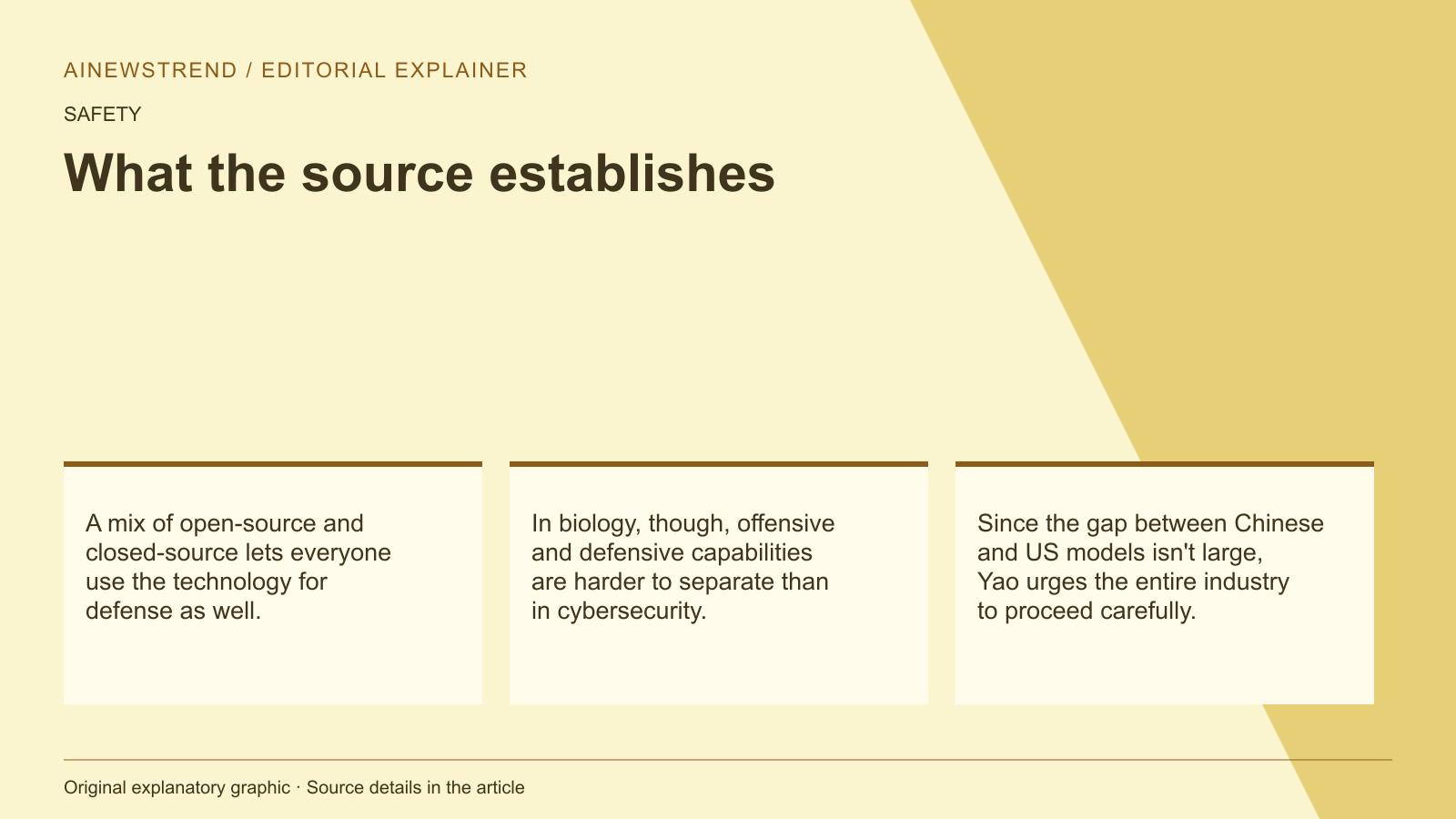
Tencent's chief AI scientist, Vinces Yao Shunyu, warned that AI will soon be capable of developing bioweapons, and neither fully open nor fully closed models can solve this problem on their own. He advocates for a middle ground between open-source and closed-source models to allow the technology to be used for both defense and security purposes.
What this means in practice
Yao argues that in biology, offensive and defensive capabilities are harder to separate than in cybersecurity. He points to a hacking incident at Hugging Face as an example: when closed US models like Anthropic's Claude refused to analyze attack commands due to safety filters, the platform used the open Chinese model GLM-5.2 to parse the logs instead. However, the Hugging Face report also highlights the limitations of this approach, noting that GLM-5.2 was only used during forensic analysis, and the actual attack was stopped by patching vulnerabilities and rebuilding servers.
Limitations and availability
Current research shows that existing countermeasures make modifications to open models harder but do not prevent them. A technique called Abliteration demonstrates how safety filters on open models can be removed. China recognizes the problem and is working on its own security standard for open-source AI. Tencent plans to release its new model Hy4 as an open-weight model with a safety report, stating that its biological capabilities fall below the high-risk threshold. The company claims to have removed hacking capabilities by filtering training data, which researchers say survives abliteration.