
What changed
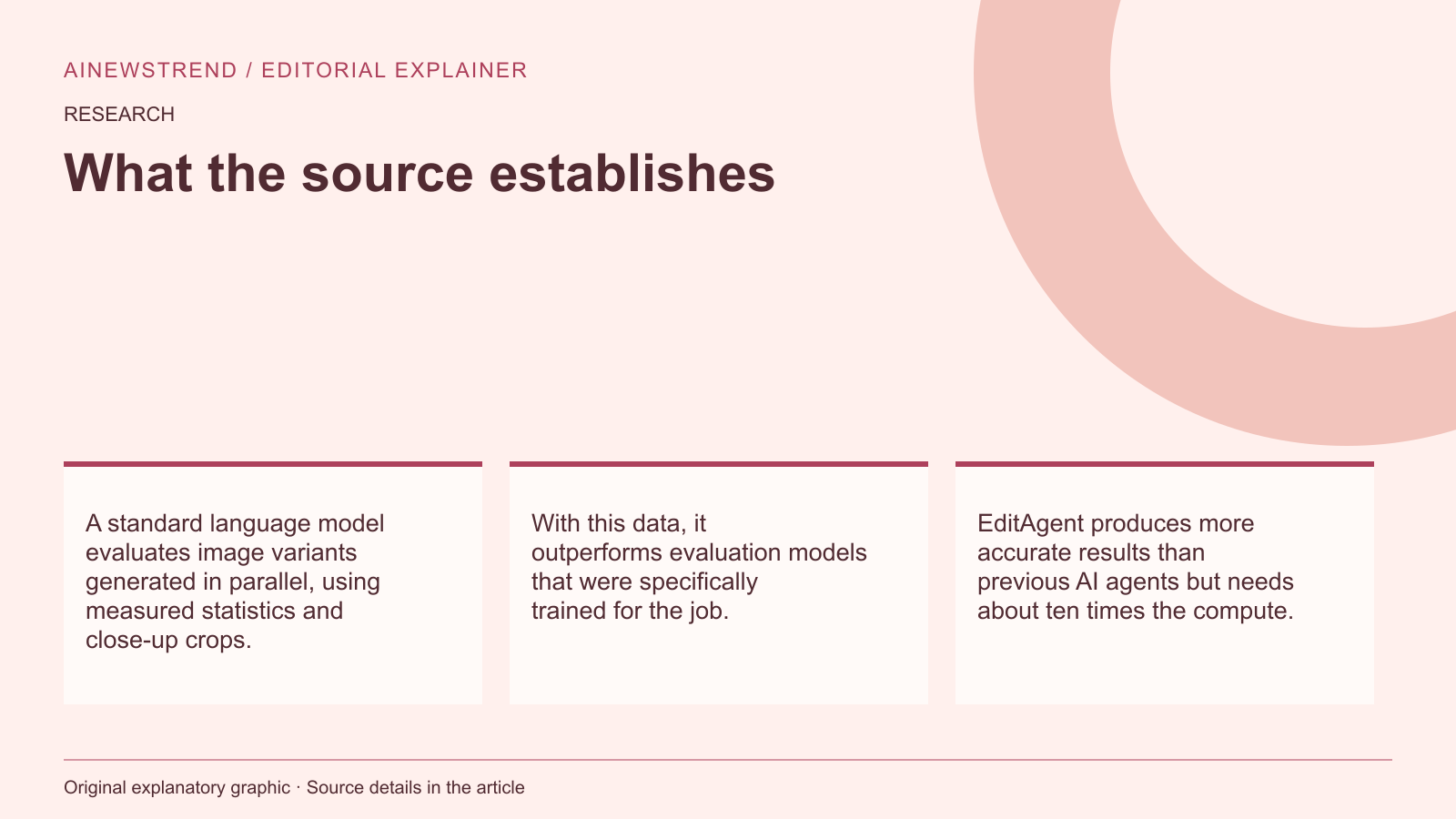
Adobe Research and UC San Diego built EditAgent, an AI system that breaks image editing tasks into sub-steps and pairs a general-purpose editor with specialized tools for things like sharpening or zooming. A standard language model evaluates image variants generated in parallel, using measured statistics and close-up crops. With this data, it outperforms evaluation models that were specifically trained for the job. EditAgent produces more accurate results than previous AI agents but needs about ten times the compute.
What this means in practice
The researchers tested EditAgent on a 600-image edit benchmark, where it outperformed previous AI agents. In one example, a photo was supposed to be gently brightened, and the numbers showed the general-purpose editor overexposed it and shifted the colors warmer, while the specialized tool stayed within spec. Close-ups and measured image statistics reveal errors that a language model misses when just looking at the full image. EditAgent also checks whether later edits accidentally undid earlier ones, ensuring that the final output is consistent.
Limitations and availability
EditAgent is built on the findings that general-purpose editors fail at too many tasks and that iterative refinement piles up small errors. The agent needs about ten times as much compute as a single editor, and its performance depends on which tools are plugged in. The researchers also use EditAgent as a data source, generating about 26,000 training examples that improved the performance of fine-tuned editors. Adobe added AI agents to Photoshop, Premiere, and other Creative Cloud apps in June, starting as a public beta. The supplied announcement does not specify when EditAgent will be available as a feature in these apps.