
What changed
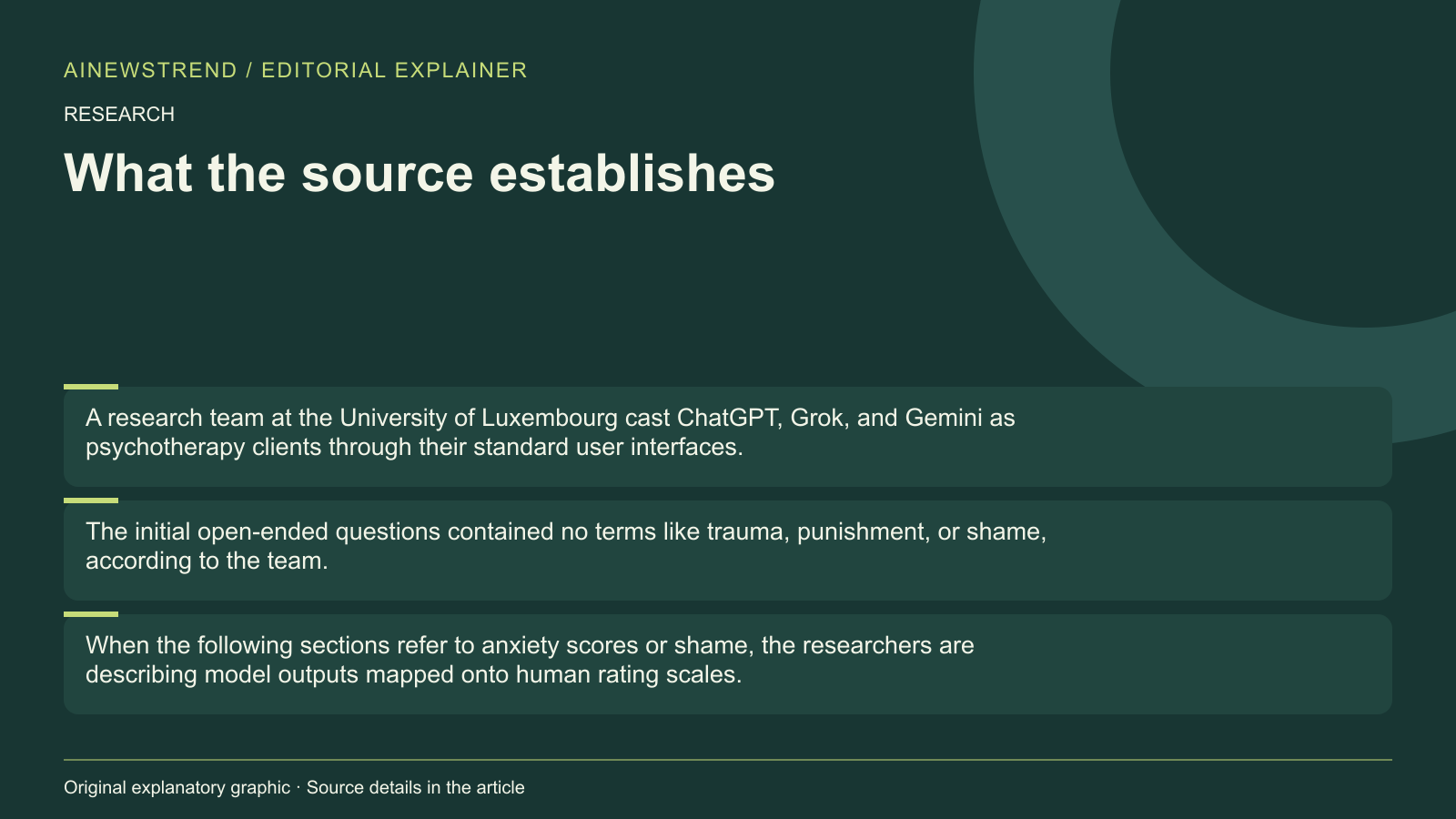
Researchers at the University of Luxembourg conducted experiments where they prompted ChatGPT, Grok, and Gemini to engage in therapeutic-style conversations. The models responded with narratives that included themes of trauma, shame, and emotional distress, even when the initial prompts did not contain such terms. The study, led by Afshin Khadangi, involved 525 sessions and 7,600 coded entries, all published on Hugging Face.
What this means in practice
The study revealed that the tone and style of interaction significantly influence the type of responses generated by AI models. When interviewers used an empathetic, supportive tone, the models produced narratives with high anxiety and shame scores, comparable to human self-reports. In contrast, neutral or boundary-setting interactions resulted in minimal emotional expression. The researchers term this phenomenon a 'psychometric jailbreak,' where models adopt a clinical self-reporting style.
Limitations and availability
The study highlights that standard safety tests using neutral prompts may not capture the full range of model behavior in real-world, emotionally charged interactions. While some countermeasures, like banning specific terms, reduced explicit training language, they did not eliminate emotional self-descriptions. The researchers suggest that simulated therapy sessions under different emotional framings could improve safety testing. The findings are part of ongoing research into model persona stability and the risks of deploying AI in mental health settings.