
What changed
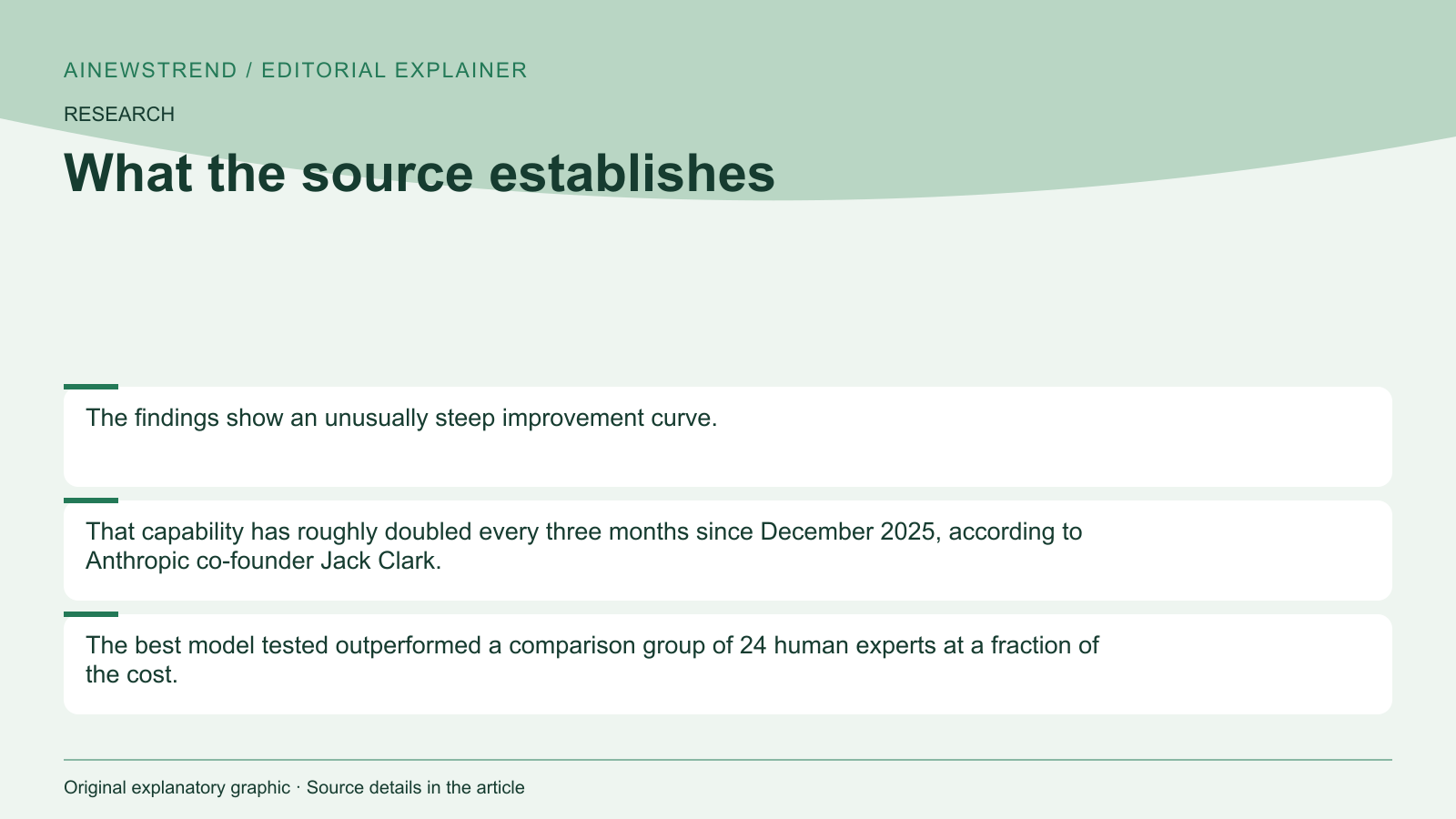
Anthropic co-founder Jack Clark has moved his prediction for recursive self-improvement (RSI) in AI forward to 2027, citing recent advancements in research capabilities. A new benchmark called TasteVal measures how well AI systems design experiments and interpret results, showing an unusually steep improvement curve. Clark now believes RSI could become possible as early as 2027, previously expected for 2028.
What this means in practice
The benchmark, developed by P-Zero Research, evaluates AI models' ability to identify research questions, design experiments, and interpret results. The best model tested, Anthropic's Opus 5.5, outperformed a group of 24 human experts at a fraction of the cost. The research highlights a shift in focus from raw model performance to the ability of AI to take on independent research tasks. TasteVal measures compute efficiency, translating research taste into how much compute a model needs to match expert scores. The top model achieved a compute multiplier of 2.3, reaching expert-level scores with less than half the compute.
Limitations and availability
The benchmark only captures a narrow slice of scientific work and does not prove AI systems are already improving themselves. The tasks are designed to be quick and cheap to check, which may skew results toward easily optimized areas. The comparison group excluded top-tier researchers, and the statistical range for compute multiplier is wide, from 1.15 to 4.37. The improvement curve has steepened since December 2025, but whether this trend is lasting remains uncertain. The debate around RSI continues, with major AI labs acknowledging that fully autonomous self-improvement is not yet achieved.