
What changed
Google AI Edge Gallery has introduced on-device Automatic Speech Recognition (ASR) and Text-to-Speech (TTS) capabilities. These features allow developers to build apps that provide live transcriptions and natural spoken replies without requiring an internet connection. The release includes optimized speech models for Android, Web, Desktop, and beyond, with support for multilingual processing and low-latency performance.
What this means in practice
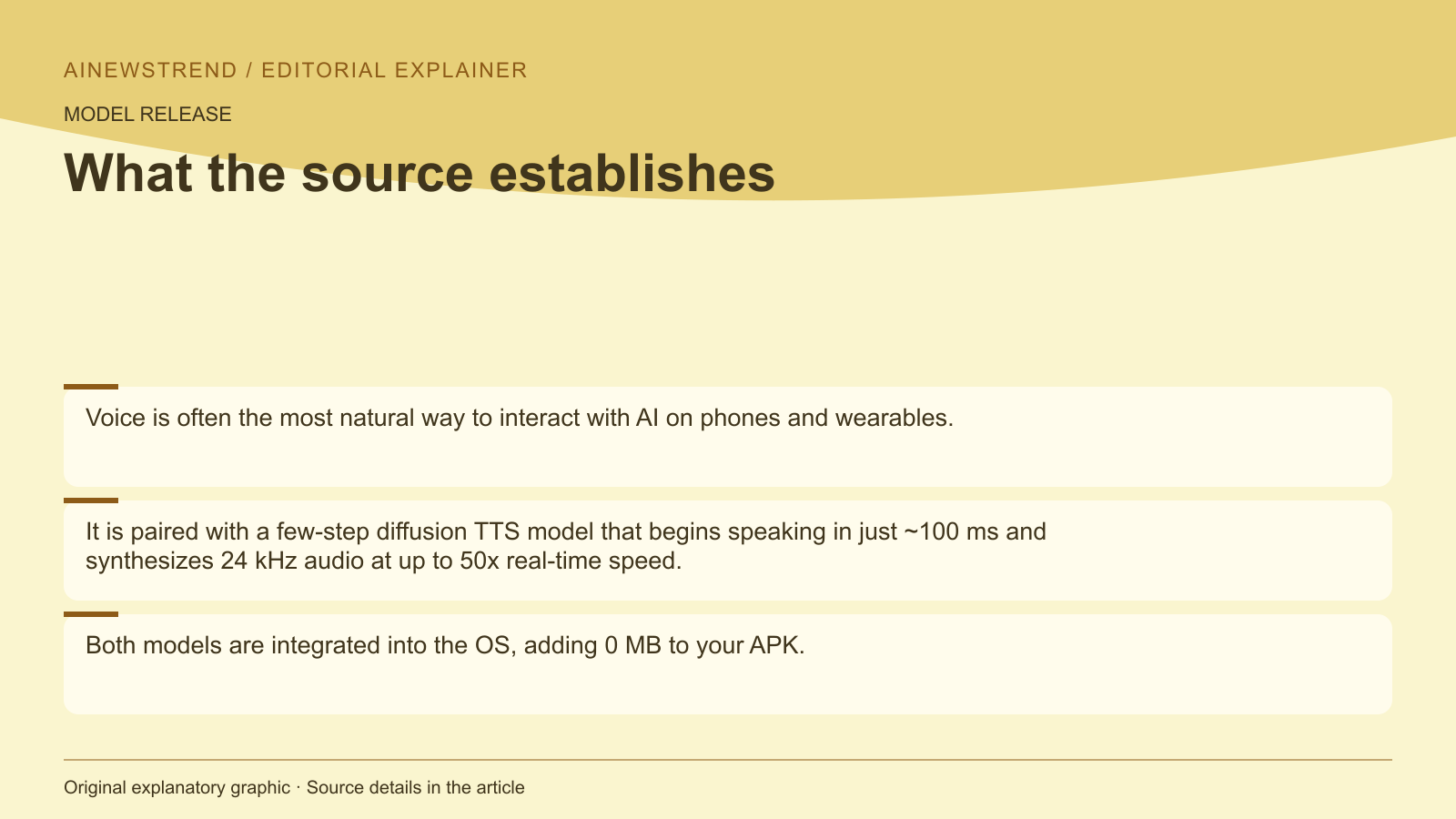
The new ASR and TTS capabilities are integrated into Google's AI Edge Gallery, enabling developers to use lightweight speech models like Parakeet-TDT 0.6B, PocketTTS 100M, Kokoro-82M, and Phonon 31M. These models run efficiently on devices with minimal memory usage and low latency. For Android developers, ML Kit provides standardized APIs for speech recognition and text-to-speech, with support for 100+ languages and real-time transcription speeds up to 10x faster than real time. The TTS models can generate natural 24 kHz speech across 8 expressive voices and 21 locales at up to 50x real-time speed. Additionally, the release includes a new XR Language Teacher showcase that uses these models to provide real-time explanations and pronunciation in local languages without requiring a network connection.
Limitations and availability
The speech models are available for integration into Android, Web, Desktop, and other platforms through MediaPipe Tasks and LiteRT. The models are designed to run locally on devices, with no network dependency required. For Android developers, the ML Kit APIs provide a production-grade solution with hardware acceleration support across NPU and TPU backends. The release does not specify exact hardware requirements for running the models, but it emphasizes low memory footprint and compatibility with existing device capabilities. The models are available for use in apps through the Google AI Edge Gallery and open-source code on GitHub.