
What changed
Hugging Face announced the release of kniv v7, a family of six models that extract entities, relations, and facts from text using user-defined schemas. The models range from 55M to 538M parameters, with each model designed for specific use cases and hardware requirements. The new version allows users to define their own schema for extracting information, with no need for retraining or additional LLM calls.
What this means in practice
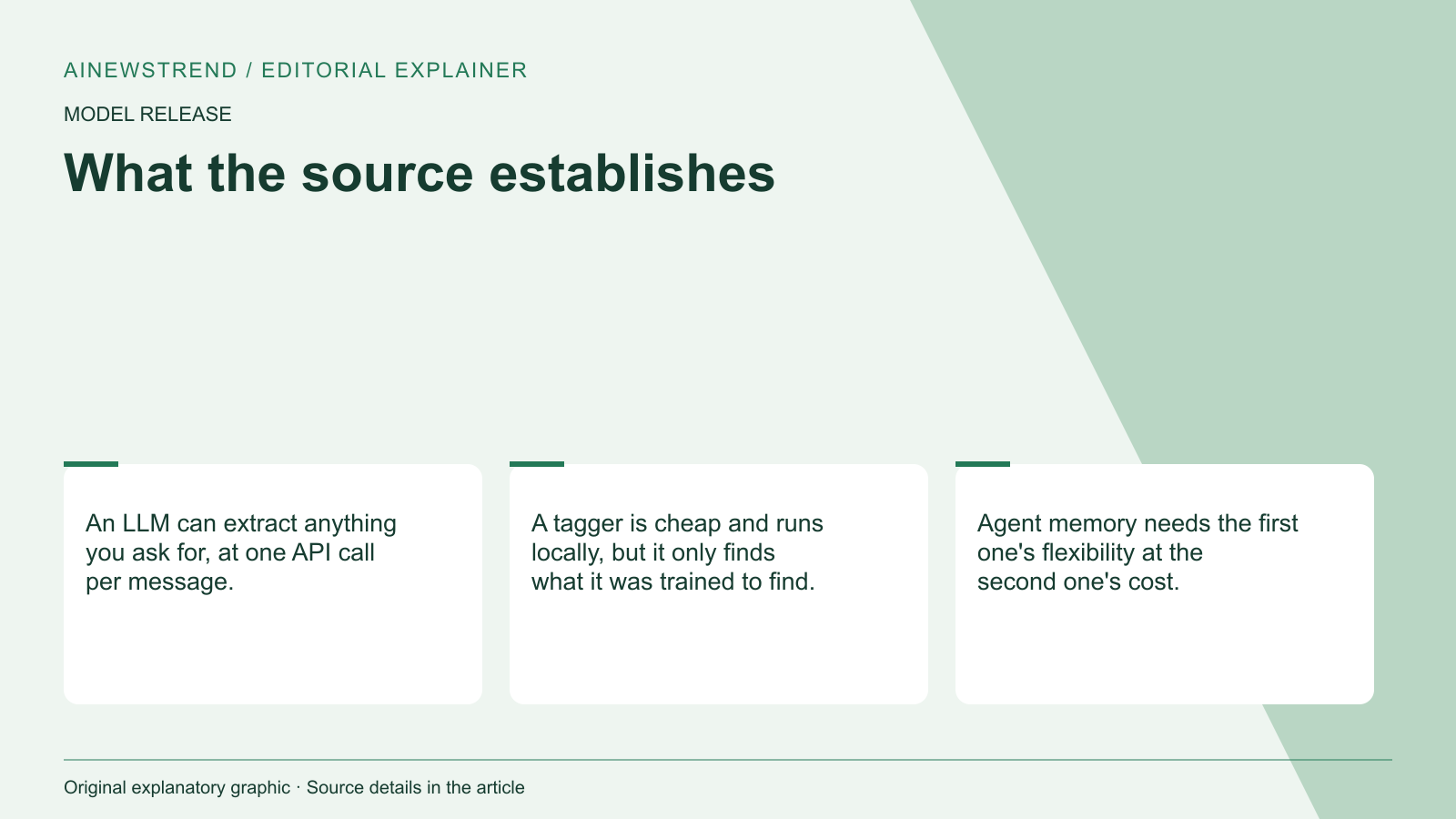
The kniv v7 models provide a fixed linguistic layer and a knowledge layer that can be customized by the user. The linguistic layer covers part of speech, named entities, dependencies, semantic roles, and dialogue acts, while the knowledge layer allows users to define their own entity types and relations. This means that users can extract information from text that is relevant to their specific needs, without requiring additional training or LLM calls.
The models are available under the Apache-2.0 license and include ONNX in three precisions. Each model takes the same call and returns the same two facts, with only the repository name changing. The models are designed to be used locally, with no dependencies on external services or APIs.
Limitations and availability
The kniv v7 models are available for download from the Hugging Face Hub. The models range from 55M to 538M parameters, with each model designed for specific use cases and hardware requirements. The models are available in English and are compatible with ONNX runtime, tokenizers, and numpy. The models are not available for commercial use without a license.
The supplied announcement does not specify the exact release date of the models, but they are available for download as of November 2, 2026. The models are not available for use in production environments without a license. The models are not available for use in commercial applications without a license.