
What changed
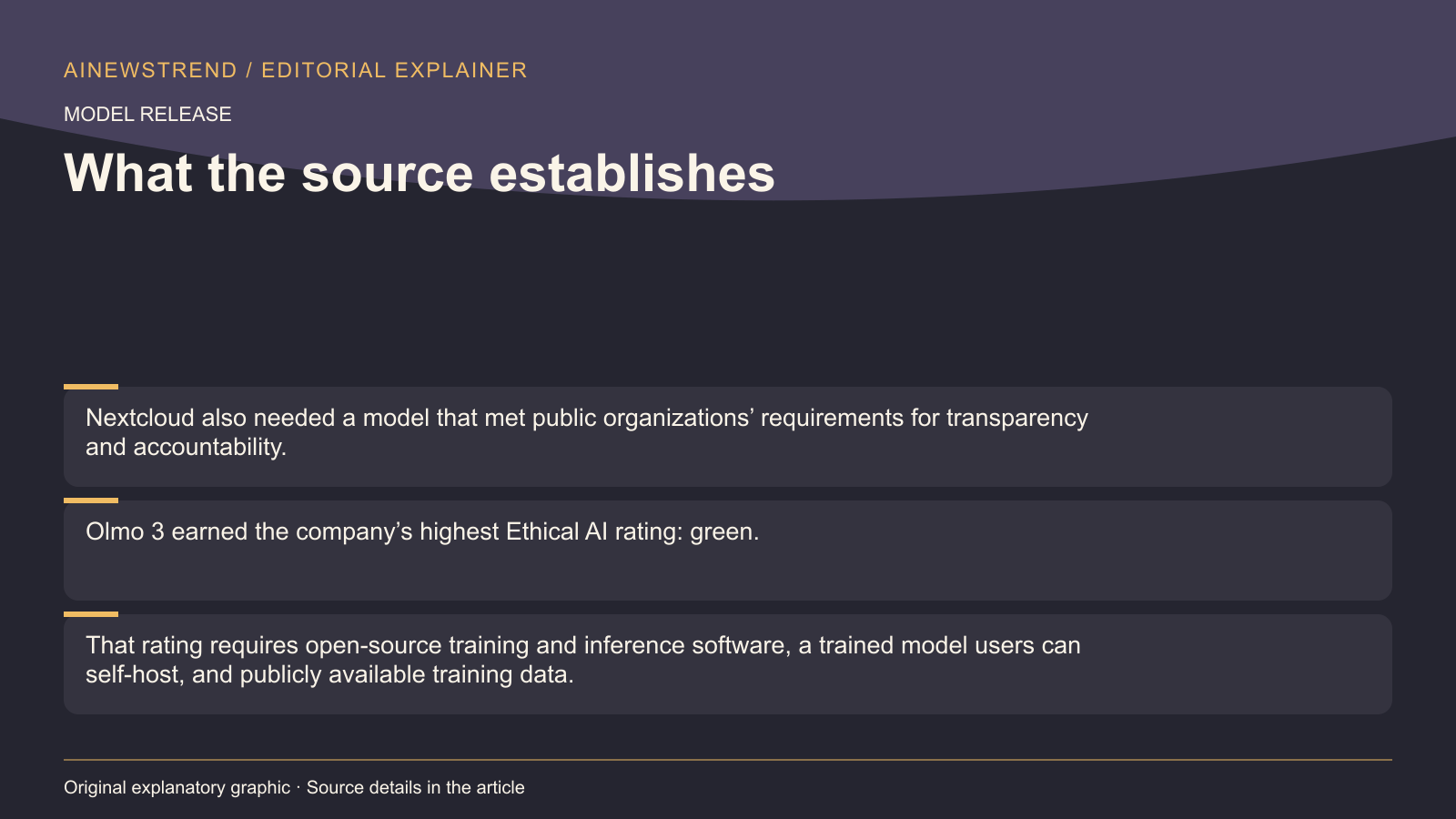
Nextcloud, an open-source collaboration platform used by organizations including Germany’s federal government and CSIC, has integrated Olmo 3, an open-source AI model, into its local LLM backend, llm2. This integration allows users to run AI features on hardware they control, meeting requirements for transparency and accountability.
What this means in practice
The integration of Olmo 3 enables users to generate and improve text, create headlines, and extract topics while running the model on their own infrastructure. Olmo 3 is one of the models Nextcloud bundles with llm2, which powers AI features in Nextcloud Assistant, Mail, and other apps. Users can invoke the model from Nextcloud Assistant or directly within supported workflows without needing to connect to Olmo separately.
Limitations and availability
Olmo 3 is available as a 7B parameter model, which is efficient enough to deliver a good local experience without requiring high-end GPUs. The model can be configured centrally through llm2 and made available to employees through existing Nextcloud tools. Nextcloud emphasizes that fully open models like Olmo allow for transparency, explainability, and control over data and AI results. The model’s relatively small size also makes it easier to run on existing infrastructure without significant hardware upgrades.
The supplied announcement does not specify exact performance benchmarks or independent testing results. The model’s capabilities align with Nextcloud’s goals of providing AI features that are fully open, self-hosted, and transparent.