
What changed
Natera, a leader in cell-free DNA (cfDNA) testing, developed an agentic AI system called SWARM using Amazon Bedrock AgentCore to enhance lab operations. This system captures and deploys institutional knowledge at scale, delivering about 130x faster first response time and 96.2 percent automated coverage across support tickets.
What this means in practice
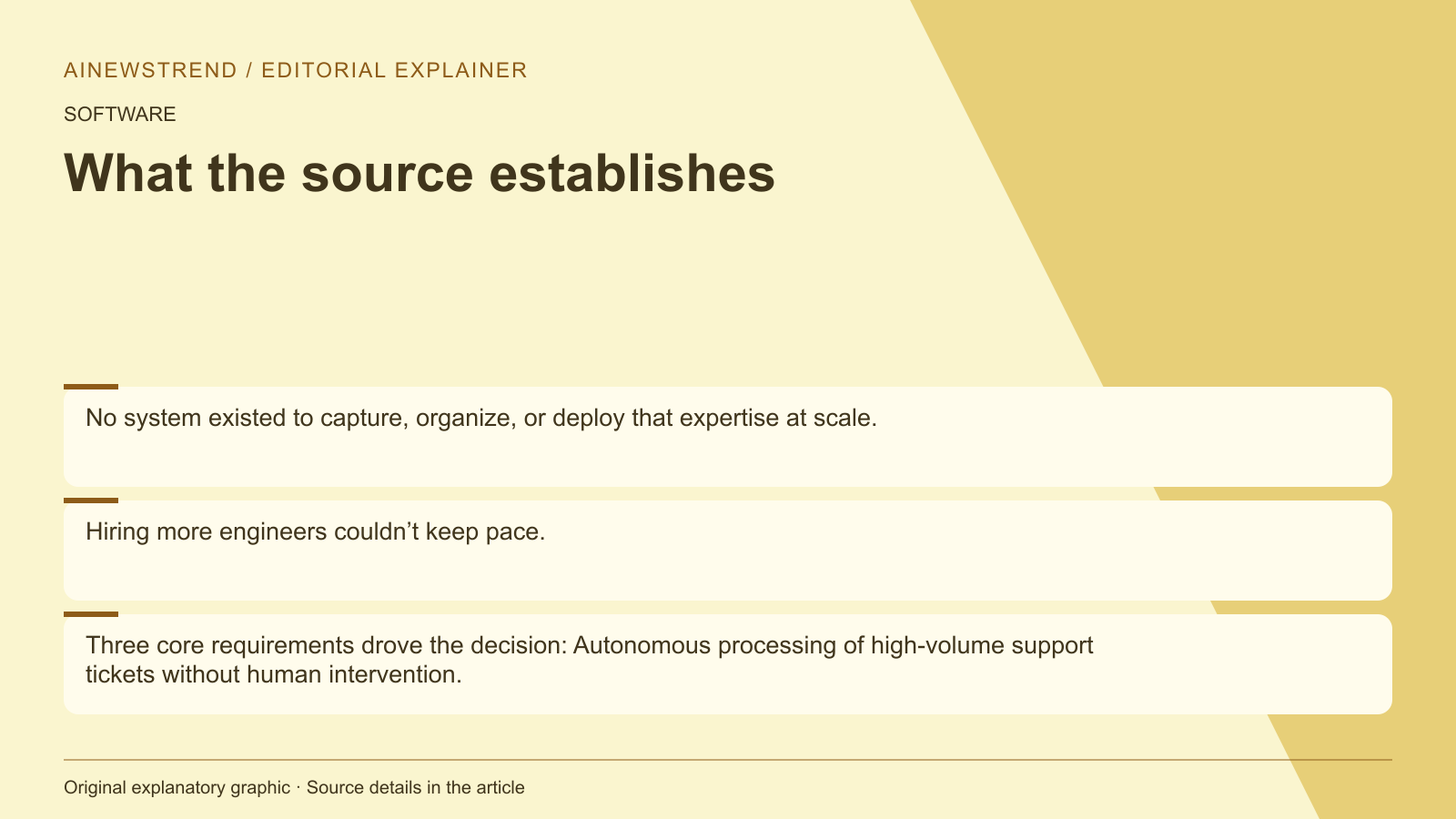
Natera’s lab engineering team, led by Ariel Jirau, built SWARM to address the challenge of knowledge continuity after a senior technician left. The system autonomously generates diagnostic reports before engineers open tickets and allows real-time interaction through swarm-hive. It integrates with tools like Jira and Confluence, and uses Amazon DynamoDB, Amazon SQS, and AWS X-Ray for data and operations.
The system’s architecture includes four layers: event, agent, context, and observability and delivery. It uses a keyless deployment model to avoid credential exposure in clinical environments, leveraging OpenID Connect (OIDC) and AWS Security Token Service (AWS STS) for temporary credentials.
AWS Identity and Access Management (IAM) enforces least privilege, and Amazon Virtual Private Cloud (Amazon VPC) keeps traffic off the public internet.
Limitations and availability
SWARM runs on HIPAA-eligible AWS services under a Business Associate Agreement (BAA), and every agent invocation is audit-logged. The system uses Amazon Titan Text Embeddings for semantic search and Amazon Bedrock Knowledge Bases for Retrieval Augmented Generation (RAG). Amazon Bedrock services, including AgentCore, are available in multiple AWS Regions. The Natera team uses the tiktoken tokenizer with the cl100k_base encoding to measure chunk boundaries.