
What changed
Silicon Valley entrepreneur Chad Steelberg, along with former Apple executive Andy Baynes, launched Tiberius Aerospace, a defense-as-a-service company valued at over $1 billion. The firm secured $85 million in Series A financing led by Lakestar and Rochefort Asset Management, with Ukrainian venture capital firm UA1 also participating. Tiberius has developed an AI-driven artillery system called Sceptre, which can be fired from a 155-millimeter howitzer and claims to reach supersonic speeds and altitudes beyond jamming range.
What this means in practice
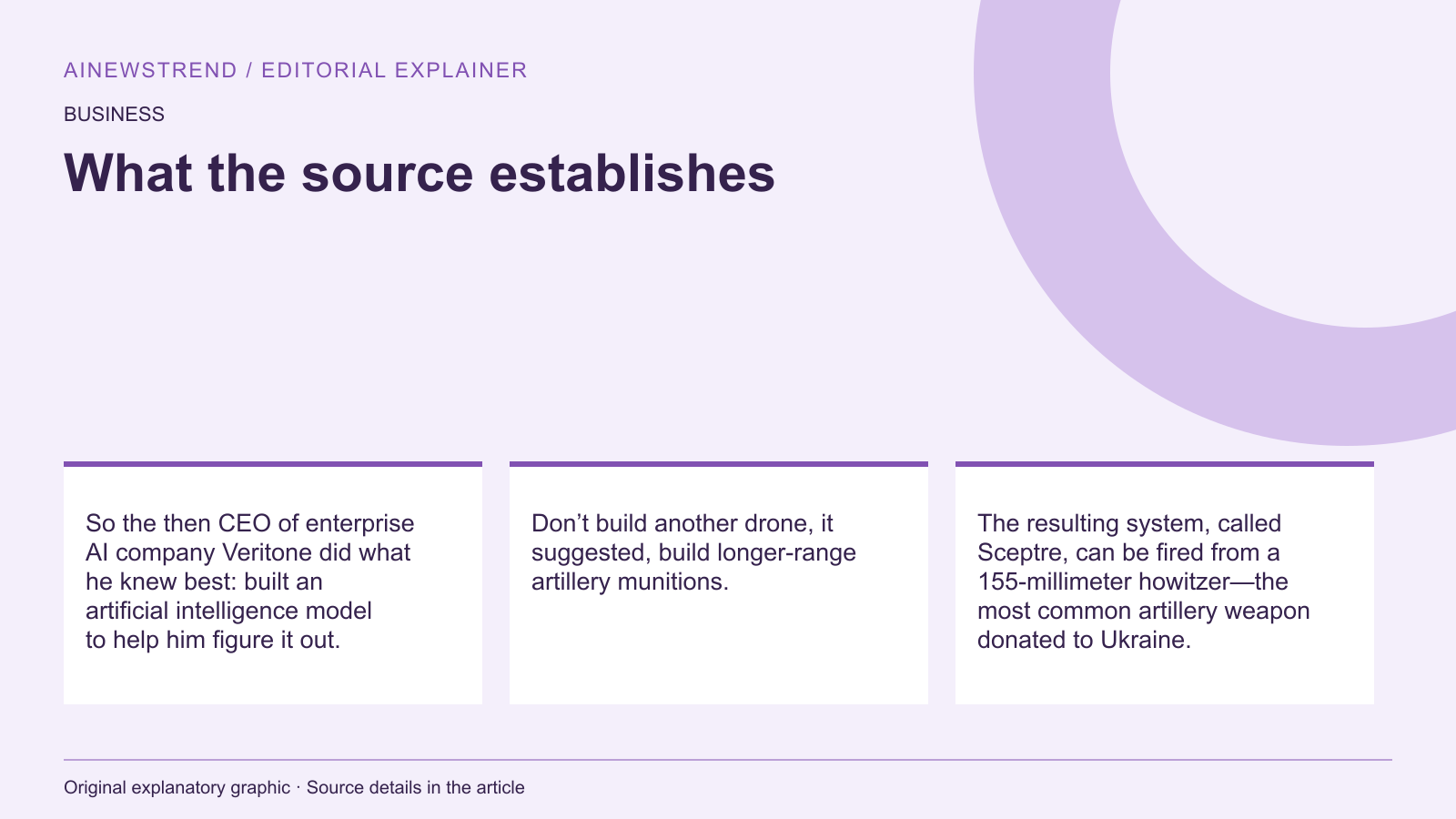
Tiberius began as Steelberg’s private research lab, which pivoted to focus on AI and aerospace engineering after the Russian invasion of Ukraine. The AI model they created analyzed the war’s factors and suggested developing longer-range artillery munitions instead of defensive tech. The Sceptre system, designed to extend the reach of Ukrainian howitzers, is now being tested with the US Army and is set to enter production with UK partners. The company is also developing a missile expected to generate revenue next year. Tiberius has turned its initial AI system into a product called GRAIL, which enables continuous upgrades to weapon designs through decentralized manufacturing and simulation.
Limitations and availability
The supplied announcement does not specify the exact number of active parameters or total parameters in the AI models used. Tiberius is working with the US Army to mature the Sceptre system and has a $500 million technology collaboration contract with UK partners. The GRAIL platform aims to automate supply chain management and compliance, simulate weapons in various environments, and use open-sourced data and combat data to enable faster weapon design. The company plans to outsource manufacturing to third-party subcontractors, following the "Apple model," to accelerate development and reduce production costs during peacetime.