
What changed
Alibaba launched Qwen4-Max, a model with a revamped architecture that processes long texts more efficiently and with less compute. It ranks second on the Artificial Analysis Intelligence Index behind Kimi K3.1 Pro but runs at roughly a third of its predecessor's cost per task. The model also features a feature called 'Live Delivery' that allows users to inspect intermediate results from autonomous agents and adjust running tasks on the fly.
What this means in practice
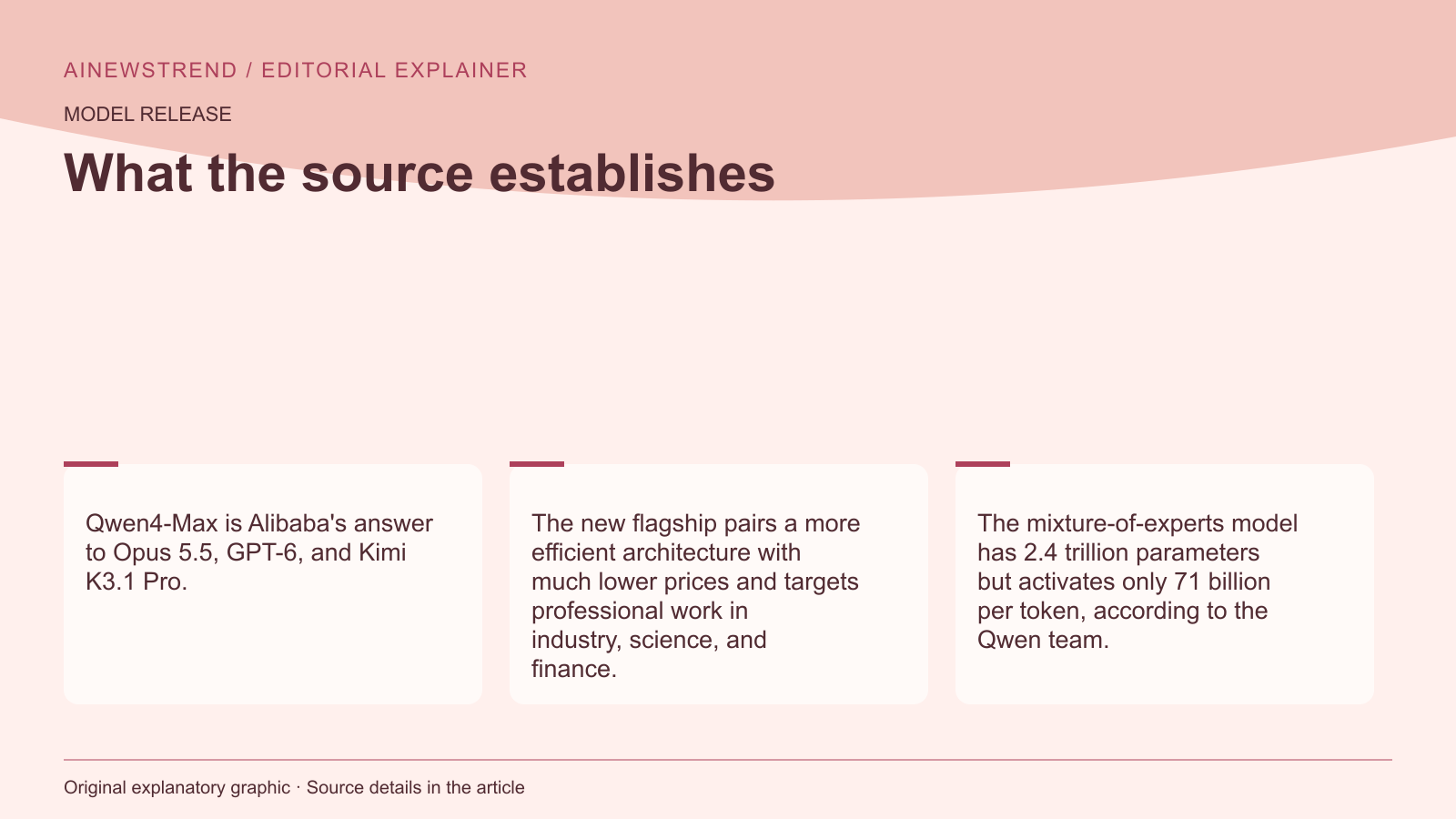
Qwen4-Max is designed to compete with models like Opus 5.5, GPT-6, and Kimi K3.1 Pro by combining a more efficient architecture with much lower prices. The model has 2.4 trillion parameters but activates only 71 billion per token. It processes images natively and offers a one-million-token context window. The hybrid architecture makes long contexts cheaper to process, with three layers compressing the prior context into a condensed state before a fourth layer focuses on the important parts. This reduces compute costs on long inputs significantly.
The efficiency gains translate into lower operating costs. On Alibaba's Work360 benchmark for industrial tasks, Qwen4-Max uses roughly a quarter to a third fewer tokens than its predecessor to solve the same tasks.
The average cost per Work360 task falls 62 percent, from $4.43 to $1.67. The benchmark score climbs from 47.74 to 52.69 at the same time. Qwen4-Max beats its predecessor on both benchmarks while using far fewer tokens.
Limitations and availability
Results on external benchmarks are mixed. On long-horizon agent tasks like Agents' Last Exam v1.1, Qwen4-Max scores 46.7 points, the best result in the comparison group. It trails Opus 5.5 and the GPT models on Humanity's Last Exam. On HealthBench Professional, it falls behind the GPT models but edges past Opus 5.5. Alibaba says Qwen4-Max leads on agent and work tasks, while Opus 5.5 and the GPT models come out ahead on Humanity's Last Exam.
Alibaba charges $1.50 per million input tokens and $4.50 per million output tokens through its own API. Cache hits cost $0.075. The model is available via Alibaba's API and has been open-sourced with the Qwen-Live-Delivery-Plugin.
Partners like SANF and Pacific Union have used it to cut manual programming time for a single workpiece from about 475 minutes to 24.
In finance, the model taps 90 MCP tools to pull market data from multiple sources, delivering results as verifiable Excel and PowerPoint files. Alibaba also uses the model internally to run its own cloud infrastructure more efficiently.