
What changed
AMD has added support for MXFP4 weights on the MI300X GPUs, which are part of the Instinct MI300 Series. This support is achieved through a software optimization that replaces a previous software-based decoding method with a bit-exact lookup table (LUT) from ROCm/aiter#5583. This change allows for faster execution of MoE GEMM kernels, particularly for models like gpt-oss, which use MXFP4 weights.
What this means in practice
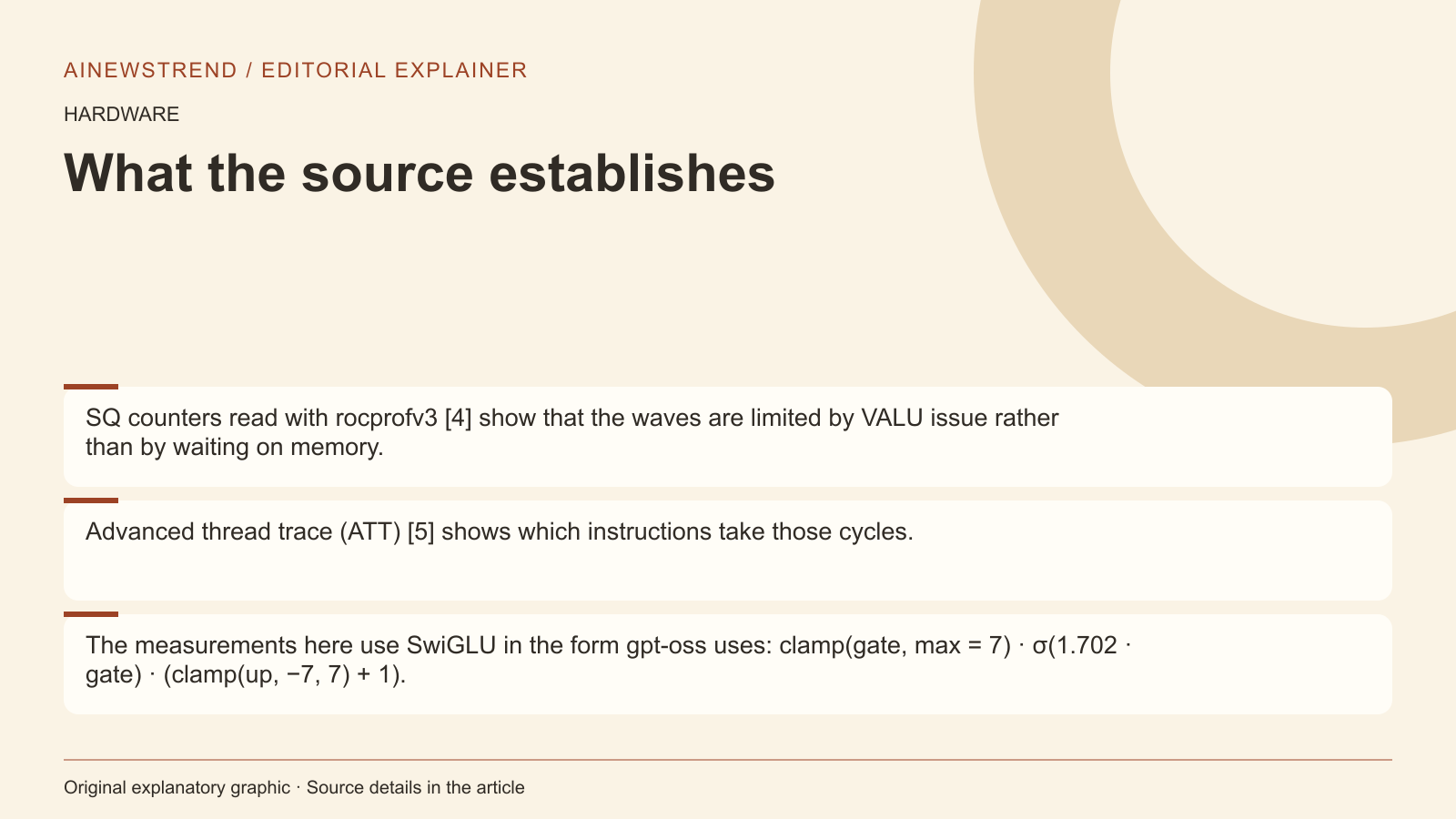
The optimization significantly improves the performance of MoE models on MI300X GPUs. Specifically, the GEMM1 stage of the moe_2stage_a16wmix kernels sees a 2.2×–2.4× speedup, while GEMM2 sees a 1.7×–2.5× improvement. These enhancements are measured using the a16wmix kernels, which are part of the AITER (AMD AI Tensor Engine for ROCm™) and implemented in FlyDSL, a Python domain-specific language for GPU kernels on ROCm.
The performance gains are observed across a range of token counts, from 1 to 8192 tokens. The optimization ensures that the decoded bf16 weights are bit-identical for every e8m0 scale up to 0xFC, maintaining the accuracy of the model's computations. This change is particularly beneficial for applications that require high-performance computing with large-scale models, such as natural language processing tasks.
Limitations and availability
The optimization is available for the MI300X GPUs, which are part of the AMD Instinct MI300 Series. It is implemented through the ROCm/aiter#5583 update, which is part of the AITER framework. The change does not affect the hardware capabilities of the MI300X GPUs, as the support for MXFP4 weights is achieved through software rather than additional hardware instructions. The optimization is expected to be useful for developers and researchers working with MoE models on AMD hardware, but it is not available for the MI300 Series GPUs that do not support MXFP4 weights natively.