
What changed
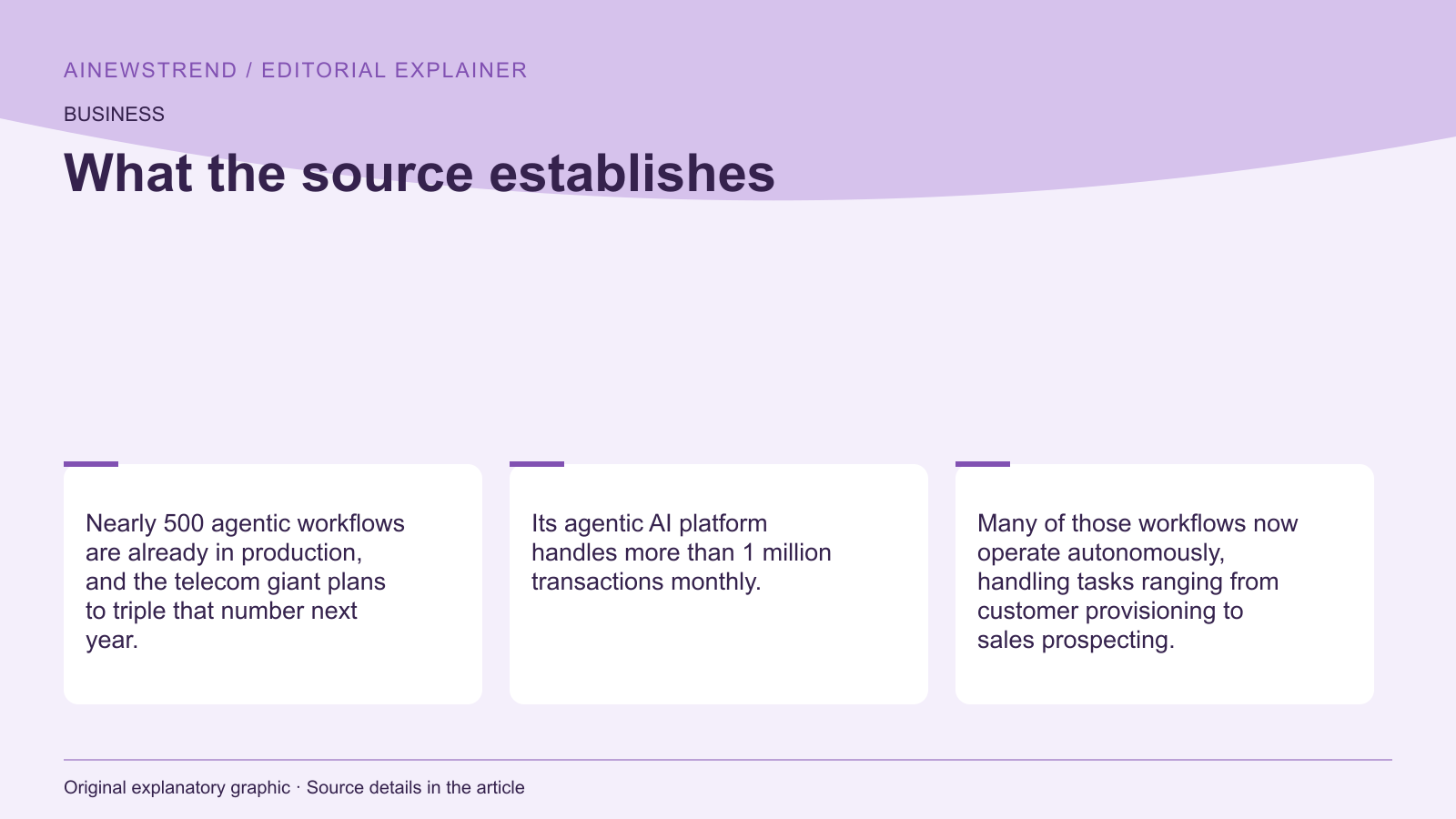
AT&T Corp. is expanding its use of agentic AI to redesign business processes, with nearly 500 workflows already in production. The telecom giant plans to triple that number next year. Luke Corbin, assistant vice president of digital transformation and AI at AT&T Business, reported that the company now processes about 45 billion AI tokens daily and handles over 1 million transactions monthly through its agentic AI platform.
What this means in practice
AT&T has moved beyond using AI to improve employee productivity, applying autonomous agents to fundamentally reshape how its business operates. The company’s approach emphasizes rethinking entire processes rather than simply automating individual tasks. Business Agent Foundry, a group established in early 2025, works with individual business units to map processes using industry frameworks and identify opportunities to eliminate unnecessary steps, organizational handoffs, and legacy application dependencies.
The agentic AI platform has already automated interactions with AT&T’s mainframe computers, reducing delays and accelerating service delivery. In another example, the company halved the time required to provision dedicated internet connections in buildings with existing fiber infrastructure.
AT&T’s architecture differs from conventional approaches by maintaining a relatively small set of agents that execute business workflows using centrally managed business logic.
Limitations and availability
Governance is central to the process, with workflows affecting customers requiring security, privacy, and compliance reviews. Every production workflow initially includes human oversight, and agents operate autonomously only after achieving accuracy in the mid- to high 90% range within a permissible risk profile. Continuous monitoring evaluates performance and detects drift. Success metrics include labor savings, revenue generation, operating costs, and customer satisfaction. AT&T is shifting its focus from improving existing processes toward using agents to launch services, enter markets, and support new sales channels.
The company has also had to consolidate fragmented data and provide reliable connectivity across data centers, cloud infrastructure, and mobile workers. Encouraging employees to share ideas for using agents has helped limit resistance to AI adoption, as has the opportunity to replace inefficient processes.